
IMF Programme #17: takes two to tango

Originally appeared on the Daily FT, Ada derana, Groundviews

By Daniel Alphonsus

On Sri Lanka’s reform-regress-run to the IMF crisis cycle

Countries never learn from others’ mistakes, they only learn from their own. Sri Lanka is an exception: we don’t even learn from our folly. Apparently neither does the IMF. Sri Lanka’s 17th IMF programme is set to be approved on March 20th. Is it welcome? Yes. Will it break Sri Lanka’s reform-regress-run to the IMF crisis cycle? Probably not. 

All reforms undertaken over the past half-year to win IMF board approval are reversible. None of them constitute entrenched changes in economic policy or governance. We are building our recovery on the shakiest of foundations. The fuel and electricity price ‘formulae’, tax plus interest rate increases and greater exchange rate flexibility can all be altered, more or less, at the stroke of a pen.  

This is not surprising. Sri Lanka has a chequered history of cosmetic compliance: ticking the boxes of virtue and sensibility via international undertakings during desperate times, and then reverting to business-as-usual once crisis abates. We have good reason to think that, this time too, the future will rhyme with this past. Undoubtedly, post IMF board approval, some reforms less easy to rewind will come to pass - the new Central Bank Act being the most notable. 

But the IMF’s bargaining power peaks prior to board approval. That is the decisive point in this process. It is the pivotal moment for any attempt to use this crisis to build the foundations required for breaking the crisis cycle and going from third-world to first. If the most contentious and critical reforms are not pushed through prior to board approval, there is good reason to think they will not come to pass. Remember that of its 16 programmes thus far, Sri Lanka’s has only completed two extended / structural programmes. The remainder are either relatively insignificant standby-facilities or derailed extended programmes

Considering the unprecedented nature of the current crisis, this is a colossal missed opportunity. As argued in a prequel article, Programme 17 could have and should have broken this cycle. Public opinion was desperate, the government commanded a super-majority in Parliament and the IMF held all the aces. The distinction between what is desirable and what is feasible had, almost overnight, dissolved. The cry for fuel and electricity was so piercing and loud that a comprehensive and deep programme permitting profound economic restructuring was possible for the first time since 1977. 

Moreover, even if some of the required reforms come to fruition over Programme 17’s next few reviews - it will still be a missed opportunity. Reform takes time, effort and energy. These are scarce resources. As major structural reforms - such as the central bank act, fiscal rules, privatisations and labour market reforms - were not completed as prior actions, it means the first few reviews will be focussed on them. This will leave little room for some of the more complex long-term reforms; especially in land, the public service and regulatory policy (e.g. competition policy). 

Of course, we are a sovereign state, so primary responsibility for this failure lies in our own polity. But we find little hope in ourselves. As weary and jaded citizens we tend to assume inertia, or worse, on our side as a given. Which is why this article is about the IMF’s failure. 

What could the IMF had done differently? Especially considering its familiarity with Buenos Aires, it should know that it takes two to tango. As Keynes famously said of the IMF and World Bank; the Bank’s a fund, and the Fund’s a bank. Considering the creditor-borrower relationship between the IMF and Sri Lanka; as a creditor the IMF should bear some responsibility for the failure of so many programmes over such a long period of time. The IMF’s own kapuralas have conceived of programme conditionality as a form of collateral. The IMF ought demand more conditionality as collateral prior to lending. This, of course, requires review of past country programmes and, as we all know, economic history and country expertise are not exactly first-rank priorities at the Fund. 

Anyone involved in economic policy-making in Sri Lanka, the IMF included of course, knows that much of the technical work was already done. When the staff-level agreement was signed in September last year, there was a great deal of reform that just required political will and nothing else. Cabinet had approved an earlier version of the new central bank bill during the last days of the Samaraweera ministry. Placing energy price formulas on a statutory footing shouldn’t take more than a day’s drafting. Fiscal rules legislation was already in a relatively advanced stage. Non-legislative measures could also have been mandated - the state could readily have divested its stakes in Sri Lanka Telecom and Lanka Hospitals. These firms are already listed with established valuations. Considering the 200 days between the staff-level agreement in September and board approval now, we had more than enough time to list the major state banks and Sri Lanka Insurance; maybe even privatize the East, Jaya and Unity container terminals. After all, for better or worse, remember the plantations were effectively privatized within fourty-eight hours. These delays are all the more astonishing due to the hypocrisy of asking for favours from our creditors while refusing to sell underperforming assets. 

Primary balance vs growth 

Considering the political cost of market pricing energy and increasing taxes, from a political point of view, there is tremendous incentive for the political leadership to undertake structural reform in return for less pain. Sri Lanka’s future debt sustainability (or lack thereof) is a function of current and future (a) government revenue, (b) government expenditure and (c) GDP growth. By raising Sri Lanka’s growth potential, both the IMF and long-term creditors could and should have been willing to trade-off revenue and expenditure targets for entrenched, high quality structural reform. The one percent rate hike - which the central bank opposed - just before placing Sri Lanka on the board agenda illustrates this well. Clearly, this temporary, one-off one percent increase in interest rates was considered decisive for obtaining board approval. Why then was not actually passing the central bank bill in Parliament - which is likely to shape inflation rates for decades? Note that in my view, the IMF’s bargaining power at this juncture could be so strong that a trade-off between primary balance linked targets and structural reforms may not exist. The IMF may have been able to demand both. That is the IMF could have had the cake, eaten the cake and called it a letter of intent. 

Primary balance today vs primary balance tomorrow

Even if one does not buy the argument of reducing the primary balance target today in exchange for growth tomorrow, two strategies superior to the status quo could have been pursued. 

First, instead of trading off the primary balance versus growth, we could have exchanged a primary balance improvement today for a larger primary balance improvement tomorrow. The IMF could have permitted reducing the primary balance target today in exchange for entrenched reforms that result in a paradigm shift in Sri Lanka’s primary balance trajectory for the future. For example, coming back to the central bank bill, through greater depoliticization and limitations on central bank funding of government deficits, this landmark reform is likely to change Sri Lanka’s medium to long term primary balance trajectory. The ‘net present value’ of this change in primary balance terms - even when discounted for the probability of it being unenforced - is likely to be greater than a few percentage point changes in the primary balance today. 

Optimizing this trade-off would also have the added benefit of placing less pain on the public and reducing the extent of contractionary policy amidst Sri Lanka’s worst economic crisis in decades. 

Second, there are some measures that can improve the primary balance today, and tomorrow. A good example is the sale of shares in state banks. The sale of minority stakes in BOC and People’s Bank will raise money for the exchequer, boosting the primary surplus. However, especially if the banks are listed, it will also make it more difficult for the state banks to permit the government to create enormous contingent liabilities via loans to the CEB and CPC, resulting in a healthier future primary balance. 

Overdiscounting the future

The argument often made in response is that the IMF cannot tradeoff the certainty of hitting quantitative targets today, in return for structural reforms whose fruits may not materialize tomorrow. This view is misguided. First, deep understanding of context enables a reasonably good assessment of the probabilities of a structural reform producing a desired outcome - enabling the computation of rough expected values. For example, we know that once a privatization takes place it is unlikely to be easily undone. Second, even after first discounting on the basis of probabilities, a second round of discounting can take place to compensate - to some degree - for the uncertainty inherent in structural reform.

Bailamos
There are two dancers in this toxic tango. They both need to take stock of the past, break with it and dance a new dance. Introspection is a good start. The IMF and our government should get together and commission a review of all past programmes to inform the design and implementation of the current programme. In the meantime, the priority should be to ensure as many structural reforms as possible are pushed through prior to the first review. If we are able to use entrenched, high-quality structural reform to credibly improve Sri Lanka’s medium term growth and primary balance trajectory, we should be able to avoid some of the short-term pain and contraction that we would otherwise experience. Then, maybe instead of toxic tango, we can look forward to a solid baila session. With the President, as he did with Iranganie Serasinghe, accompanying the IMF’s managing director for a round of kaffirhina. After all, compared to austerity, structural reform is a sumhiri pane.

The opinions expressed are the author’s own views. They may not necessarily reflect the views of the Advocata Institute or anyone affiliated with the institute.
SL slides down to 115 on Global Soft Power Index

Originally appeared on The Morning

By Dhananath Fernando

Global research outfit Brand Finance ranks countries by considering each country as a brand through the Global Soft Power Index. Sri Lanka’s brand results as a nation were released in partnership with the Sri Lanka Institute of Marketing (SLIM) last week and the country was ranked 115th out of 121 countries – a steep drop of 42 positions from ranking at 73 on the index in 2022.

Below us are Iraq, Laos, Trinidad, Uganda, Guatemala, and Zimbabwe. This survey was conducted globally with more than 11,000 samples. SLIM has to be appreciated for taking such an initiative at a very difficult time for Sri Lanka. A country’s perception and brand image are very important, especially when it comes to ‘Country of Origin’ status in global trade. The same matters in tourism and many other income-generating activities.

Brand strength of a country is determined under eight key themes and sub categories for each key pillar:

Business and trade

Governance

International relations

Culture and heritage

Media and communication

Education and science

People and values

Sustainable future

It is said that “perception is reality”. In simple terms, though we may feel that we do not deserve to be ranked 115th, outsiders do not perceive us positively. The reasons for our steep drop are quite obvious. It is more important to understand the drivers of positive perception according to the Brand Finance survey than to dwell on our ranking.

Out of the key drivers of reputation, a strong and stable economy is considered the most important driver for people. In a survey conducted within the index, it ranked very highly, with 8.9 points out of 10. The next driver, with 6.2 points, is having internationally admired leaders. Being politically stable and well-governed is ranked as the third most important attribute, while ease of doing business and sustainable cities for transport are ranked at fourth and fifth place respectively, based on importance.

Developing a nation’s brand

The expectations of people indicate that a dynamic economy and the ability to do business easily are the main drivers of pretty much everything else. If we, as Sri Lankans, are serious about building our brand, attracting FDIs, and bringing in tourists, there is no other choice than to undergo economic reforms.

The expectations indicate that most of the attributes that help develop a nation’s branding are influenced by the market and freedom. When a paternal government steps in, there is no ease of doing business for enterprises. When a government imposes high tariffs on imports, there is no efficient trade. When a government restricts movement of people and adds visa regulations, tourism cannot prosper. Countries which experience a higher degree of economic freedom also have credible country brands and soft power.

In Sri Lanka’s assessment, our worst ranking is for ‘international relations’. We have ranked 120 out of 121 countries. This comes as no surprise after our poor management of foreign relationships with all our key friends including India, China, Japan, the Middle East, and the US.

Our immaturity in managing the Indian Free Trade Agreement (FTA) and the East Container Terminal (India), managing the Port City and the fertiliser shipment (China), cancelling the Light Rail Transit Project (Japan), forced cremations of Muslims (the Middle East), and dealing with the Millennium Challenge Corporation (MCC) (the US) undeniably isolated us, pushing our reputation to a historic low.

Our diplomatic service is basically a meal ticket for unemployable relatives of politicians. It is imperative that a merit-based exam for diplomatic service be required in order to ensure our economic prosperity. Diplomacy is economic; a friendship built on doing business is much better than a business built on a friendship.

We have ranked relatively better on ‘culture and heritage,’ standing at 92 from among 121 nations. On ‘governance,’ we are ranked at 118 and on ‘business and trade’ we come in at 115.

Solutions

There are quick fixes, but building a brand is like raising a child. Values, ethics, and dynamism take time to instil. If we are to improve Sri Lanka’s brand, a comprehensive economic reform package is needed. Countries that recently picked up their ranking did it through reforms and allowing markets to work smoothly.

New Zealand had a reform plan in the 1980s while South Korea transformed through market-based reforms. Dubai was converted into a business hub, Vietnam was converted into an export-oriented economy, and so on. The common denominator is a concrete economic reform plan.

In the short run, what we can consider is implementing a free, six-month business and vacation visa plan for countries with twice the per capita GDP of Sri Lanka. This will allow us to earn much more through their spending in Sri Lanka. At present, we have nothing to lose, as they are not visiting Sri Lanka anyway.

The next step is to allow foreign spouses to work in Sri Lanka. As many people leave the country, at least some may consider staying back in these cases, especially those married to foreigners. They will bring their skill set, which enables better knowledge transfer. In some areas such as Galle, this synergy can already be observed in the tourism industry, despite bad regulations.

Thirdly, all tariffs should be brought under either a four-tier structure (0%, 5%, 10%, and 15%) or a higher tariff structure that is simple and unified so that it can incentivise trade. We need to keep our Central Bank independent and not intervene in the forex market in order to get the maximum benefits out of this. All these can be done with just a stroke of a pen at zero cost to the Government.

The brand ‘Sri Lanka’ can only be built by instilling the right values within the brand. A communications campaign may only dilute the brand when people realise we oversell ourselves by overpromising and under-delivering.

The opinions expressed are the author’s own views. They may not necessarily reflect the views of the Advocata Institute or anyone affiliated with the institute.

Which reforms should take the spotlight after the IMF?

Originally appeared on The Morning

By Dhananath Fernando

According to news reports and a tweet by International Monetary Fund (IMF) Managing Director Kristalina Georgieva, Sri Lanka is likely to enter its 17th IMF programme since its membership began. We are yet to know the details of the programme, but we have an overview of key areas as per the press conference in September 2022, when we entered the Staff-Level Agreement. Out of the previous 16, we have only completed nine programmes and have given up in the midst of seven programmes without completion.

This time, things are slightly different, because on the previous 16 occasions our debt was sustainable, but this time it is not. Dropping out in the middle of the programme while we are under a debt restructuring plan will erode even the remaining confidence of investors and many other stakeholders.

There seems to be an overestimation that the IMF can fix all our problems. We have been trying to debunk this myth for a long time; the IMF cannot fix our economy. It is merely a lifeboat to make sure we don’t drown in our debt. Only we can fix our economy through economic reforms.

What the IMF can bring us is credibility. Credibility will provide us breathing space on a few fronts. It will provide room to negotiate debt with external creditors and enable us to obtain some relief before we start our debt repayments. This credibility will allow Sri Lanka to tap into more bilateral and multilateral funds to reactivate some of its economic activity.

It is imperative that we reform the economy and move forward with all this funding. Other countries that have gone through debt distress have fallen into a cycle of defaulting. We have to avoid this, which can only be done by creating a competitive economy.

A competitive economy can only be achieved through economic reforms and not in any other way. Most of these reforms are simple to understand but complicated to execute, as many of the beneficiaries of the current inefficiencies will be on the losing end. They will all have to work hard and compete in a market environment.

While there are many reforms to be undertaken, which will also be included in the IMF agreement in different forms, I would like to prioritise three key reforms.

Social safety nets to protect the poor

During an economic crisis, people are angry as well as hungry. Protecting the most vulnerable section of society has to be a priority. Ultimately, the objective of all economic principles we practise is to eradicate poverty.

Poverty eradication cannot be undertaken simply by distributing money to the poor. We can only eradicate poverty by opening up opportunities for the impoverished to engage in economic activity and expand their capacity to add productive value to society. During difficult times, they should have some support so they can worry less about basics and worry more about joining economic activities.

The current expenditure on our main social safety net programme – Samurdhi – is about Rs. 55.4 billion. This is peanuts compared to the losses of the Ceylon Petroleum Corporation (CPC) over eight months in 2022, which amounted to Rs. 632 billion. Most of the losses in petroleum caused by the Government’s fuel subsidy have benefitted 60% of the wealthiest families in the country.

Rather than entertaining the inefficiencies of the CPC and transferring fuel subsidies to those who can obviously afford it, the money should be channelled to the poor. This needs to be done by proper targeting and via cash transfers to their accounts, rather than in a material form.

It was reported that about 3.7 million families have applied for the social safety net system, but unfortunately, the Government authorities have been on strike without having verified the families that have applied. Cash transfer systems should ideally be connected to inflation with a targeted time frame, so that those below the poverty line are incentivised for upskilling and to contribute to economic activity.

State-Owned Enterprises reforms

It is no secret that our State-Owned Enterprises (SOEs) are massive burdens to taxpayers with limited value being added to our economy. Therefore, selected SOEs should be privatised, which will improve the income levels of employees.

It cannot be emphasised enough that the privatisation process has to be transparent and should take place on a competitive basis. Politicians cannot be the facilitators of these transactions. There are some SOEs which can be opened up for Public-Private Partnerships (PPPs). Certain SOEs can be consolidated and others can be brought under a holding company.

Some of these SOEs are managed extremely poorly. Therefore, with the current liabilities, finding a buyer too seems next to impossible. As such, unfortunately, some of the debt may have to be absorbed by the Government, considering the stoppage of longer-term money leakage. We have to realise that the Government has no role in doing business. This has been proven many times globally and in Sri Lanka. Without SOE reforms, Sri Lanka simply has no future.

Trade reforms

In many forums where we converse about solutions for Sri Lanka’s economic crisis, a common refrain is that “Sri Lanka has to come out of this crisis”. A country of 22 million, which is almost the same population as the city of Mumbai, cannot grow by selling goods and services to its own citizens.

Sri Lanka’s market size is very small, so we have to sell to a global market. However, we cannot sell to a global market without being competitive. As such, imports are a big component in being competitive. What we need is a simple unified tariff structure; when things are simple, we can limit the room for corruption.

The complicated para-tariffs such as cess, PAL, and many other tariffs added one on top of the other have to ideally be within three main tiers. For instance, 5%, 10%, and 15% customs duty so that importers are clear on what to pay and can estimate in advance.

Monetary policy has to be fixed with trade reforms so that we will not face a currency crisis. It is true that the US Dollar is required for imports, but import demand is created by the Sri Lankan Rupee when the exchange rate is artificially low and money is added to the monetary system in the form of filling the deficit in Government expenditure and income.

When we fix this monetary policy, the currency will remain solid and exports will automatically start picking up with the stability in the market. The scarce US Dollar resources will be shared only for the prioritised needs through the pricing system.

In conclusion

If we can implement these three reforms within the next 12 months and maintain them for three years, we most likely will not require an IMF bailout for the 18th time.

The opinions expressed are the author’s own views. They may not necessarily reflect the views of the Advocata Institute or anyone affiliated with the institute.

Feasibility of estimating economic recovery via LKR appreciation, CSE performance

Originally appeared on The Morning

By Dhananath Fernando

Sri Lankans base their assessment of the economy’s performance on two crucial factors. One is on the operations of the Colombo Stock Exchange (CSE) and the other is on the exchange rate – the appreciation or depreciation of the LKR to the USD.

However, neither are the right indicators to measure the performance of the economy. The companies listed on the CSE are insignificant compared to the number of business establishments in Sri Lanka.

Around 99% of the business establishments in Sri Lanka are Micro, Small, and Medium Enterprises (MSMEs) but they are not listed on the CSE. However, the MSME sector accounts for 75% of all employment. Large firms are responsible only for 25% of all employment, but not all large corporations are listed on the CSE.

For instance, MAS Holdings, which is one of Sri Lanka’s leading apparel manufacturers and employers in the sector, is not on the CSE. Moreover, just before the economic downturn in Sri Lanka, there was a bull run at the CSE. A performing economy is measured through the reduction of poverty and when the populace contributes to solving an economic problem.

The second popular measure to assess economic performance is the exchange rate. Recently, with the appreciation of the LKR, there is a sentiment that the economy is recovering. Previously, when the LKR was depreciating, the perception was that the economy was not doing so well.

Appreciation or depreciation of a currency has its own consequences, but connecting the exchange rate to performance of the entire economy is definitely not the right way to look at things.

There were few reasons behind the recent appreciation of the LKR. Nevertheless, the exchange rate is simply the price we pay to buy USD. Like for many other commodities and services, the price of USD is determined through demand and supply. Suppliers of USD are mainly exporters, service exporters, remittances, foreign grants, and tourism. Main buyers are importers, the Central Bank, service importers, etc.

If you are wondering how the Central Bank becomes a buyer of USD, that is one way reserves are built. Until the last week of February, the Central Bank had a direction for all commercial banks to surrender 25% of their USD flows from exporters. That limit has now been reduced to 15%, which means that banks will have an additional 10% of USD than they did before, so the availability of USD in the market is slightly higher. Further, over the last few months, the Central Bank has been the main buyer of USD/forex and as a result our reserve levels have improved slightly.

The International Finance Corporation (IFC) also approved a $ 400 million facility to support Sri Lanka to purchase essential items, so the inflows to the market are likely to increase. As a result of high supply and constant demand, the exchange rate has come down slightly.

Another reason is that the Central Bank increased the middle spot rate for banks to Rs. 5 from Rs. 2.50 last week. In simpler terms, previously, the Central Bank had provided a direction on the price of the USD. It is similar to a price control but slightly more flexible. As a result, banks can now provide better rates so that forex sellers are willing to supply.

As the economy contracted by 7.1% in the first nine months of 2022 and the World Bank projects a further 4.2% contraction for 2023, demand for imports has been low. On top of this, most imports are restricted. Additionally, tourism is slowly picking up and with many Sri Lankans migrating for work, it helps to recover remittances to an extent.

We need to realise that none of the above changes are reforms. They are just dynamics in the market. These little fluctuations are not an indication to measure whether we are moving in the right direction.

Reforms mean establishing a dynamic market and creating a suitable environment as soon as possible given the gravity of our crisis. When reforms are implemented, the exchange rate will become predictable rather than subject to speculation.

Reforms involve systems design and thinking, so that the system works even when a new person takes over. It is important not to mix up market changes and reforms. Markets will always fluctuate based on the availability and scarcity of resources, but reforms are about creating an environment for markets to work. Even the forex market optimises the use of resources.

The opinions expressed are the author’s own views. They may not necessarily reflect the views of the Advocata Institute or anyone affiliated with the institute.

Why it takes so long to recover from an economic crisis

Originally appeared on The Morning

By Dhananath Fernando

I have been reflecting on the last few years of public policy and discussion, which I can broadly divide into three main chapters:

Chapter 1 – Denial

Chapter 2 – Realisation

Chapter 3 - Recovery

Chapter 1 – Denial

There was a time when even respected businessmen thought an economic crisis was a distant scenario. Many politicians, across all party lines, failed to consider a situation of 12-hour power cuts and long fuel lines, and viewed debt restructuring and accessing the International Monetary Fund (IMF) as taboo conversations.

We relied on a $ 3.6 billion bailout from an unknown Omani fund and thought China and the Port City would bail us out as a last resort. Some even thought the discovery of a sapphire cluster might be the breakthrough Sri Lanka needed. Sri Lankans believed we were a special nation with a magical power that would rescue us in some other way.

Despite our strategic location, beautiful weather, and natural beauty being undeniable assets, they do not guarantee a rescue from our own bad policies. Our denial was so strong that an international institution titled their report on the Sri Lankan economy as ‘Denial is Not a Strategy’.

Chapter 2 – Realisation

The moment of truth came, but we were too late to respond. None of our bailout expectations materialised and the international financial architecture found it difficult to save us. Our debt is unsustainable and the IMF requires a commitment from our creditors before providing us financial assistance.

We are struggling due to global geopolitics and our poor diplomatic service and lack of professionalism doesn’t allow us to be taken seriously. We hurt all our friendly nations as well as India, China, Japan, and the US. Islamic countries too were concerned and unhappy with us over different issues.

People only realised the depth of the crisis when medicine was in short supply and their loved ones considered leaving the country. Inflation skyrocketed, prices increased, and poverty affected about 30% of the population.

Chapter 3 – Recovery

The moment people realised the severity of the crisis, they started asking about when we would recover. The simple answer is that it takes a long time and now many of us understand why. Overcoming a crisis of this scale, which in itself is a combination of multiple crises, cannot be done easily.

Simultaneously, we face a balance of payment crisis, a debt crisis, a financial crisis, a humanitarian crisis, and a political crisis. The cost of delaying a response to the crisis and mismanagement has to be shared by us all, with mounting tax increases and high inflation pressure from the grassroots.

As a result, we can see constant protests and interruptions to public life, further worsening the situation. At the same time, this opens a new political space where any political party can make unrealistic promises and auction for votes. This vicious cycle is why recovery from the economic crisis takes a long time.

The specifics of debt restructuring are still a mystery to us. We don’t know how the restructuring will be carried out or the impact it will have on the banking industry. It is also unclear how the markets will respond.

Without domestic debt restructuring, even if we apply a 50% haircut on International Sovereign Bonds (ISBs) and Sri Lanka Development Bonds (SLDBs), our debt to GDP ratio after 10 years will be 136%, according to a Verité Research study published in October 2022. Cost of servicing new debt and the cost of rolling over previous debt at a high yield curve will not bring down our debt to GDP ratio.

Nevertheless, it is still possible for domestic debt to be restructured and banking recapitalisation is necessary. According to the same document, investments in Government securities, primarily Treasury bills and Treasury bonds, account for more than 30% of the interest revenue for the total banking industry.

Hence, changing the interest rates on these securities will affect the stability of banks. On the other hand, 82% of the money in the EPF and ETF has been put into Government securities.

As the required changes take place, no one will be happy, so people and opinion leaders will react in different ways. The changes will go back and forth and recovery will be prolonged. Elections will come and decision-making authorities will change and policy decisions will also go back and forth.

All this is why it takes so long to recover from an economic crisis.

The opinions expressed are the author’s own views. They may not necessarily reflect the views of the Advocata Institute or anyone affiliated with the institute.

Our only saviour is reforms

Originally appeared on The Morning

By Dhananath Fernando

Whether we will be able to receive International Monetary Fund (IMF) Executive Board approval is now a topic of discussion even amongst the most economically-illiterate person. Let us first set the context.

The Sri Lankan Government and the IMF came to a Staff-Level Agreement in early September 2022. One of the key milestones we have to pass through is to get to some level of negotiation with our creditors. Our credit portfolio is diverse. We have multilateral senior creditors followed by bilateral creditors, including members of the Paris Club, mainly Japan.

On the other hand, there are two main creditors who are non-Paris Club members; India and China.

Paris Club members agree on equal treatment in debt restructuring. In simple words, all member countries of the Paris Club will be treated equally when it comes to restructuring. India has also agreed to assist Sri Lanka in the debt restructuring plan and has provided a letter to the IMF. However, according to the IMF, letters provided by China are not adequate. It has indicated a two-year moratorium, but given the financial needs expected by the IMF, Sri Lanka will not be on a sustainable debt path after a two-year moratorium alone.

Generally, credit assistance provided by multilateral donor agencies such as the World Bank and the Asian Development Bank is not restructured, provided it has been given with very long maturity periods and very low interest rates. Therefore, restructuring those loans has not been the practice. That is how the global financial architecture is designed, given their assistance in eradicating poverty and the IMF being the lender of last resort. 

However, over the last few years, there has been a request by private creditors, bondholders, and some stakeholders that the credit of multilateral donor agencies should also be restructured and China is one party that has made this request. Unfortunately, Sri Lanka is too negligible an economy to make that request or challenge the global financial architecture. .

Given the delays, there is now an emerging conversation on whether we have any other alternative options if the IMF agreement is further delayed. In fact, I asked this question at the meeting convened by the National Council Sub-Committee on identifying short- and medium-term programmes related to economic stabilisation, on whether alternative options were being considered in the likelihood of a delay. According to its Chair MP Patali Champika Ranawaka, the committee has not considered it, but he has an aim of being prepared for the worst-case scenario.  

As we have been saying over the years, we have come to this situation through our own policy errors and with our bad reputation, we do not have many choices in hand. Therefore, finding a solution without the IMF is a major challenge, but we, as a country, cannot avoid the consequences should this agreement get further delayed; social discussion is needed on what we can do to get it soon and on the available alternatives. 

Managing with what we have

One option is to drastically cut down our consumption, including essentials such as food and medicine, and face the situation with what we have. That option can trigger some level of social unrest because ‘a hungry man is an angry man’. 

Even at this level of consumption contraction, our poverty rate has increased above 30% according to a Parliament committee. Out of about five million households, about 1.7 million receive Samurdhi and another 1.1 million are on the waiting list. Of course, Samurdhi is not a good indication, as some people who should receive Samurdhi benefits are not recipients, while others who should not be in the programme are included. However, managing with what we have is one available option that comes with its own consequences. 

Moving ahead with debt restructuring without China?

The next option is to move ahead with debt restructuring without China. This option has a significant limitation because IMF confirmation is required even to restructure the debt of bilateral creditors. Without the IMF, it will be difficult to get Paris Club members and other stakeholders to a debt negotiation table. The more we delay and if China takes a very hard stance, which is likely, we have to request the IMF to move ahead with those who have agreed and hold China’s debt payments until we come to some level of agreement.

We have to understand China’s point of view and geopolitics as well. Our crisis has also become a tug of war between two economic powerhouses. On one hand, China does not want to align or agree with a US-led programme. On the other hand, the relief measures given to Sri Lanka have to be provided to all other countries making similar requests in future.

Pakistan and many African countries and emerging economies are expected to face debt distress in the coming years. China’s growth predictions are low, impacting global economic growth. Hence, the more we delay opening up Sri Lanka to geopolitical sensitivities, the more we will be pushed to align with certain superpowers. If we were to depend on China or India for continuous relief measures, it would be extremely difficult to avoid becoming a geopolitical pawn.

Possible reforms and opportunities 

In this context, it is clear that all available options (with the IMF or without the IMF), will result in extremely difficult times. However, in a crisis, there will be winners as well. Regardless of any of the aforementioned options, there are basic levels of reforms we have to undertake in any scenario. 

State-Owned Enterprise (SOE) reforms must be at the forefront. Without this, we have no future. One good opportunity is to capture the drive within the Indian market. Even if Sri Lanka does nothing, there will be spillover effects from India. The Indian economy, especially the North Indian economy, is growing very fast and we have to connect to their market. If we had played our cards right, we could have become a good connection point for trade between India and China. Instead, we made enemies all over. However, there is still potential. 

The more we delay reforms, it will further exacerbate the problem. As such, reforms are the only saviour in any scenario. It is sad to see how we are distancing ourselves from reforms, with political developments triggering another round of economic and political uncertainty which will lead to social uncertainty. Let us hope reforms move forward fast. 

The opinions expressed are the author’s own views. They may not necessarily reflect the views of the Advocata Institute or anyone affiliated with the institute.

Sri Lanka’s biggest insecurity: Fear of competition

Originally appeared on The Morning.

By Dhananath Fernando

If we were to take some collective responsibility for the sad state of our country and attribute it to any cause, I believe it is due to our ‘fear of competition’. 

From top to bottom, Sri Lankans have been fearful of competing. Over a period of time, we have become very reluctant to compete and our fear has grown into incompetence. The fear of competition syndrome is spread across all sections of society, from the top executives to people below the poverty line. 

Sadly, as a country, we have not understood the meaning of ‘competition’. In our vocabulary, competition is where winners are selected and losers are ridiculed. However, competition is actually where the winner and the loser both win – when the winner wins, the loser also wins. How can this be?

A winner is defined as an individual who takes the leap to utilise the resources available to their maximum potential. Even in a 100 m race, the winner is the person who covers the distance within the shortest time span.

The recipe for the title of a winner is determined by the effort endured by any individual to go that extra mile and maximise the resources available. Once that formula is found, even the loser can use the formula of the winning person without wasting their resources further. Losers can ask the winners to run on their behalf next time so that the losers can better use their skills elsewhere.

This is how we all use so many consumable goods. Let us take computers as an example: most of us have lost the race of manufacturing computers while many have not even tried. But someone found the computer formula, so now we can all use the winning formula, which helps many of us save our valuable resources. Thus, losers have also benefited. This is why competition makes winners win and losers also win. It is much more than simply picking a winner – it is about the allocation of resources.  

In the Sri Lankan context, the fear of competition is what mainly led to the misallocation of resources. From top to bottom, not only are Sri Lankans fearful, but we also instigate fear in others. 

It was recently reported that a driver who was providing a taxi service using a mobile app had been threatened by some other drivers who were not using the app-based taxi service. The threat had taken place while the service was being provided to foreigners. The underlying reason for this is the fear of competing with mobile app-based technology.  

Fear of competing with private medical schools

While our tuk-tuk drivers have fear of competition regarding app-based solutions, our doctors have a fear of competition regarding private medical schools. They do not want someone capable with a better service in the market because they are fearful that someone else will overtake them. 

Fear of competition in furniture manufacturing 

Our furniture manufacturers are fearful of competing with other furniture manufacturers in the region. Not only are they fearful, they even ask the Government to support some of these industries with taxpayer money.

Fear of competition in the construction industry

Our bathware and tile manufacturers are reluctant to compete with the same category of products overseas. As a result, our cost of construction is about 25-40% higher than the region due to our widespread fear of competition. Most of our construction materials have a tariff of nearly 100% to avoid competition. Even the private sector is suffering from the fear of competition, which is one of the main reasons Sri Lanka lacks big industries and innovation in the system.

University students’ and the labour force’s fear of competition 

Our university students and teachers do not want to compete with international students. As a result, resistance is high against the entrance of any type of private university to the market. Rankings of our universities and colleges have been deteriorating over the years, but we still remain reluctant to compete. Not only do university students want to avoid competition, but they also want to be dependent on the Government.

Our Government servants and entire labour force are fearful that if we open the job market, foreigners with better skills will replace them. Although we are not competitive, we want to maintain our stake.

Across the board, Sri Lankans are deeply fearful of competing with the world. We lack the courage to admit the truth that our competitors can produce high quality products with high efficiency and productivity. If we are so afraid to compete with the world, there is little reason to claim that we have to improve exports. Exporting would mean competing with the world on an uneven playing field with different tariffs imposed in different regions.

Hasn’t our fear of competition not only made the country worse, but also contributed greatly to our economic crisis? Not just politicians, but all Sri Lankans have promoted fear among our fellow citizens. There are no innovations, inventions, or new technologies without competition. That is the sad truth. We have unfortunately become victims of our own actions.

For once, we should admit that we are the problem without absolving ourselves and instead blaming our political elites. While the poor decision-making of politicians is definitely a problem, if we are reluctant to compete, they can easily say that they simply represented our worldview and opinion.

The opinions expressed are the author’s own views. They may not necessarily reflect the views of the Advocata Institute or anyone affiliated with the institute.

A flawed independence

Originally appeared on The Morning.

By Dhananath Fernando

Over the years, our definition of ‘freedom’ has become full of flaws. We took freedom for granted and we lost both our freedom and independence. Even though we gained independence in 1948 from Great Britain, we have no understanding of what real freedom is. 

We fail to understand that freedom comes at the cost of hard work, courage, respect, the ability to cooperate, and being competitive with the world. There is an ecosystem we should have built if we really want to be free. We did not build that ecosystem, so over the 75 years of independence, we question ourselves and argue back, asking, “Are we really free?”

Prof. Amal Kumarage in a recent tweet has asked this question very eloquently on independence and freedom.

“I’m confused as to what’s happening on 4 February in #SriLanka. Is it: 

1. A fake celebration of a real independence, 

2. A real celebration of a fake independence, or 

3. A fake celebration of a fake independence?”

Freedom is an alluring subject to many as people in general summarise freedom to being liberated to have an easy life, getting things free of charge. Over time, as the dire need for freedom kept rising, the wrong seeds of freedom grew by encapsulating and manipulating the idea of freedom to a level where people truly believed that we are entitled to many benefits even though we lack the resources. 

The drive down the tunnel of distorted versions of freedom led to many ethnic and religious turns over the years, believing that freedom is restricting someone else’s freedom for the betterment of someone else.

This is similar to a situation where a child learns the wrong values or habits without realising they are wrong and instead thinking they are right. After 75 years of practising the wrong values and ethics, we now have an operating system which we try to sustain with unsustainable resources. That is a brief summary of insights on our 75 years of independence.    

During that journey of 75 years, we have failed to understand the damage done by the existing system to our competitiveness and productivity. We simply became irrelevant in the world over a period of time. By deciding not to compete with the world, we decided to sacrifice our freedom. 

Our decision to not compete with the world mainly came through our economic policy. We simply misread the world and future of the world. In a world of sharing resources and collaborating for each other’s benefit and independence, we thought that real freedom is the ability to produce everything on our own. 

We supported the narrative of ‘self sufficiency’ when the world actually moved away from self sufficiency to interdependence. As per the Fraser Institute’s Economic Freedom of the World Index, Sri Lanka has been ranked at the 138th position out of 165 countries based on our ‘Freedom to Trade Internationally’. Though we claim we are an open economy, the facts say otherwise. In terms of our openness, we are at one of our lowest points.

My father used to say: “If you think you are the smartest person on the street, it is time to change the street.” This is because an uncompetitive environment does not support growth. Without growth, no wealth will be created nor will there be freedom or independence.

When we isolate ourselves from global trade, we avoid competition. Avoiding competition means we are out of touch with the real needs and wants of people. Not only that, we try to become dependent on the world without contributing anything to the world or to its maximum utility of resources. Being open to competition is what keeps us all competitive and relevant.

Real freedom is the freedom to compete and be competitive in a global landscape. Even when we are one of the closed economies in the world, we are open for global competition. Our IT, apparel, tea, and rubber sectors and even unskilled labour that contribute with remittances are competing at a global level. 

When we are really competitive it provides us the tools and freedom to change the direction of our fellow human beings and to support humanity. That comes only through the freedom to trade. That is the real freedom we should all aspire to. We are far from this and we are moving further away, but at least it is important to keep the idea alive so that one day someone can move towards it. 

A fake celebration of a real independence, 

A real celebration of a fake independence, or

A fake celebration of a fake independence? 

According to Prof. Kumarage, it is difficult to judge what we are actually trying to do this year, but we should aspire to have real freedom and this real freedom comes at the cost of hard work, free exchange, and free trade by being relevant and competitive in relation to the world.

Source : Central Bank of Sri Lanka

The opinions expressed are the author’s own views. They may not necessarily reflect the views of the Advocata Institute or anyone affiliated with the institute.

On the 75th Independence, time to re-plug to the world economy

Originally appeared on the Daily FT

By Anuka Rathnayake & Thilini Banadara

As Sri Lanka is inaugurating its political independence of 75 years on 4 February, the burning issue the public is struggling to grapple with, in the recent past, is the worst economic slump. Many factors have contributed to the current economic crisis but protectionism and trade barriers are main elements that have further depleted the economy, shaping it as uncompetitive and inward-looking.

Even though Sri Lanka was known as a fairly open economy, the dynamics of trade has changed since 2004. The planned reduction of tariffs into a single band had been abandoned by the end of 1990s.  Since about 2005, Sri Lankan trade policy has been characterised by a protectionist approach. 

The Government was involved in economic decision making and policies related to import substitution were much more prominent. As highlighted in the Trade Policy Review of Sri Lanka by the World Trade Organisation in 2010, the average tariff protection increased . In fact, it can be noted as frequent and ad hoc changes in tariff structure. The trend in protectionist policies resulted in a fall of exports as depicted by the ratio of exports to GDP . 

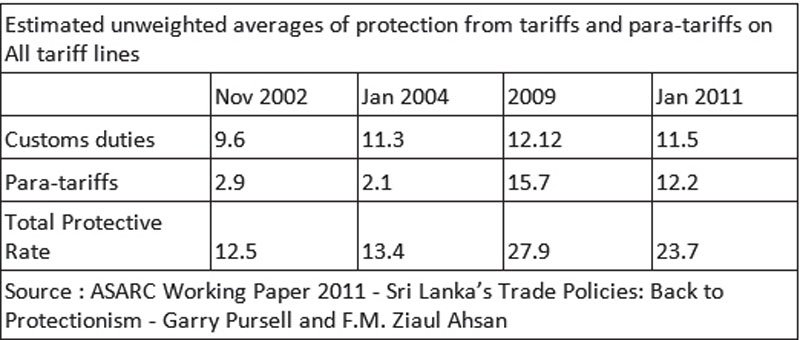
In 2009, by the time peace was restored, Sri Lanka had nine para tariffs applicable for imports  in addition to the standard customs duties, of which , five were ‘para-tariffs’: taxes which are only applied to imports and there is no domestic equivalent. Adding  to whatever protection is provided to domestic production by customs duties, with such para tariffs being in place, the protectionism became even more complicated. 

A systematic comparison of Sri Lanka’s tariff structure at November 2002, January 2004, 2009 and January 2011 suggests that the total protection rate notably increased between 2004 and 2009 . 

The ensuing years were followed by many ad hoc and duty exceptions and case-by-case adjustment of duties on many imports which directly compete with domestic production. By 2015, the average effective rate of protection for manufacturing production had increased by 16%.

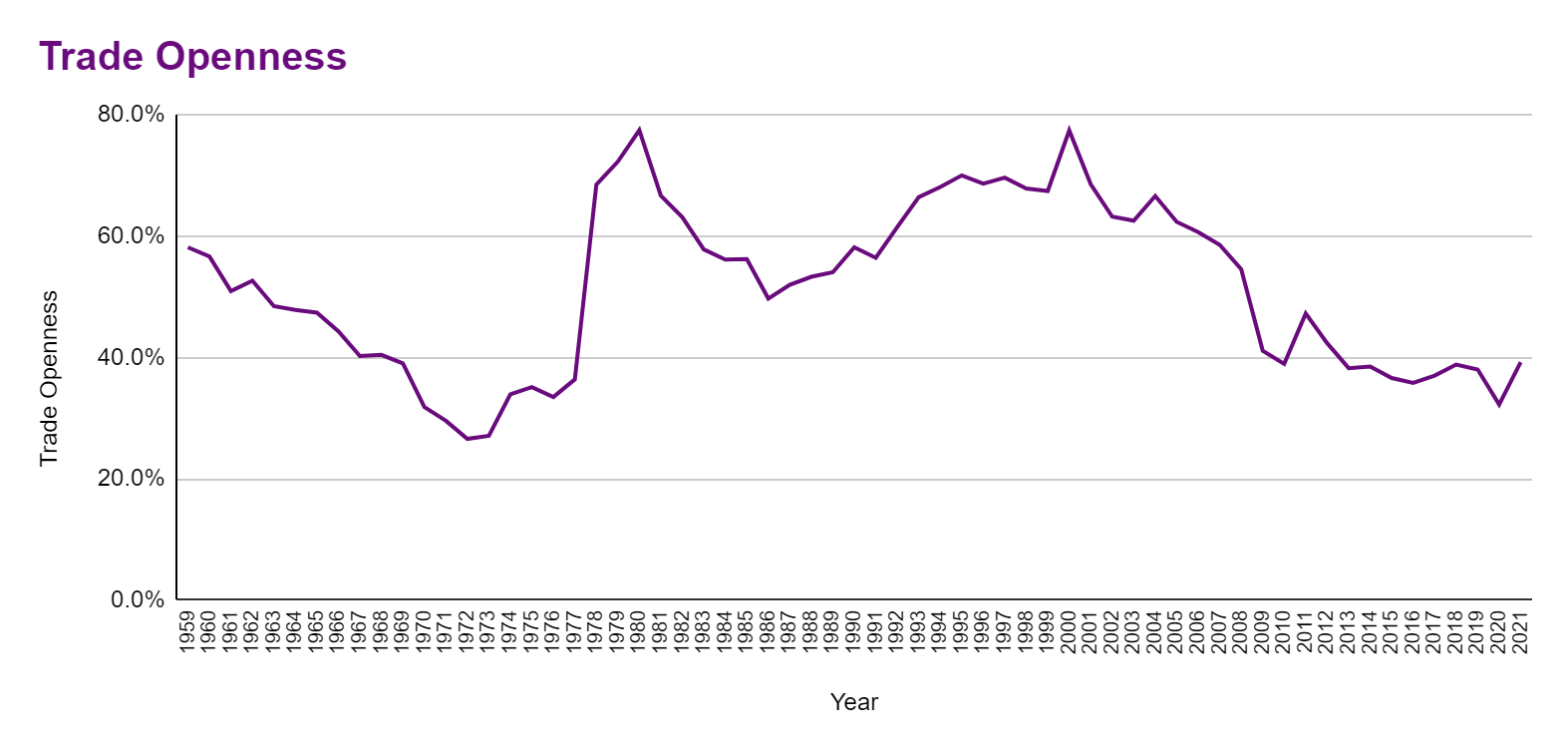
This trend is well depicted through the Trade Openness indicator as given in Figure 1. The degree of openness is measured by the actual size of registered imports and exports of an economy. In other words, it suggests how free or restricted a country is in its relations with the rest of the world. 

Since 2004 onwards there has been a decline in the trade openness of Sri Lanka and this trend continued up until 2010. By 2015 with an increased rate of protection, the trade openness deteriorated to 36.6%. 

Since 2019, Sri Lanka has been pushing many import controls creating disruptions in the market. This tendency resulted in further decline of trade openness 32.2% in 2020. It is similar to the trade openness during 1970 - 1976 when the liberalisation policies were reversed and the economy had high regulations. The trade policy was more aligned towards import substitution.

Trade restrictions 

Sri Lankan businesses face a variety of trade restrictions exacerbated by the economic crisis. Accordingly, such conditions that impact the price, quality, quantity, or timeliness of product delivery but are outside the direct control of the exporter or importer. 

Both the importing country’s border and the border of the exporting country have been parallelly imposed with restrictions. Even though a number of Free Trade Agreements have reduced external trade barriers and expanded access to markets, Sri Lanka has kept its borders closed by enacting internal trade restrictions.

Internal trade restrictions can be identified in terms of broader categories such as; 

1. Monetary and regulatory barriers, 

2. Procedural barriers, 

3. Service barriers,

4. Technical barriers and 

5. Market barriers 

Currently a number of monetary and regulatory barriers exert pressure on Sri Lankan businesses, while lowering the country’s competitiveness on international trade. Such barriers include complex tariff structures, quotas, import restrictions, excessive duties or levies and export and import licenses. 

Both exporters and importers encounter ineffective, unpredictable, and less transparent procedures throughout the entire trade process. This is mostly the result of poor coordination between agencies and excessive bureaucracy (red tape) among Government employees.

Additionally, the distribution and financial services channels are two areas where existing enterprises face significant service obstacles, which slows down the final stage of clearance.  Shedding further light on the obstacles placed, the technological obstacles  have a negative impact on the export competitiveness of local enterprises because of their limited technical and financial resources. Besides the market constraints like price controls are a significant obstacle because they are unrealistic in a setting of shifting global markets and fluctuating currencies.

Impact of trade restrictions

Over the years, the country has experienced a number of adverse effects due to trade restrictions. Net economic losses in the wider economy have increased as this restricts competition. Shrinking volumes of exports and imports have negatively affected domestic production. Consumers are left with limited choice of products while they experience increased prices. 

Trade restrictions impact the macroeconomy with a fall in employment opportunities mainly due to the deterrents on domestic and foreign investment. Limitations on land, labour and capital have disincentivised investors from competitive export industries to protected industries and inefficient import substitution. Reduction in economic activity has increased the economic woes among people.  

Restrictions on trade have put a significant number of businesses in a precarious position.  Starting with street vendors, small and medium scale enterprises who depended on imported raw materials to the larger apparel and construction industries; all the businesses are finding it a challenge to continue their business. 

Way towards trade freedom

The way to greater freedom of trade is to reformulate the existing monetary policies and laws in order to enhance trade freedom and provide more opportunities for local enterprises to engage in trade. Also in the current context, easing import restrictions and reducing taxes or levies on imports and exports would be crucial.  Additionally, it is important to remove unnecessary Government red tape or bureaucracy wherever possible to make customs processes more simple, effective, clear, predictable and timely. This will help to cut down on processing times at the border and make the movement of goods cheaper, faster and more efficient.

Paving way to greater freedom to Trade - the ability to exchange goods and services openly, creates greater opportunities for Sri Lankans to achieve greater economic prosperity. It opens many avenues towards competition, innovation and economies of scale. The beneficiaries of open trade are the Sri Lankan citizens and businesses who will benefit from lower prices and greater choice.  

Freedom to trade will ensure the economic freedom by which the fundamental rights of an individual to make their economic decisions will enhance. The true meaning of independence will only be assured through greater economic freedom. 

Source : Central Bank of Sri Lanka 

The opinions expressed are the author’s own views. They may not necessarily reflect the views of the Advocata Institute or anyone affiliated with the institute.

A well-told lie is worth a thousand facts

Originally appeared on The Morning.

By Dhananath Fernando

Sri Lanka has always been consistent about two things. First, finding a villain to blame for incidents that have taken place in the past for Sri Lanka’s performance. Second, waiting for a hero to rescue us all with magical powers without making sure the systems and markets work. 

We always fail to evaluate reasons and economic context and understand the behaviour of people from an economic angle. A recent example is politicians claiming the economic crisis was a result of the Aragalaya and blaming the people who protested against the hardships they were going through, without realising that the economic crisis is what led to the Aragalaya.  

In a new turn, fingers have now been pointed at exporters, claiming that they have not brought money back into the country and accusing them of being part of the problem. In my view, the figures mentioned in relation to claims that exporters have parked funds outside are unrealistic. Some Sri Lankan companies have scaled their operations very successfully around the world, which has been done legally. For instance, there are energy investments in Bangladesh and Senegal and manufacturing plants in Africa and neighbouring India. Even our IT sector is expanding to the Middle East and to different regions around the globe using legally owned foreign exchange. 

This is obviously illegal and remedial action needs to be taken, but what is more important is to understand why it happens. We need to understand the reasons behind this and understand the reality with a solution-oriented framework. In most cases, the enemy is within, though we try to find the enemy outside. 

In my view, there are three main factors that influence such malpractices

Market intervention by the Central Bank

When central banks infuse more money into the system to maintain artificial interest rates, the exchange rate comes under pressure or the currency depreciates. The fear of currency collapse makes people withdraw money or avoid bringing money into the country.

Not only exporters, but even Sri Lankans who were sending remittances stopped sending their money through the banking system. Instead, they sent money through unofficial means at a depreciated exchange rate. When domestic prices are rising due to money printing or import controls, their families back home naturally need more money to buy goods.

However, exporters cannot keep unlimited amounts of money outside the country. Exporters need money to run their local operations, so they have to convert their export proceedings and get Sri Lankan Rupees to run the operation. When interest rates are kept artificially low, there is an incentive to borrow domestically and delay the conversion of dollars into rupees. 

However there is a limit to what exporters can borrow. Even if they borrow domestically, it cannot contribute to a foreign exchange shortage unless the Central Bank printed money to maintain an artificially low policy rate through discount windows or reverse repo operations.

If banks give extra loans to exporters, they have to cut down on other loans (to housebuilders, for example) or they have to pay higher rates and get deposits and reduce the consumption of their customers. Banks do not have to reduce other credit if the interest rate is maintained artificially through the injection of new money.

The policy of the Central Bank has simply created a highly unstable financial situation and it is human behaviour to protect one’s hard-earned money, so they will obviously keep their money outside. Understanding this should not require any financial expertise; even basic logic is enough. This is understood by our unskilled workforce contributing to our economy through remittances. 

To return to the matter of exporters, the margins are low in trading businesses and export quantities have to keep moving; a business cannot run without money. We have to reevaluate the numbers and it is unlikely that more than 10% of the proceedings will be repatriated, which is a figure that leans more towards the higher side. Even that is profits or value created by exporters. 

If the money comes, the exporter will use it and it will trigger demand. If money is not brought back, it will not become imports and instead becomes a private foreign reserve. While it may contribute to higher interest rates, this type of activity will simply reduce imports and not create forex shortages.

There were claims that some exporters sent goods to Singapore or Dubai and re-sold the goods to third countries while keeping some money there. 

We need to understand why people try to keep money outside the country. Who wants to bring money into an unstable country? Dubai and Singapore do not have central banks that print money and people not only import and export freely, they can also freely send capital in and out.

Sri Lanka, on the other hand, has exchange controls. Again, this is due to money printed to keep interest rates artificially low, which is exerting pressure on the exchange rate. Economists call this the impossible trinity of monetary policy objectives. A central bank cannot hold an exchange rate and allow the free flow of capital if it also prints money to control interest rates.

Exchange controls can be seen as a tool used to delay interest rates. It is worthwhile to recall the scale of Central Bank interventions and controls during this crisis. The Central Bank places price controls on Treasury bills and printed money. Exchange controls were also tightened further instead of correcting interest rates and stopping money printing.

The Treasury placed import controls on hundreds of items. The Central Bank increased margins for Letters of Credit (LCs). Moreover, forward markets for foreign exchange were killed, putting importers at risk and also damaging businesses that had hedged their imported input costs. Exporters were forced to convert their dollars early, which created problems for some exporters who had been in the habit of giving credit to customers to win business from competitors.

Additionally, forced conversion rules were imposed on service receipts. Some service workers and those others who used to bring these to the country and save them in foreign exchange accounts then kept their money abroad. Unlike goods exporters, service exporters have larger margins.

By this time, banks were facing a capital outflow and were unable to renew their credit lines and in some cases dollar-rupee swaps. Forced dollar conversions reduced dollar liquidity and brought these closer to default.

There are also concerns as to whether it is a violation of property rights for banks to force account holders to convert dollars without their consent. Foreign exchange controls are in any case a violation of property rights.

This very column previously warned of the potential drying up of forex with such market interventions. In simple terms, in a context where LKR is not hard pegged to the USD with floating interest rates or if there are no floating rates, all additional money supplied to the financial system to keep rates down evaporates in the form of imports, even with under-invoicing.

Trade barriers – High and complicated tariff structure 

Making tariff structures complicated is an incentive for corruption. The level of corruption that takes place at customs is no secret and the more complicated the system becomes, the more room for corruption. Simply, when the cost of corruption is lower than the legal procedure, the incentives are in place for corruption. 

This column has on many occasions recommended a simple tariff structure with three bands so that paying import tariffs becomes easier than taking on the cost of corruption. This was proved by Prof. Premachandra Athukorala in a practical research he undertook, where bringing down the tariffs by half on selected HS codes ensured that the Government income from those particular imported items doubled. Too many restrictions and intervention are the genesis of black markets and corruption. One of the easiest ways to minimise corruption at Sri Lanka Customs is to make our tariff structure simple, low, and consistent. 

Poor business environment 

Overall, Sri Lanka’s business environment is extremely poor. We have to ask ourselves why our own people leave the country and why they are reluctant to bring their money into the country. The answer is not complicated; we may act rationally or emotionally at times, but when it comes to money, we all tend to make rational decisions, especially when there is a tangible cost or benefit associated with it. 

It is obvious that people consider all alternative options to protect their hard-earned money. This is one reason remittances were not sent through official channels. Family members still received the money and imports still took place, but without going through the official channels. Any imports paid for with unofficial funds – such as open account imports – reduce the demand for dollars from exports.

Now that the Central Bank has raised rates and reduced money printing, leading to reduced exchange rates, people are sending their money through official channels. This shows that most people prefer to send their money through official and legal channels if a stable and consistent system is available.

It has been a while since Standard and Poor’s, Fitch Ratings, and many other international agencies warned about Sri Lanka’s worsening economic crisis. As such, our economic environment was extremely poor, which was why people did not feel that it was safe to bring their money into the country. The same happened even in Africa – with the crisis in Zimbabwe, many had bank accounts in Cape Town to protect the value of their money. 

Final thoughts 

One has to be careful about harassing exporters. Exporters, especially subsidiaries of foreign countries, have other countries to operate in. 

Under-invoicing exports is wrong, as it will reduce profits within the country. This is a tax fraud. However, reducing profits cannot contribute to forex shortages since any money that is not spent in the country will also reduce imports.

Sri Lanka wishes to be a hub for South Asia. It wishes to become a place where companies set up regional headquarters. If currency instability and exchange controls exist, these will not be set up in this country. Moreover, there are also rules on transfer pricing. 

If Sri Lanka possessed monetary stability, if there were no exchange controls, and if its tax rates were reasonable – the US has been pushing for a global corporate tax rate of 15% – companies would not try to take profits to safer places.

Exporters and importers have been harassed over the years. Framing exporters as the reason for the crisis instead of solving our own problems will simply make the situation worse. 

Can we really put the entire weight of the economic crisis on our exporters, forgetting the bond scam, Easter attacks, droughts, Covid-19, borrowing money at very high interest in USD, and investing in unproductive projects? The enemy is within, but we are always looking for a culprit outside. In politics, sometimes a well-told lie is worth a thousand facts.    


The opinions expressed are the author’s own views. They may not necessarily reflect the views of the Advocata Institute or anyone affiliated with the institute.

What next for Sri Lanka?

Originally appeared on The Morning.

By Dhananath Fernando

New predictions are emerging that debt restructuring and International Monetary Fund (IMF) Board-level agreement may take until the end of this year. Another ongoing discussion is about the Local Government Elections and postponement of elections. Electricity tariffs are to be increased and 10 banks have been downgraded by Fitch Ratings as a recalibration of Sri Lanka’s sovereign rating.

Overall, it appears that economic reforms are being sidelined faster than expected, without realising the consequences of each action. It is true these complicated problems have no easy, straightforward solutions. No solution will be perfect and the validity, impact, and effect of any solution will be weighed against time. To put it simply, a solution that appears valid and reasonable today may not sound reasonable in a few weeks or months.

Each action has its consequences and inaction will also have consequences. It will be a battle between the consequences of action and inaction and the continuation of this for the next few years.

Reforms and restructuring

Let’s take the case of reforming State-Owned Enterprises (SOEs). With the election cycle commencing with Local Government Elections, attempts at restructuring SOEs such as the Ceylon Electricity Board (CEB) may be delayed. This delay means that inefficiencies will continue and tariffs will be increased without any competitive basis. This will in turn impact all businesses as well as macroeconomic indicators given the monopoly and the size of the electricity business. It may also extend the duration of power cuts and pave the way for another wave of protests, worsening the business environment.

Reforms too will be painful. Trade unions and some employees will be affected and an electricity monopoly can interrupt the life of the common man in multiple ways, with political and capital implications.

The cost of not implementing reforms will be much higher politically and economically, as it would be a cyclical result. Therefore, the reasonable decision is to restructure loss-making SOEs. Unfortunately, there is no other way out and delaying this further may invite darker years in the future.

The delays in the debt restructuring process will have its own consequences, both economically and geopolitically. The debt restructuring delay is a repercussion of maintaining bad foreign relations.

Poor international relations

How we treated India over the Economic and Technology Cooperation Agreement (ETCA) and in discussions on the East Container Terminal was extremely unprofessional and irresponsible. There is a significant difference between disagreement, negotiation, and unprofessional treatment.

By suspending the Light Rail Transit (LRT) project, we lost the respect and trust of Japan. We even annoyed China with the fertiliser matter and continuous regulatory delays with the Port City project. Our relations with the Middle East deteriorated with the cremation of dead bodies of the Muslim community during Covid.

We are not even in the good books of the US over the way we dealt with the MCC grant. Simply put, we do not have a friend who will extend a helping hand during troubled times. It is said that countries have longer memories than people. As such, we have limited our options due to our own grave mistakes.

A stalemate in a crisis

Economics and politics often go hand in hand. During an economic crisis, instability in politics is unavoidable. Our President does not have a direct mandate and the composition of the Parliament may not really reflect the people’s voice with the dawn of the completely new sociopolitical environment.

This was one reason the discussion of a common minimum programme was floated by concerned individuals and professionals, but it appears that this too has been discarded, with everyone slowly turning their attention to the election cycle. The calibre of our politicians is too inferior for them to understand the dynamics involved and to come up with responsive and novel policies and political options.

We are now in a stalemate, with a lot of short-term distractions. In such situations, we become distracted and waste our time on non-value adding activities without realising the massive deterioration of the quality of life. A deeper analysis shows that while the absence of economic reforms is a major issue, the fragility of our institutions is a bigger concern, with the institutional capability for the functioning of a basic society being almost nonexistent.

Solutions

Appointing capable and credible human resources for debt negotiations with China is essential to avoid delays. Acceleration of debt restructuring will unblock many other barricades, enabling us to move forward. There is a huge vacuum of capable human resources needed to carry out reforms. Therefore, providing space for already appointed committees to recruit more capable people and working out a time-bound solution matrix is important. The solution now lies in setting up institutions that can execute reforms to get us the required results.


The opinions expressed are the author’s own views. They may not necessarily reflect the views of the Advocata Institute or anyone affiliated with the institute.

Promoting competition over price controls

Originally appeared on The Morning.

By Dhananath Fernando

The decision to import eggs is a classic example of how price controls are backfiring. It proves once again the main argument put forth by Advocata’s research report ‘Price Controls in Sri Lanka – Political Theatre’ published in 2018. It suggests that price controls are merely politically motivated and have never succeeded in bringing prices down. 

The story of price controls imposed on eggs has two sides. Firstly, it is about competitiveness. According to media reports, an imported egg can be sold for Rs. 25-30 while a local egg costs over Rs. 60. When an egg is imported, it involves both a value chain and the distribution of margins. At the production stage, the farmer keeps a margin. 

Secondly, there are taxes and storage charges at customs of the particular country we import eggs from. There are also charges for insurance and shipping. Once the consignment reaches Sri Lanka, there will be tariffs and handling charges imposed by Sri Lanka Customs. There may also be storage expenses in Sri Lanka and the importer and retailer will keep the margins. Even with all these costs, local eggs are almost twice as expensive as imported ones. This indicates the inefficiency of local egg production. 

Restrictions hamstring production  

A primary reason for the uncompetitive and expensive nature of local egg production is the price controls imposed by the Consumer Affairs Authority (CAA). A few months ago, the CAA imposed price controls, expecting a drop in prices. As we all remember, eggs simply disappeared from the market. 

The poultry industry as a whole was also challenged. No poultry farmer could survive at the prices set by the CAA. Some micro- and small-scale poultry farmers had to scale down while some had to close down. They sold their laying hens for meat amid the price controls. Daily production of eggs dropped to about four million per day from seven million. The price cap was later increased but the damage had already been done. Additionally, due to import controls, essential chemicals for the poultry industry were in shortage.

As a result, the poultry supply contracted and led to a price hike. Now we expect to import eggs. Accordingly, the price controls not only increased prices but also damaged the efficiency of the industry. 

We often forget that markets are interconnected. The poultry industry is often interlinked with maize production as it is the main source of food for poultry. Price fluctuations of maize affect the prices of chicken and eggs. Any intervention in the form of price controls, import controls, or regulation has a direct impact on the industry. 

It was not the first time we faced such a situation. Many governments and many trade ministers fell into the same trap over and over again by failing to understand the fundamentals. 

To recall some incidents in the recent past, there was a price cap of Rs. 60 per 1 kg of dhal and Rs. 100 for tin fish during the Covid-19 pandemic. Just compare these prices now. There was also a price cap for rice and at one point, a former military officer was appointed to conduct field raids on rice mills. 

There were times a price ceiling was imposed on hoppers and egg hoppers. Similarly, in 2015, there was a price cap on plain tea and tea. In the same year, price controls were imposed on broiler chicken. Traders started selling chicken parts instead of whole chicken to avoid price controls. Have you ever noticed prices being reduced due to price controls? The simple answer is no. 

Instead, things worsened. After repeating the same mistake over and over again, the poultry industry experienced the same bitter results. Its effect was felt not only by the poultry industry, but by the poorest sections of the population as well. 

Eggs are a necessary protein intake for the poor as they do not have refrigerators for storage. Eggs are also one of the main ingredients in the bakery and restaurants industries, which involve an extended value chain. Everything has been affected and some restaurants have even had to downsize their menus due to unavailability of eggs at one point.       

Solution 

Improved efficiency in local egg production is important to reduce the cost per egg and increase the output, thereby reducing the price of eggs. The farmers in India and Pakistan are doing something right to be able to sell eggs at Rs. 35 after passing through many touchpoints and cost centres. 

We have to make ourselves productive and efficient. Efficiency works when there is competition and when we allow competition to work. We cannot restrict competition for selected markets because one way or the other, all markets are interconnected. We have to redesign the CAA as an agency to promote competition and not as an agency to regulate prices. 

The same is valid for the Public Utilities Commission of Sri Lanka (PUCSL). The solution is setting up institutions to accelerate competition across all industries. The role of the Government is to remove barriers for market operations, not to control prices. Price controls make things worse and it cannot bring down prices, but it will kill the industry and many other connected industries.  


The opinions expressed are the author’s own views. They may not necessarily reflect the views of the Advocata Institute or anyone affiliated with the institute.

Privatisation! the need of the hour

Originally appeared on The Morning.

By Dhananath Fernando

I travel mainly by a common staff transport from Moratuwa to Colombo to work. I travel by train as well as on normal public transport for other travel purposes. Undoubtedly, my staff transport is the most efficient and affordable, providing the most value for money. It not only provides value for the money I pay, but it also provides a great example of why the Government should not do business and why the private sector should be allowed to. Even in the toughest conditions, private enterprises can bring solutions.   

The operator of my private staff transport is Amal, an executive at an office in Colombo. While a normal bus typically has three main stakeholders, Amal has made it so that there’s just one main stakeholder. That’s efficiency. A normal bus on the road generally has an owner, a driver, and a conductor. Amal just has one. He is the driver who drives us all safely and on time. He does not have a conductor because he has an automated door which the driver can operate easily with just a switch in the dashboard.

He charges about Rs. 12,600 for an air-conditioned bus ride for the entire month. That is approximately Rs. 286 per one-way journey from where I live, which is around 20 km. If I were to calculate my cost per kilometre for a peaceful air-conditioned bus ride where I can sleep comfortably or work on my computer, it costs just Rs. 14. 

Even if I travel by a normal non-air-conditioned bus, the incremental value I pay for Amal is negligible. If I use an air-conditioned bus, my costs are higher than what Amal charges. In the first place, there are no air-conditioned buses where I live and with Amal, my travel time is almost one-third of the total time taken on the normal route. I believe that travelling with Amal not only saves time but also reduces carbon emissions as well. 

A win-win situation 

Amal is just one man in the private sector who adds value to my life while making a profit and a living out of it. He recently bought another bus and now he has two rosters both ways with a time gap of about 30 minutes, meaning I can choose either the first bus or the second according to my convenience. He shares the live location on WhatsApp before every ride, so I can track where the bus is and be prepared. 

Amal is not the only such person. If you observe Colombo between 7-9 a.m. you will notice that there are many buses operating on the same model as Amal’s. There is no regulatory authority on staff transports in Colombo and yet it operates efficiently, with both Amal and I being beneficiaries of the system. It’s a complete win-win. I hope that after reading this article, there won’t be any Government regulations set up regarding staff transport to ruin the market. 

Amal is a one-man private operator who solves a burning issue for me or at least provides me with a reasonable solution which my Government has been unable to provide for more than three decades, even with billions worth of funds.    

Amal can improve efficiency because he has an incentive for improving efficiency. His incentive has a ripple effect leading up to minimising carbon emissions. 

Privatisation to solve problems

Given the discussion on privatisation, there is no better example than Amal of how private enterprises help people. Economics and businesses are all about solving people’s problems. Our life is all about solving each other’s problems and depending on each other. Amal solves my transport problem and by paying him, I may be contributing money for his child’s education. 

Our entire economy is a complicated yet interconnected web. Efficiency and getting the maximum out of our resources are needed, which can only be done when the markets are in operation. Markets are operated by private individuals like you and me who read this article. 

While the process of privatisation is complicated, privatisation is just a normal process for market operations. Sri Lanka’s economic problem is that we don’t solve anybody’s problems. When we do not solve problems, how can we earn money? How can others solve our problems? 

Problem-solving is nothing but improving efficiency. Efficiency can only be improved when people have incentives. It is a universal truth, like the earth revolving around the sun. Even if you look at the Return on Equity (ROE) or Return on Assets (ROA), which are indications of a company’s efficiency, it is very clear that under normal circumstances and on level playing fields, the private sector’s efficiency and impact is much higher than when the Government runs businesses. 

Just take a look at Figure 1, which is a comparison between Sri Lanka Telecom (SLT), which has some private sector engagement and Dialog, which is a private sector player.

Figure 1: ROE analysis of SLT vs. Dialog

Source: Annual Reports of SLT and Dialog (2018-2021)

In some cases, the State sector ROE is simply higher because of the absence of a level playing field. The banking sector is a good example. Most State banks get preferential treatment so their returns are high due to the non-competitive nature of getting businesses. Given the size of the Government, most Government banking is done through the State-owned People’s Bank and Bank of Ceylon. Anyone visiting a State bank and a private bank will experience the difference in service levels. This doesn’t mean the private sector is perfect; markets are always imperfect, but it is obviously many miles ahead of businesses run by the State.

Figure 2: ROE comparison of the banking sector

Source: State of the State-Owned Enterprises, Advocata Institute (2022)

The private sector is not anyone else, it is us. We should be given the opportunity to solve our problems instead of making the Government solve them. When the Government tries to solve the problem, it will not only block the private sector but it will also waste our tax money. Just think of Amal; he is providing me with a reasonable solution to a problem that the Government has been unable to solve for over three decades.  

The opinions expressed are the author’s own views. They may not necessarily reflect the views of the Advocata Institute or anyone affiliated with the institute.

Defence expenditure: The elephant in the Budget

Originally appeared on the Morning

By Avishka Jayaweera

In his recent Budget speech, President Ranil Wickremesinghe stated: “It has been difficult to allocate resources to health, education, and other important sectors due to the lower level of Government revenue generated from taxes in comparison to other countries.” However, increasing revenue is only one side of the coin. On the flip side, an equally important aspect of a state’s finances is expenditure.

It is only logical that if one tends to spend in excess of what they earn, effectively living beyond their means, their spending is unsustainable in the long run. The same holds true for a state. If a state spends beyond its earnings, it has no alternative but to borrow money to finance its expenditure. However, such borrowing can only be sustained for so long. This is Sri Lanka’s folly.

Except for 2017 and 2018, Sri Lanka has regularly run on a primary deficit [1]. The deficit has largely been financed through debt and money printing. It is the foreign component of this debt, which kept growing incrementally, that is responsible for the crisis Sri Lanka faces today. There is a limit up to which creditors are willing to extend loans to the country. Once Sri Lanka’s credit rating was downgraded and it lost access to the International Sovereign Bond market, the Government could not finance the current account deficit, causing the balance of payments crisis.

Government expenditure and the 2023 Budget

It is clear that the Government must balance its Budget, which is what the International Monetary Fund (IMF) Staff-Level Agreement with the Government aims to achieve by aiming for a primary surplus of 2.3% of the GDP by 2025 [2]. The Government appears to be attempting to do this purely by increasing taxes. This places a high burden on consumers who are already facing diminishing standards of living and an inflation tax, caused by excess money printing among other factors.

What then is the alternative? The answer, although politically unpopular, is relatively straightforward. It lies in cutting down on State expenditure. State expenditure must be scrutinised and prioritised. Instead of reducing expenditure in the 2023 Budget, the Government has increased expenditure by 31% from the 2022 revised Budget to Rs. 5,819 billion.

Expenditure must be rationalised. Calls to cut Government spending do not mean reducing the amount spent on health, education, or social welfare. There are more obvious areas where expenses can be cut, freeing up resources to be used in these aforementioned areas that are of national importance. Defence and security spending is one of the main culprits. The Ministry of Defense has the third highest Budget allocation of all ministries.

Defence and public security spending

Allocations for defence and public security spending have risen in the 2023 Budget to Rs. 539.2 billion, which comprises approximately 1.78% of the GDP for 2023 [3]. The allocations for defence and public security spending have constantly been on the rise, with a 9.1% increase in the 2022 revised Budget and a 10.2% increase in the most recent 2023 Budget.

It has been 10 years since the civil war and Sri Lanka is yet to demilitarise. In fact, since the end of the war in 2009, military expenditure has consistently been on the rise. According to a publication in 2021 by Daniel Alphonsus, not only did military expenditure not return to pre-conflict levels, but even when adjusted for inflation, the military spending post-conflict (from 2009 to 2017) was higher than the spending during the wartime peak [4]. Defence expenditure as a percentage of the GDP was three times higher than in the last period of peace [5].

It must also be noted that 88% of the spending on defence and public security is for recurrent expenditure. Most of this is to sustain an active military force of around 250,000 – incidentally, the 17th highest in the world, exceeding even the military force sustained by the UK [6].

The defence expenditure also includes spending on a Police force of 74,835 officers and a Special Task Force of 8,860 [7]. In 2021, 34.6% of Government salaries and wages were spent on defence [8]. Bearing such a high cost on maintaining an active force during peacetime is not only overspending but is also an inefficient allocation of these resources.

The need for action

Reduction of these active personnel will not only lower Government expenditure but with proper programmes, provide valuable labour that can be utilised in an effective and productive manner in the private sector. While the proposal in the 2023 Budget speech mentions that armed force personnel will be allowed to retire after 18 years, it is unclear if this is optional or mandatory. Further, whether this proposal would even be implemented remains to be seen.

Many Sri Lankan citizens today find it difficult to simply get by due to the crisis brought about by the mismanagement of public finances. While the public is burdened with paying more in taxes, the Government should ensure that the public spendings are efficient, effective, and deliver good social outcomes. It is difficult to justify maintaining a large standing army or a vast defence expenditure in a time of peace.


(The writer is a Research Assistant at the Advocata Institute. He can be contacted at avishka@advocata.org. The Advocata Institute is an independent public policy think tank. Learn more about Advocata’s work at www.advocata.org.)

(The opinions expressed are the author’s own views. They may not necessarily reflect the views of the Advocata Institute or anyone affiliated with the institute.)

References

  • Central Bank, Annual Report 2021.

  • IMF, Press Release No. 22/295.

  • Based on 2023 Budget Estimates; Public Finance.

  • Daniel Alphonsus, Sri Lanka’s Post-War Defence Budget: Overspending and Underprotection, South Asia Scan, Issue No. 15 (Singapore: Institute of South Asian Studies, November 2021).

  • Daniel Alphonsus, Sri Lanka’s Post-War Defence Budget: Overspending and Underprotection, South Asia Scan, Issue No. 15 (Singapore: Institute of South Asian Studies, November 2021).

  • The International Institute For Strategic Studies, ‘The Military Balance 2021’; Global Fire Power.

  • Sri Lanka Police, ‘Performance Report 2019’.

  • Calculations based on Central Bank, Annual Report 2021.

Why is OT work necessary for women in Sri Lanka?

Originally appeared on the Morning

By Sumhiya Sallay

‘Overtime work for women’ is a topic that is not touched upon much in Sri Lanka, however, it can bring an array of benefits to women and our economy. It can improve financial security by providing an additional source of income and provide the next generation of women and girls with more opportunities to work and increase economic participation and improve productivity. 

Given Sri Lanka’s current economic crisis, there is a dire need for a dual income role in lower-income and lower-middle-income households. As Sri Lanka navigates through this economic crisis, where high levels of inflation have significantly reduced the purchasing power of the public, one earner is no longer sufficient for a household. This is where the need for laws that provide more opportunities for women are needed. 

The freedom to choose a job, a place of work, and how long to work are all decisions that should be given to every employee, whether male or female. However, in certain private sector industries in Sri Lanka, female employees do not have the legal right to choose overtime work, while male employees can [1]. 

Legal safeguards needed for overtime work

It is important for a country to have laws that support women so that women are given the choice and freedom to work in order to support themselves and their families. The World Bank’s ‘Women, Business and the Law 2021’ report states that when economies are more equal, they become more resilient [2].

It also highlighted the need to safeguard women’s economic rights under the law [3]. When laws are discriminatory against women, it makes it much more difficult for them to remain in the workforce. Therefore, it is vital for countries to enable laws that are more supportive towards women. 

The report, which captures the laws and regulations that restrict women’s economic opportunities, indicated that Sri Lanka scored 65.6 out of 100 in the ‘Women, Business and the Law’ 2021 index. Overtime work restrictions are also among one of the various discriminatory laws identified in Advocata’s report on ‘Gender Discriminatory Labour Laws in Sri Lanka and Female Labour Force Participation’. 

In Sri Lanka, women above the age of 18 are not allowed to work for more than nine hours per day (45 hours per week) within a five-day workweek, with an exception provided for female employees employed in residential hotels, clubs, and other places of entertainment or in any shop situated at an airport where they may be employed until 10 p.m. under specific conditions [4][5]. However, male employees are entitled to work for up to 12 hours of overtime per week (on a five-day work week). This discrimination towards female employees prevents them from working overtime. 

Although a practice known as administrative relaxation exists where the law is relaxed to allow women to work overtime, it is not recognised by the law [6]. Due to this, issues arise where employees who have worked overtime are not provided compensation for the hours worked overtime by the employer. Therefore, not having a formal, legally recognised law or regulation for overtime work discourages employees from working overtime. 

Furthermore, having laws that are not supportive towards women, especially discriminatory overtime laws that prohibit women from working overtime prevents them from having an extra source of income. 

Benefits of enabling overtime work

Given the current situation in Sri Lanka, with the high inflation rates, more income generation is needed and increasing female labour force participation by having supportive laws will give women the opportunity to earn more and also be financially independent. In return, women can increase their household spending on items that will enhance a country’s growth prospects by changing spending in ways that benefit children’s nutrition, health, and education [7].

Overtime work can not only benefit female employees but also benefit employers as it increases productivity and contributes towards the overall economic development of a country. The economies of both developed and developing countries would greatly benefit from increasing female labour force participation if women participate in the labour force at the same rate as men, work the same number of hours as men, and are employed at the same levels as men across sectors [8]. 

Overall productivity will increase if employees’ skills and talents are used more fully. There are several studies that have been published on how much more productive an economy could be if it took full advantage of the potential of its women workforce [9].

As more women enter the labour force, economies have the potential to grow faster in response to higher labour inputs. Women’s supply of labour increases household incomes, which helps families escape poverty and increase their consumption of goods and services. 

In Advocata’s report on ‘Gender Discriminatory Labour Laws in Sri Lanka and Female Labour Force Participation,’ key reforms and recommendations that need to take place in order to allow women to work overtime are highlighted. 

These recommendations include removing the restriction on overtime work under the Shop and Office Employees (Regulation of Employment and Remuneration) Act No. 19 of 1954 [10] and introducing a regulation to allow women to work overtime. In order to support this regulation, we also recommended that certain guidelines be included within the law to prevent the exploitation of excessive overtime. 

References

  • Shop and Office Employees (Regulation of Employment and Remuneration) (SOE) Act No. 19 of 1954.

  • Women, Business and the Law 2021, (Washington: The World Bank, 2021).

  • Women, Business and the Law 2022, (Washington: The World Bank, 2022).

  • Subject to conditions under the Shop and Office Employees (Regulation of Employment and Remuneration) (Amendment) (No. 32 of 1984), Section 2A.

  • Employment In Terms Of The Shop And Offices Employees’ Act Monograph No. 17 (Rajagiriya: The Employers’ Federation of Ceylon, 2016), 13.

  • Employment In Terms Of The Shop And Offices Employees’ Act Monograph No. 17 (Rajagiriya: The Employers’ Federation of Ceylon, 2016), 13.

  • Ana Revenga and Sudhir Shetty, ‘Empowering Women Is Smart Economics’.

  • McKinsey Global Institute (MGI), ‘The Power of Parity: How Advancing Women’s Equality Can Add $12 Trillion to Global Growth,’ (2015).

  • McKinsey Global Institute (MGI), ‘The Power of Parity: How Advancing Women’s Equality Can Add $12 Trillion to Global Growth,’ (2015).

  • Shop and Office Employees (Regulation of Employment and Remuneration) (SOE) Act No. 19 of 1954, Section 3 (1)(3)(a).


Sumhiya Sallay is a Programmes Executive at the Advocata Institute. She can be contacted at thilini@advocata.org. The Advocata Institute is an Independent Public Policy Think Tank. The opinions expressed are the authors’ own views. They may not necessarily reflect the views of the Advocata Institute.

Current Food Inflation in Sri Lanka: Causes, Consequences and Way Forward

Originally appeared on the Morning

By Thilini Bandara

In recent times, rising food prices have become a global phenomenon owing to various factors including the Covid-19 pandemic, climate impacts, the Russia-Ukraine war and the downturn of the global economy. These have played a part in Sri Lanka recording the highest food inflation rate of 94.9% in September 2022 according to the Colombo Consumer Price Index—a rate which averaged at 9.39 per cent during 2009–2022. The World Bank's food security update highlights  Sri Lanka among the top 5 countries with the highest food price inflation in September 2022. This article explores the recent trends, causes and consequences of food inflation in the country. 

Fluctuation of food prices over time

Advocata Institute’s Bath Curry Indicator (BCI) tracks the monthly changes in the retail prices of a limited basket of goods normally consumed by Sri Lankans as per the 2016 Household Income and Expenditure Survey (HIES). 

Accordingly, the BCI supermarket prices recorded a 78% increase between September 2021 to 2022.  However, there is a slight decrease in prices on a month-on-month basis of 7.63% in September 2022 compared to August 2022. Further, when considering the BCI-Supermarket prices, it has recorded an 83.88% increase between August 2021 to August 2022 on a year-on-year basis, while showing a slight decline of 6.59% between September 2022 and August 2022. 

Table 1 depicts the price fluctuations in terms of BCI and BCI-Supermarket from 2019 to 2022.

Table 1: Price fluctuation over time according to the BCI index

Causes of food inflation in Sri Lanka

At a glance, rising food prices can be attributed to disruptions in both global and local supply chains due to various factors that include the energy crisis, climate impacts, the pandemic and the Russia-Ukraine War. Additionally, domestic policy restrictions such as import bans of essential commodities, the rising cost of agricultural inputs, recent changes to agricultural policy, and the ban on chemical fertilisers and quick shift to organic fertilizer lowered agricultural production and heightened supply chain disruptions. 

Moreover, the expansionary monetary policy of the previous government through lowered interest rates and heightened money printing contributed to higher food inflation.

Additionally, due to the uncertainty surrounding imports entering the markets, traders must reassess their pricing decisions. This creates distortions in the marketplace and can lead to additional pressure on consumers. 

Consequences of food inflation

People living below the poverty line and middle-income groups with a fixed income are the most severely impacted by this high inflation. Food inflation rising rapidly in contrast to household incomes has widened the income gaps. It has further dealt a massive blow to the economic stability and well-being of the poor through poverty and malnutrition. A recent survey by the Sri Lankan Red Cross Society and the International Federal of Red Crescent Societies has revealed that 50% of households have reduced the intake of meat and fish, while 11% have completely dropped protein intake from their diets. Also, a survey conducted by WFP in September 2022, reveals that more than 1/3rd of Sri Lanka’s population is in food insecurity, while 79% of households are adopting food-based coping strategies to keep food on the table.  Moreover, the evidence revealed that even non-food expenditure such as education, housing, and health has lowered owing to rising food costs, which will lead to socioeconomic pressure.

Way forward

A recent report by the Food and Agriculture Organisation and the WFP highlights that the food security problem could be further heightened during the upcoming “maha” season between October 2022 - February 2023, if the country is unable to import sufficient amounts of rice and other food products to meet demand. In the absence of a sufficient supply of agricultural inputs such as fertilizers, pesticides, and other supplies, targeted assistance should be provided to farmers to increase domestic production and resilience of the agri-food systems. In fact, introducing incentive schemes, identifying special regions for off-season cultivation, implementing innovative food storage and preservation strategies, distributing farm inputs at subsidized rates, and promoting substitutes for imported items are some of the measures that can be implemented to address the food security problems. 

Targeted interventions should also be provided through social safety nets and humanitarian initiatives for low-income groups that are food insecure and require immediate assistance. Though funds for this have been already allocated from the 2022 interim budget, effective and efficient execution is required to identify the most vulnerable groups and provide them with the food assistance they require. 

References

Aneez, S. (2022). Crisis-hit Sri Lanka looks for foster parents to face malnutrition among children. Economynext. Available at: https://economynext.com/crisis-hit-sri-lanka-looks-for-foster-parents-to-face-malnutrition-among-children-101200/. [Accessed 17 October 2022]

CBSL. (2022). CCPI based headline inflation recorded at 69.8% on year-on-year basis in September 2022. CBSL. Available at: https://www.cbsl.gov.lk/sites/default/files/cbslweb_documents/press/pr/press_20220930_inflation_in_september_2022_ccpi_e.pdf. [Accessed 13 October 2022]

Economynext. (2022). Sri Lanka households drop meat from diet, slash drug doses as poverty worsens: survey. Available at: https://economynext.com/sri-lanka-households-drop-meat-from-diet-slash-drug-doses-as-poverty-worsens-survey-101259/.[Accessed 19 October, 2022]

FAO & WFP.(2022). FAO/WFP Crop & Food Security Assessment Mission (CFSAM) to the Democratic Socialist Republic of Sri Lanka. Rome: FAO & WFP. Available at: https://www.fao.org/3/cc1886en/cc1886en.pdf.[Accessed 17 October 2022]

OCHA. (2022). Food Security and Nutrition Crisis in Sri Lanka. OCHA. Available at: https://reliefweb.int/report/sri-lanka/food-security-and-nutrition-crisis-sri-lanka. [Accessed 17 October 2022]

Trading Economics. (2022). Sri Lanka Food Inflation. [online] Available at: https://tradingeconomics.com/sri-lanka/food-inflation. [Accessed 19 October 2022]

The World Bank. (2022). Food Security Update. The World Bank. Available at: Food-Security-Update-LXX-September-29-2022.pdf (worldbank.org). [Accessed 20 October 2022]

The opinions expressed are the author’s own views. They may not necessarily reflect the views of the Advocata Institute or anyone affiliated with the institute.


Thilini Bandara is a Research Analyst at the Advocata Institute. She can be contacted at thilini@advocata.org. The Advocata Institute is an Independent Public Policy Think Tank. The opinions expressed are the authors’ own views. They may not necessarily reflect the views of the Advocata Institute.

Repeal para-tariffs on period products

Originally appeared on The Morning

By Thathsarini Siriwardana

On 2 October, the President’s Media Division announced that the Government had decided to remove all import duties on imported raw materials for domestically-produced sanitary napkins while providing zero VAT benefits for imported finished sanitary napkins. This is yet to be implemented; no gazette has been issued at the time of writing. 

The move to reduce tariffs is positive and doubtless well-intentioned and should be welcomed. These tax revisions will help to reduce the prices of domestically-produced sanitary napkins considerably. Nevertheless, we would have liked to see the tariff cuts on sanitary napkins as part of a broader overall reform of the tariff structure rather than an ad hoc adjustment.

Women constitute just over half of Sri Lanka’s population of 21 million. Of the female population, 5.3 million menstruate. Menstrual products had high tariffs prior to 2018. The total tariff imposed on sanitary napkins was over 101.2% [1] in 2018, but these were gradually reduced. 

The current total tariff on sanitary napkins is 46.9% [2]. Although the current tariffs are much lower, they are still quite high, so access to affordable and safe menstrual products remains a luxury for some women. 

The collapse of the currency and soaring inflation have brought a lot of pressure on household budgets. The Government should try to reduce inflationary pressure through supply-side reforms. Simplifying and standardising the tariff structure will facilitate trade and can reduce costs.

Sanitary napkins are vital for girls and women. High protective tariffs imposed on these products benefit producers, but this is at the expense of consumers. The inability to afford sanitary napkins in Sri Lanka is pervasive, especially among the low-income segment of society.  

Tariffs on menstrual hygiene products

It is clear that in terms of tariffs on menstrual hygiene products, such policy decisions benefit producers. The current total tariff of 46.9% consists of 15% (VAT) + 10% (PAL) + 15% (CESS) [3] and while this is an improvement, prices are still high.

When a protectionist tariff is placed on a good, it will achieve two main things. First, it will act as a barrier for new products entering the domestic market. This lowers competition and reduces the choice available to women when purchasing sanitary napkins. Secondly, high tariffs trickle down to final product prices, resulting in higher prices for both domestically-produced and imported products. 

Sri Lankan women and girls face challenges in choosing a menstrual hygiene product that best suits them. The ability to choose comes with the affordability and the availability of the product. The current high tariff rates hinder the choice of women and girls.

By reducing tariffs, the cost of importing products will decrease while simultaneously creating competition, which will help to reduce the prices. This will encourage new local producers to innovate better quality products while ensuring their prices remain low and competitive in the market. 

Cost analysis of sanitary napkins

A market price analysis of sanitary napkins shows that the average imported price per pad remained more expensive than the most expensive locally-produced price per pad as of September 2022. The currently available cheapest price per pad is Rs. 33. When comparing per-pad price changes within a year, it shows that both prices of local and imported brands have increased by more than 70%. 

Economic factors such as the depreciating exchange rate and high rates of inflation are the main contributors to this vast price increase. The increasing prices are also influenced by the high para-tariffs. Removing the imposed protectionist tariffs on sanitary napkins and menstrual hygiene products will provide some degree of relief for low-income-earning women.

Advocata Institute reported that in 2016 Sri Lanka’s absolute household period poverty rate was approximately 50%. This means that around half of the households with menstruating women do not report buying sanitary napkins as part of their household expenditure. In 2019, Sri Lanka’s absolute household period poverty rate was approximately 40%. Even though this is an improvement compared to 2016, the situation is expected to worsen due to the economic crisis.

To provide relief, the Government should also focus on removing the PAL (10%) and the CESS (15%) imposed on imported sanitary napkins. This will allow competition to enter domestic markets while providing cheaper and healthier options for women. 

Necessary tariff structure reforms

The Sri Lankan tariff structure is complex, disorganised, and comprises a combination of multiple para-tariffs and duties. The current protectionist import tax structure has significant negative effects on exports as well as the domestic economy. 

The International Monetary Fund (IMF) in its Article IV consultation in 2021 stated that high para-tariffs hindered competitiveness and growth [4]. This clearly shows that immediate reforms should be carried out on the Sri Lankan tariff system. 

To begin with, the existing Customs duty and excess para-tariffs such as PAL, VAT, CESS, surcharge, etc. should be unified into a single Customs duty. For a simpler tariff system, a single rate should apply across all categories where possible, within each HS code. A uniform tariff rate should apply for raw materials and components of the industry [5].

Sri Lanka has been a member of multiple international organisations such as the World Trade Organization (WTO) since 1955, the General Agreement on Tariffs and Trade since 1948, and the IMF since 1950, due to which we have to reaffirm commitments to the multilateral trading system. As members of these organisations, we have to adhere to their protocols and commitments to reducing barriers to international trade by eliminating or reducing tariffs and quotas. 


Thathsarini Siriwardana is a Research Assistant at the Advocata Institute. She can be contacted at thathsarini.advocata@gmail.com. The Advocata Institute is an Independent Public Policy Think Tank. The opinions expressed are the authors’ own views. They may not necessarily reflect the views of the Advocata Institute.

Restructuring SriLankan Airlines can help reduce our economic woes

Originally appeared on The Morning

By Anuka Ratnayake

There is much discussion on the precarious financial situation of the island’s National Carrier SriLankan Airlines. A month ago, Minister of Ports, Shipping, and Aviation Nimal Siripala de Silva revealed that “The only way to rescue the National Carrier is via urgent restructuring” [1].
The airline has racked up significant losses while its debt obligations have increased significantly with the depreciation of the currency. Getting rid of the airline will allow the Government to focus on its limited resources to strengthen social security nets and improve social infrastructure.
The argument regarding the airline has been muddied by emotion, for it is ultimately the people who pay for it and who have the right to ask if this is the best use of taxpayers’ money.
SriLankan Airlines’ Annual Report for 2020/’21 (latest available annual report) provides that the SriLankan Airlines Group recorded a loss of Rs. 49.7 billion. However, the Ministry of Finance in its latest Annual Report records that the loss (before tax) of SriLankan Airlines for the year 2021/’22 is Rs. 170.8 billion [2]. The accumulated loss amounts to Rs. 542.5 billion as at 31 March 2022. The National Carrier lost Rs. 248.4 billion in the first four months of 2022 due to the volatility in exchange rates [3].
The airline is in debt to the Bank of Ceylon and the People’s Bank to the tune of $ 380 million in 2022, while another $ 80 million loan has been obtained from the Bank of Ceylon by mortgaging shares of SriLankan Catering. The banks have extended support to the airline on the basis of letters of comfort issued by the Ministry of Finance.


Further, the airline has a debt payable on an international bond on a Government guarantee of $ 175 million. The guarantees extended by the Government to banks and bondholders represent additional potential losses of public funds. The group owes an arrears amount of $ 325 million to State-Owned Enterprises (SOEs) such as the Ceylon Petroleum Corporation (CPC), the Airport and Aviation Services (Sri Lanka) (AASL), and the Civil Aviation Authority of Sri Lanka (CAASL) [4].
The group’s current liabilities exceeded its current assets by Rs. 214.6 billion by 31 March 2021 and the total equity of the company as at reporting date has declined to a negative Rs. 281.5 billion.
The Auditor General’s report has continuously warned the company that “a material uncertainty exists that may cast significant doubt on the group’s ability to continue as a going concern” [5]. The Auditor General has relied on the Cabinet approval dated 7 February 2022 and the letter issued by the Secretary to the Treasury on 24 February 2022 confirming the support of the Government to the company to continue its operations as a “going concern”. In simpler terms, the SriLankan Airlines Group is technically insolvent and it continues to operate using taxpayer money.
The airline last reported a profit in 2008, under the management of Emirates. It has failed to report a profit in any year since then. The airline industry is known to be a high-risk, low profitability business.

Future losses and lessons learnt from India

The International Monetary Fund (IMF) has now reached a Staff-Level Agreement (SLA) with Sri Lanka to assist its economic recovery process. It was agreed that the IMF would provide an Extended Fund Facility (EFF) of $ 2.9 billion on a 48-month arrangement.
The total debt of SriLankan Airlines (just over $ 1 billion) is nearly one-third of the EFF. Sustaining further losses is an impossible task since the Government can no longer fund the airline. Covering future losses of the airline through tax increases is unacceptable given the dire economic conditions faced by the public.
Sri Lanka needs air connectivity, but this is best provided by privatising air services and not by operating an airline. A good example is the Air India privatisation which took place in the past year. The Indian National Carrier was sold to the Tata Group for the relatively small sum of INR 180 billion [6]. Prior to the sale of the airline, it was losing $ 3 million a day on average, which totaled to over $ 1 billion per year [7].
The rising aviation fuel prices and airport usage charges were not sustainable after the pandemic restricted air travel. Further, competition from low-cost carriers and the poor financial performance of the airline made things worse. Air India’s poor client orientation, lack of punctuality, obsolete productivity practises, and poor revenue generation techniques were among the reasons for its incompetency [8].
The impact of the Air India privatisation was discussed at a panel at the ReformNow Conference hosted by the Advocata Institute. The panellists stressed how the Tata Group had already begun the process of value addition through efficient customer care services, improving fleet productivity, and focusing on budget flights for the domestic market.

Aviation hub

Singapore’s aviation policy has been a key factor in the growth of Singapore’s Changi International Airport, where air transport contributed to nearly $ 20 billion of value added to the Singapore economy or about 6% of the Singapore GDP in 2011.
There is much public support for restructuring SriLankan Airlines due to its heavy burden on State coffers and thereby the taxpayers. However, rather than selling the airline alone, bundling the sale of the airline with the other business units such as SriLankan Catering and SriLankan Airlines Ground Handling would be attractive to investors. At the same time, the airport too can be included and marketed as an aviation package with a similar potential to the Changi International Airport.
A national carrier is a source of pride, but it is not a priority for a cash-strapped Government. The airline should be disposed of or even closed, and a liberal air services policy should be adopted instead.
This could boost growth and truly turn Sri Lanka into an aviation hub, freeing taxpayers’ money to be used for health, education, and other priorities.

References
1. https://www.ft.lk/top-story/Answering-aviation-Aragalaya/26-739243
2. https://www.treasury.gov.lk/api/file/a7a35d1a-556f-49b2-81e0-20294eb5a519
3. https://www.treasury.gov.lk/api/file/bc1e8eaf-91eb-4cb3-94e0-35d81f65a949
4. https://www.ft.lk/top-story/Answering-aviation-Aragalaya/26-739243
5. https://www.srilankan.com/pdf/annual-report/SriLankan_Airlines_Annual_Report_2020-21_English.pdf
6. https://www.indiatoday.in/business/story/explained-air-india-handover-government-to-tata-group-changes-1904217-2022-01-25
7. https://www.advocata.org/commentary-archives/2021/10/11/air-india-sold-privatise-srilankan-now
8. https://www.bbc.com/news/world-asia-india-60150531


Anuka Ratnayake is a Research Assistant at the Advocata Institute. She can be contacted at anuka.advocata@gmail.com. The Advocata Institute is an Independent Public Policy Think Tank. The opinions expressed are the authors’ own views. They may not necessarily reflect the views of the Advocata Institute.

Who pays God’s electricity bill?

Originally appeared on The Morning.

By Dhananath Fernando

Over the years, I have volunteered at a humanitarian organisation named CandleAid Lanka to help the poor. The organisation has a programme called ‘Gift a Meal,’ where we provide meals to selected vulnerable households. When these people receive meals or dry rations, they thank the organisation profusely. I have noticed that most families also thank whichever god they believe in, because poor people think it is their god who is giving them a meal through CandleAid. 

I shared this observation later during a dinner table conversation with CandleAid’s Founder, Captain Elmo Jayawardena, who, as usual, cracked a joke regarding my observation. He said: “God takes very good care of people who support CandleAid, because God is rational. God ultimately gets the credit for all the hard work we do, so he must be thinking that he will lose the people’s support on two fronts if he harms such people. Firstly, he will lose the credit he gets through CandleAid’s work, and secondly, people will lose trust in God, because if something happens to people who donate to these charities, others will wonder why generous people are not being taken care of by God. So any rational God would simply do everything to protect us.”

Captain Jayawardena of course did not mean any particular god or religion, but was simply sharing a light moment at a private dinner. 

Lower power tariffs for religious institutions 

There was a time when the high powers of the Ceylon Electricity Board requested the blessings of a rain god for uninterrupted power supply during the Yahapalana regime. Now, religious institutions have requested a lower tariff rate compared to the normal rate.

Let’s face the truth. Even if we provide low tariffs for religious institutions or ask them to pay high tariffs, it is the common people who will pay. If we provide a tariff concession, common people and businesses have to pay it as taxpayers. Someone has to bear the cost of electricity generation, transmission, and distribution. If we cross-subsidise religious institutions, it is ultimately the taxpayers who have to pay. If we ask religious institutions to pay higher tariff rates, these same common people have to pay, as devotees of the god they believe in. 

However, there is a significant difference in behaviour and impact of usage, although the end payer is the same. 

If taxpayers are asked to pay the subsidy for religious institutions, religious institutions have no motivation to reduce their usage, because the buying price is far less than the market price. Therefore, there is no motivation to save electricity. 

At the same time, the difference in treatment of one set of customers will create market distortions. It will also set a bad example and many other customer categories will make the same request. 

Moreover, even those who don’t use electricity at the religious institution have to indirectly pay for it through taxes, instead of spending the money on something productive. This will incentivise the religious institutions to continue using electricity without moving to sustainable energy sources. Even if the particular line ministry pays the electricity bill, it is ultimately the taxpayer who has to foot the bill. 

If the higher electricity tariff is borne by the religious institutions, even then the same taxpayers have to pay the bill, as devotees of the institution. But in this case, devotees who use electricity at the institution will be the ones to bear the cost, so they have a motivation to reduce their consumption. This will also incentivise them to look for alternative energy sources. 

Market reform for better options

Considering the political dynamics surrounding the tariff hike, it appears that once again electricity tariffs are becoming a political weapon as usual. Most likely this will block some electricity sector reforms. 

If there was a market system, there could have been a concessionary rate for religious institutions. For instance, if we had a few companies that undertook electricity generation and distribution, one of these companies may have offered an option for religious institutions to receive electricity at a concessionary rate as charity. 

For example, supermarket chains run various charity projects geared towards sustainability through their outlets. Telco service providers offer different services to donate money on a range of issues at a corporate level. 

Therefore, I believe that religious institutions should request for market reforms rather than tariff concessions, because it is more likely that they will receive a better offer from a market system than from politicians. 

Energy sector reforms should not only be about simple tariff hikes. When we approach an election, these same politicians will simply use the electricity tariff as a political tool, resulting in a bigger mess. The same will happen for fuel as well. 

In Sri Lanka, the culture of entitlement across all sectors is a genuine issue. This culture is not only present in requesting tariff concessions for religious institutions but also in requesting tariff protections for selected industries. On both occasions, the burden is simply passed on to the common man. When the same thing happens repeatedly, there is only one thing left for the common man to say: “God save us.” 

The opinions expressed are the author’s own views. They may not necessarily reflect the views of the Advocata Institute or anyone affiliated with the institute.

Education is an investment for the future

Originally appeared on The Morning.

By Dhananath Fernando

Last week I was invited for a panel discussion by one of Sri Lanka’s leading stationery manufacturers. This was  for an initiative by them to support 100,000 families with children who are facing hardship due to the current economic crisis. 

According to their data, 50% of Sri Lanka’s families are struggling to support their children’s education. High inflation was mentioned as one main reason for this hardship.  Especially as more than 60% of what people earn have to be spent on basic food so what is left for education is shrinking. Unlike any other crisis, economic crises are the worst because it disrupts society. Inflation is not what the Central Bank says or what Prof.Steve Hanke’s updates as numbers. 

It is people’s pain, sorrow, emotion and helplessness. 80 page exercise books have increased from Rs. 75 to Rs. 100, 120 page books from Rs. 120 to Rs. 225. If you recall Sri Lanka’s World Champion Toastmaster Dhananjaya Hettiarachchi’s winning speech, he says mothers have three types of tears - tears of joy, tears of sorrow and tears of shame. There cannot be any sorrow or shame for a mother other than the inability to educate their loving children. Education is pretty much the most poor parents' insurance policy to overcome poverty at their later stage in life, especially in our context.

In Lebanon the protein intake came down by half and  35% of Lebanon’s 2 million student population have dropped out of school due to the current  economic crisis. As a result of this World Human Capital Index (2020) have projected that children born in Lebanon will only have 52% of productivity. 

So since Sri Lanka is on the same route as Lebanon,  it’s very unlikely that we would deviate far from Lebanon.  The impact of an economic crisis is beyond fuel queues and LP gas lines. Impact can run longer for generations. As Prof.Ricardo Hausmann from the Harvard Kennedy School mentioned, “economic crisis is the same as a civil war.”

So Sri Lanka has to be prepared to overcome this productivity deficit by reskilling and upskilling people. 

Sri Lanka keeps bragging about our skilled labor force and services exports of IT (Information Technology).  This is an industry that is already affected, especially as many such skilled individuals are migrating to greener pastures. Unskilled labour is remaining simply because they can’t afford to leave or they are not skilled enough to leave. Some are unskilled not due to any of their faults but due to economic conditions and flaws in the education system. 

Even though Sri Lanka moves somewhat forward towards economic reforms, after a few years we will experience a skilled labour shortage. When labour is in short supply investors don’t look at us and we become uncompetitive. 

Existing businesses will be further impacted and recovery would be challenging 

What can we do

Reskilling and upskilling our labour force is not just a function of formal education. It is mainly a function of working with co-skilled workers. For example, someone who works in a pizza restaurant has a higher chance of coming up with his or her own pizza recipe than someone just taking a degree in pizza. It's the same like someone who practices and bowls with Lasith Malinga will bowl better yorkers than someone who just watches Malinga bowling or someone just taking a theory course on bowling in cricket. 

So we have to revamp our labour regulations allowing foreign workers to come and work here specially for skilled job categories. That is one way we can attract investors. Not only will it attract investors it would reskill and upskill our own people through on the job training. We have to allow labor markets to work where hiring and firing is easy. 

If the government cannot spend money on education and if the government is too late to contain inflation then at least the government can change the archaic labour laws which have made Sri Lanka uncompetitive. 

While the support and the initiatives by the private sector in uplifting education is welcome, there are quite a lot that can be done with just a stroke of a pen which would have a very high impact at the same time. We need to do charity and reforms both to really survive this education crisis which has been triggered as a result of the economic crisis. 

The opinions expressed are the author’s own views. They may not necessarily reflect the views of the Advocata Institute or anyone affiliated with the institute.