Cyclone Ditwah

Rebuilding without derailing reforms

By Dhananath Fernando

Originally appeared on the Morning

The Government is proposing an additional Rs. 500 billion supplementary budget for 2026 to manage expenditure linked to Cyclone Ditwah.

Obviously, we have to spend money to restore damaged civil infrastructure, livelihoods, and businesses. But we also need to remember that some reforms were already delayed, and now the cyclone has arrived on top of that.

The economic stability we have achieved, including 5.4% growth and the performance of the stock market, rested on five key pillars of reforms. We cannot compromise those reforms on one side. On the other, we must actively push the next set of reforms needed for growth. The cyclone should not become an excuse to pause the growth agenda.

The Central Bank independence law, the Public Financial Management Act, the Anti-Corruption Act, the setting up of the Public Debt Management Office, and cost-reflective pricing for fuel are five pieces of key legislation that helped rebuild stability. Now, with a new Rs. 500 billion supplementary budget, we are looking at amending the Public Financial Management Act and the 13% primary expenditure limit as a percentage of GDP.

Yes, we need to spend. But before we go to the full stretch of a supplementary budget, we must first be serious about repurposing existing allocations and redirecting budgets to rebuilding priorities. With higher expenditure being planned, revenue performance in 2026 may also weaken.

The main tax measure announced was to bring the Value-Added Tax threshold down, which may broaden the base. Still, the cyclone will affect consumption, production, and compliance in ways that are hard to predict. If revenues underperform while spending expands, we risk a wider budget deficit at the very moment we thought we had regained control.

We also need to be careful about what it means to relax the primary expenditure limit from 13% to 14.4%. This does not mean we should never amend the limit. Exceptional events require flexibility. But once we loosen a fiscal anchor, we should be clear-eyed about the political economy.

If another unexpected event happens within the next few months, the risk is that expenditure drifts further and discipline becomes harder to restore. The right sequence matters: repurpose first, tighten implementation, and then expand only what is absolutely unavoidable.

A wider budget deficit will also create pressure on other safeguards. When fiscal policy slips, monetary credibility comes under strain. The temptation then is to reopen backdoors, delay hard decisions, and use inflation as a silent tax. Even when intentions are good, this is often how political systems behave during shocks.

That is why defending the credibility of the Central Bank independence framework and the fiscal rules-based approach is not a technical obsession. It is the firewall that prevents emergencies from becoming permanent instability.

At the same time, we must move ahead with the reforms that were already pending: strengthening the social safety net through better targeting, land reforms, public transport reforms, and, most importantly, State-Owned Enterprise reforms. These reforms can unlock existing assets, reduce losses, and lift growth without continuously leaning on taxpayers.

Alongside this, trade and investment reforms are necessary for sustained growth. Simply lowering tariff rates, simplifying the tariff structure, and fixing Customs processes are not optional anymore. In fact, the cyclone opens a reform window for the Government, but the reforms must aim beyond merely returning to where we were before the disaster. Rebuilding should mean building better systems, not just repairing broken structures.

The immediate risk is that the national conversation narrows to cyclone recovery and, conveniently, forgets recovery from the economic crisis. Of course, if we fail to recover from the cyclone, another economic crisis is inevitable. But the reverse is also true. If we recover from the cyclone but abandon the economic reforms, we may still slide back into crisis, only with a different trigger.

The only way out is economic reform-led recovery, and we need to move quickly.

At the moment, there is talk of an international donor conference and an International Monetary Fund (IMF) Rapid Financing Instrument to support recovery. These can help, and Sri Lanka should pursue them with urgency and credibility. But the real game changer is defending the reforms that brought stability and executing the reforms that generate growth.

Donor support works best when paired with reforms, because the donor community understands our real weakness: after every external shock, we struggle not because we lack sympathy or even financing, but because we delay hard economic reforms once the immediate pressure eases.

Let us hope this cyclone becomes a turning point not only for relief and reconstruction, but also for the fundamentals of growth. And let us hope the donor community connects its support to long-delayed reforms that can prevent the next shock from becoming the next crisis.

When relief meets reality

By Dhananath Fernando

  • Sri Lanka’s construction cost problem

The Government has announced Rs. 5 million for houses completely destroyed by Cyclone Ditwah and up to Rs. 2.5 million for houses that are partly damaged. Bridges and a lot of civil infrastructure have been damaged.

On the other side, the Government has announced a Rs. 200,000 initial relief package for Micro, Small, and Medium-sized Enterprises (MSMEs). The Central Bank of Sri Lanka has also requested Licensed Commercial Banks (LCBs) to offer a loan moratorium of 3–6 months for affected businesses.

These measures are meant to help people rebuild their lives and restart the economy. But there is one vital reform missing from the response. If we ignore it, even well-intended relief will deliver less than promised.

That reform is lowering the cost of construction.

This crisis has created a rebuilding requirement at a scale that no one can ignore. As per released data, about 5,000 houses have been completely destroyed and about 87,000 houses are partly damaged. More than 40 bridges have been affected, and flood waters have reached more than 720,000 buildings, including schools and hospitals.

The damage goes far beyond housing and bridges. A further 1,777 tanks, 483 dams, 1,936 canals, and 328 agricultural roads under the Department of Agriculture have been damaged.

You do not need to be an economist or a financial analyst to understand what this means. Rebuilding will require an enormous volume of construction work. Even the smallest repair job requires materials. A partially damaged house may need new switches, repainting, replacement tiles, and electrical wiring checks after floods. Public buildings will need similar work, while roads, canals, tanks, and dams will need steel, concrete, and heavy repair inputs.

This is precisely why Sri Lanka’s cost of construction becomes the real litmus test of our crisis response.

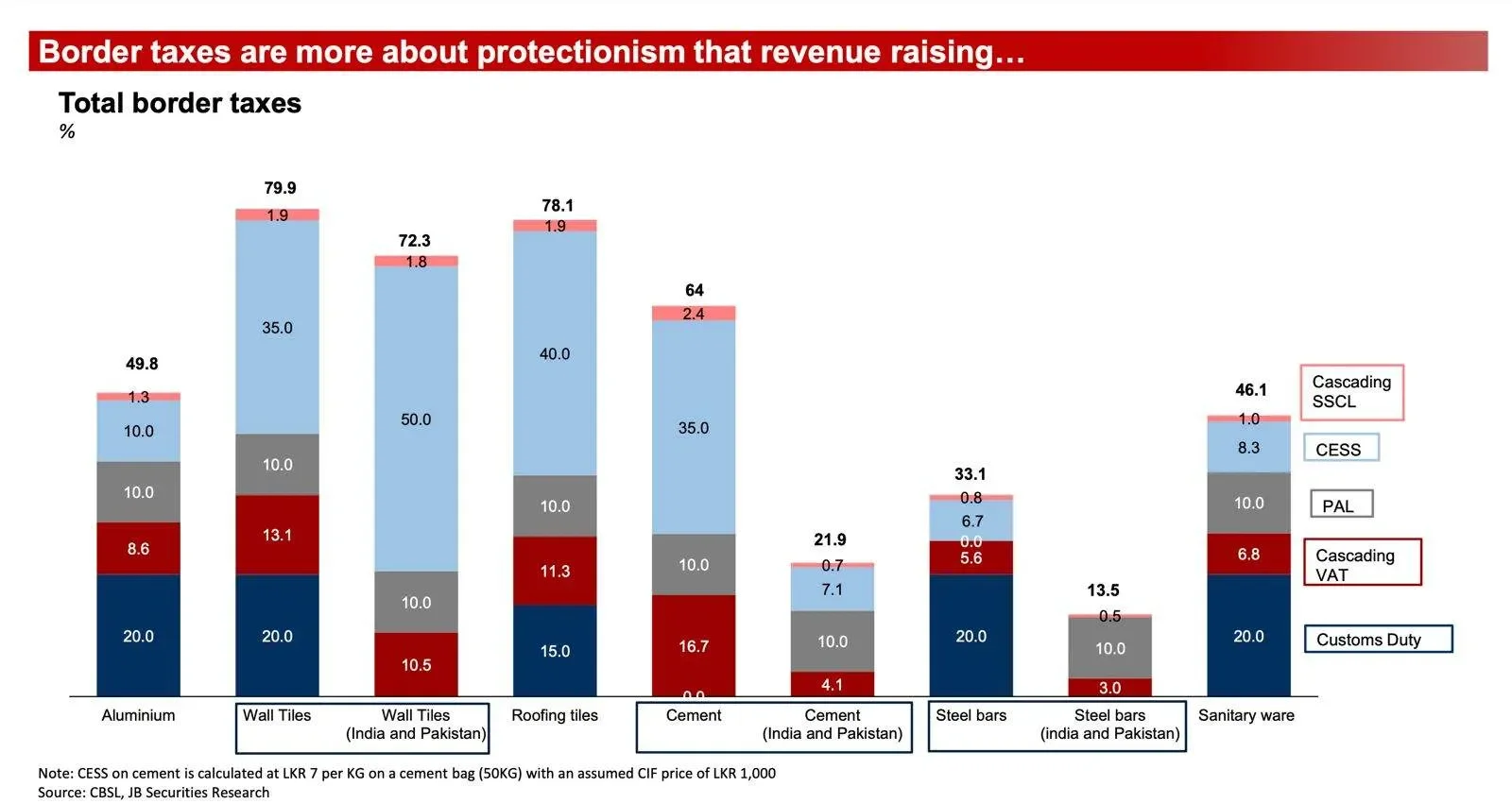
Sri Lanka’s cost of construction is higher than the region. Worse, the tariff rates on basic construction materials are so high that one can only describe them as inhumane. Housing is a basic need, especially in a disaster. Yet we continue to push up prices through taxes and para-tariffs that make rebuilding unnecessarily expensive for families and for the State.

Consider just a few examples. The total tariffs on steel bars is 33%. The total tariff for cement is 64%. Tariffs on wall tiles are 80%. Sanitaryware is 46%. Aluminium is about 50%. When these numbers sit on top of a massive rebuilding effort, it becomes obvious that a large share of what the Government allocates for construction-related rebuilding ends up as taxes and para-tariffs embedded in prices.

Some may argue that these tariffs help raise revenue to redistribute to cyclone-affected people. But the reality is different. Many of these tariffs are not designed primarily as revenue measures. They are designed to block competition.

Just think about it: why would anyone import when there is an 80% tariff rate? Yet in some sectors, imports still happen even at such rates, because even after paying the tariff, the imported product is cheaper than some local items protected behind these same barriers.

That should tell us something uncomfortable. If the Government does not reduce construction-related tariffs, a significant portion of ‘relief’ becomes indirect support for unproductive, protected businesses. In other words, the country attempts to rebuild after a disaster while keeping policies that quietly inflate the bill and reward rent-seeking.

During the crisis, there was a powerful story that Welikada Prison inmates contributed one meal for those affected. Even prisoners were willing to compromise. Now imagine, at the same time, the State maintaining a policy environment that creates room for excessive profits for protected sectors in one of the worst crises Sri Lanka has faced. That is not just bad economics. It is morally indefensible. It will not pass the test of any moral compass.

There is also an international dimension that the Government cannot keep dodging. The World Trade Organization (WTO) does not permit customs duty in excess of 30%. Sri Lanka imposes the Ports and Airports Development Levy, the Commodity Export Subsidy Scheme (CESS), Value-Added Tax (VAT), and Social Security Contribution Levy (SSCL), all of which have a cascading impact.

These layers are used to find loopholes in WTO guidelines, but the economic outcome is simple: higher prices, lower competitiveness, and a heavier burden on citizens at the worst possible time.

So the question of whether the Government is willing to change tariffs on construction is not just a test of the influence of certain rent seekers. It is a test of common sense and a test of our humanity. If we are serious about rebuilding after the cyclone, the Government must remove these additional tariffs and bring the cost of construction down for all those affected.

If we fail, we will not only fail families trying to rebuild homes. We will fail as a nation trying to recover with dignity.

A turning point for a more resilient economy

By Dhananath Fernando

What Sri Lanka faced with Cyclone Ditwah is unprecedented. The loss of human lives and the damage to homes, roads, and livelihoods cannot be captured in a single-rupee figure.

There is very little value in the blame game now. The only useful response is to ask how we can build better, not simply build back. Our strategy has to be better than before.

This is not easy. We are coming out of a painful debt restructuring and a severe economic crisis.

The first step is a decision. If we aim only to put things back to where they were, we will almost certainly fail. If we decide to build better, we must accept that the main bottleneck will not be money alone. It will be the way the State works.

Governments can find money. Multilateral agencies and friendly countries can support us. But delays come from bureaucracy and procedures.

After the tsunami, Sri Lanka had more than enough funds on paper. The real problem was spending it on time. Files moved slowly, approvals were stuck, and people waited.

Transparency and good governance are essential. Yet too many layers, too many signatures, and too much fear of taking a decision can cause more harm than good.

Four pillars

To avoid repeating the same mistake, we need four pillars to work together.

The first is the strategic layer, led by the President and the Cabinet. They must set clear priorities and identify the main areas for rebuilding. Roads, bridges, schools, hospitals, tanks, and other public infrastructure that are critical for mobility, education, health, and agriculture need immediate attention. This is a macro-level decision. The Government must say clearly which districts, which sectors, and which projects are first in line and publish that list.

The second is the Treasury and finance layer. This is where funds must be released quickly and predictably. The good news is that in the first 11 months of 2025, revenue performance has been better than expected. That gives some room. But the key is not only how much money we allocate. It is how fast we transfer it to the agencies that can actually spend it. Districts that are hardest hit must get advance allocations linked to the priorities decided at the top, with simple formulas and simple reporting.

The third is the operational layer. Here the district and divisional secretariats, provincial authorities, and local councils are in the front line. Their spending limits need to be raised for emergency work. Their procedures to call bids for urgent repairs must be simplified. If we wait for a central mechanism in Colombo to clear every road, tank, dam, culvert, and minor bridge, recovery will drag on for years. Many of these tasks can and should be done at the local level, with standard price schedules, simple contracts, and strict but reasonable timelines.

The fourth is the governance and transparency layer. Faster spending does not mean a free-for-all. The Auditor General’s Department should be involved from the start, not at the very end only to write a critical report. Clear guidelines on emergency procurement and reconstruction can be issued for all district and divisional secretariats so they act as one team. Major bridges and A-class roads can remain under central ministries. But cleaning debris, repairing rural roads, restoring minor irrigation, and helping affected households should be decentralised.

The work of rebuilding

To make this work we have to trust our officials, empower them, and hold them accountable. If the State worries about capacity, we can invite professional bodies such as the Institute of Chartered Accountants of Sri Lanka and engineers’ associations to support audit, monitoring, and technical approval. This will improve both speed and credibility.

Support to affected households should also be as close to the ground as possible. Cash transfers, vouchers, or material assistance should be handled at local level using existing social protection lists, with space to update them after proper verification. People who have lost everything should not have to travel from office to office, or from district to Colombo, to prove that they are victims.

If any regulatory changes are needed to relax procedures in the short term, the Government has the numbers in Parliament to act. Emergency regulations and amendments with sunset clauses can be used for a limited period, with clear publication of all contracts and major payments.

At the same time, the Government must revisit the 2026 Budget. Some spending planned for less urgent areas will need to be repurposed towards rebuilding and repair. This will also mean a conversation with the International Monetary Fund (IMF). Some targets and benchmarks may have to be adjusted so that the revised budget remains consistent with the programme while giving space for essential recovery spending.

In the medium and long term, ‘building better’ must be tied to structural reforms. Ditwah has shown again how vulnerable our people are. Food tariffs that keep prices high hurt poor households during and after a disaster. Construction sector tariffs on cement, steel, tiles, and fittings raise the cost of rebuilding houses, bridges, and factories. Land and labour market rigidities slow investment and job creation when people need work the most. State-owned enterprises that control key inputs like electricity and fuel must also be part of a serious reform agenda.

Usually, a government has a reform window of three to six months after coming to power. A crisis of this scale opens another window of three to six months. People understand that change is necessary when their lives and livelihoods are at stake. If the Government chooses to lead, Ditwah can be not only a tragedy but also a turning point for building a stronger, fairer, and more resilient Sri Lankan economy.

The economics of floods we keep forgetting

By Dhananath Fernando

Natural disasters and national emergencies do not arrive every day. But when they do, if we are unprepared, the damage can shape our lives for years. As floods intensify across the country, we hope our readers and all Sri Lankans are safe. Our thoughts are with everyone affected.

A familiar pattern repeats during every crisis. In the middle of the emergency, there is no shortage of commentary, ideas, and expert panels. Yet once the water recedes, our attention recedes with it. Reports gather dust, committees dissolve, and we wait for the next disaster to teach the same lesson again.

But natural disasters have an economic side that we rarely discuss. Managing them is not a simple Government-versus-private sector debate. It requires everyone – State, private sector, communities, and individuals – to play a part.

The first pillar is identification and prevention. This lies mainly with the Government. Investing public funds in proper disaster management systems is essential, not optional. A modern system must include accurate weather forecasting, river and reservoir monitoring, rapid communication tools, and tsunami alert networks.

With climate change intensifying extreme weather, Sri Lanka must prioritise floods, landslides, and coastal hazards. The encouraging news is that many global partners stand ready to help, if we can present a credible plan and maintain continuity in implementation.

The second pillar is understanding risk and preparing people. After the 2004 tsunami, Sri Lanka built some capacity: drills, awareness programmes, and clear guidance in risk zones. These efforts are not perfect, but they show we can act when we learn from tragedy.

We now need the same commitment for floods, landslides, and droughts. Risk maps must be updated regularly, zoning laws enforced, and evacuation routes rehearsed. But identifying risks alone does not guarantee safety.

The Koslanda landslide is a painful example. The area had been identified as high risk and equipment had been issued, yet the system failed. Telling people to evacuate is easy. Convincing them is difficult. Many fear theft, losing their valuables, or damage to their homes.

In every major flood near the Kelani River, we see hesitancy to leave, even when the danger is clear. For a family with limited assets, their home is everything. Walking away without assurance of security feels impossible.

This is where community-level solutions matter. Secure storage points, community-managed watch systems, and support from local Police can give people confidence to evacuate early. Temporary safe locations must be identified, tested, and publicised long before an emergency. These systems do not require large budgets, only coordination and trust.

The third pillar is insurance as a financial buffer. In Sri Lanka, the first responders are the armed forces, Government officers, and volunteer groups. Their role is essential. But in a well-prepared system, insurance absorbs a significant part of the financial loss.

Insurance is not only about payouts. When insurers assess a property, they analyse its disaster risk. This creates clear price signals. High-risk zones face higher premiums, discouraging settlement in vulnerable areas. Better data allows insurers to price risk accurately, which encourages investment in monitoring and early-warning systems. It creates a virtuous cycle where good information has real economic value.

Sri Lanka’s insurance penetration is low, and it is unrealistic to expect every household to be covered. But even partial coverage builds resilience. Insurance spreads risk, supports recovery, and funds the very information systems that reduce future losses.

Disaster management, the rule of law, and proper regulation are core responsibilities of the State. When government performs well here, the whole country benefits. Unfortunately, over successive administrations, the State has often done what it should not do, and failed to do what only it can do. Unlike many other areas of governance, disaster management has no private sector substitute.

Ignoring the economic logic of disaster preparedness is itself a silent disaster. If we continue to treat floods and landslides merely as humanitarian events, and not as recurring economic shocks that can be managed and reduced, we will keep paying the price in lives, in property, and in opportunities lost.

Disasters may be natural. Their impact, however, is shaped by the choices we make long before the rains begin.