
Infrastructure

When relief meets reality

By Dhananath Fernando
  • Sri Lanka’s construction cost problem

The Government has announced Rs. 5 million for houses completely destroyed by Cyclone Ditwah and up to Rs. 2.5 million for houses that are partly damaged. Bridges and a lot of civil infrastructure have been damaged.

On the other side, the Government has announced a Rs. 200,000 initial relief package for Micro, Small, and Medium-sized Enterprises (MSMEs). The Central Bank of Sri Lanka has also requested Licensed Commercial Banks (LCBs) to offer a loan moratorium of 3–6 months for affected businesses.

These measures are meant to help people rebuild their lives and restart the economy. But there is one vital reform missing from the response. If we ignore it, even well-intended relief will deliver less than promised.

That reform is lowering the cost of construction.

This crisis has created a rebuilding requirement at a scale that no one can ignore. As per released data, about 5,000 houses have been completely destroyed and about 87,000 houses are partly damaged. More than 40 bridges have been affected, and flood waters have reached more than 720,000 buildings, including schools and hospitals.

The damage goes far beyond housing and bridges. A further 1,777 tanks, 483 dams, 1,936 canals, and 328 agricultural roads under the Department of Agriculture have been damaged.

You do not need to be an economist or a financial analyst to understand what this means. Rebuilding will require an enormous volume of construction work. Even the smallest repair job requires materials. A partially damaged house may need new switches, repainting, replacement tiles, and electrical wiring checks after floods. Public buildings will need similar work, while roads, canals, tanks, and dams will need steel, concrete, and heavy repair inputs.

This is precisely why Sri Lanka’s cost of construction becomes the real litmus test of our crisis response.

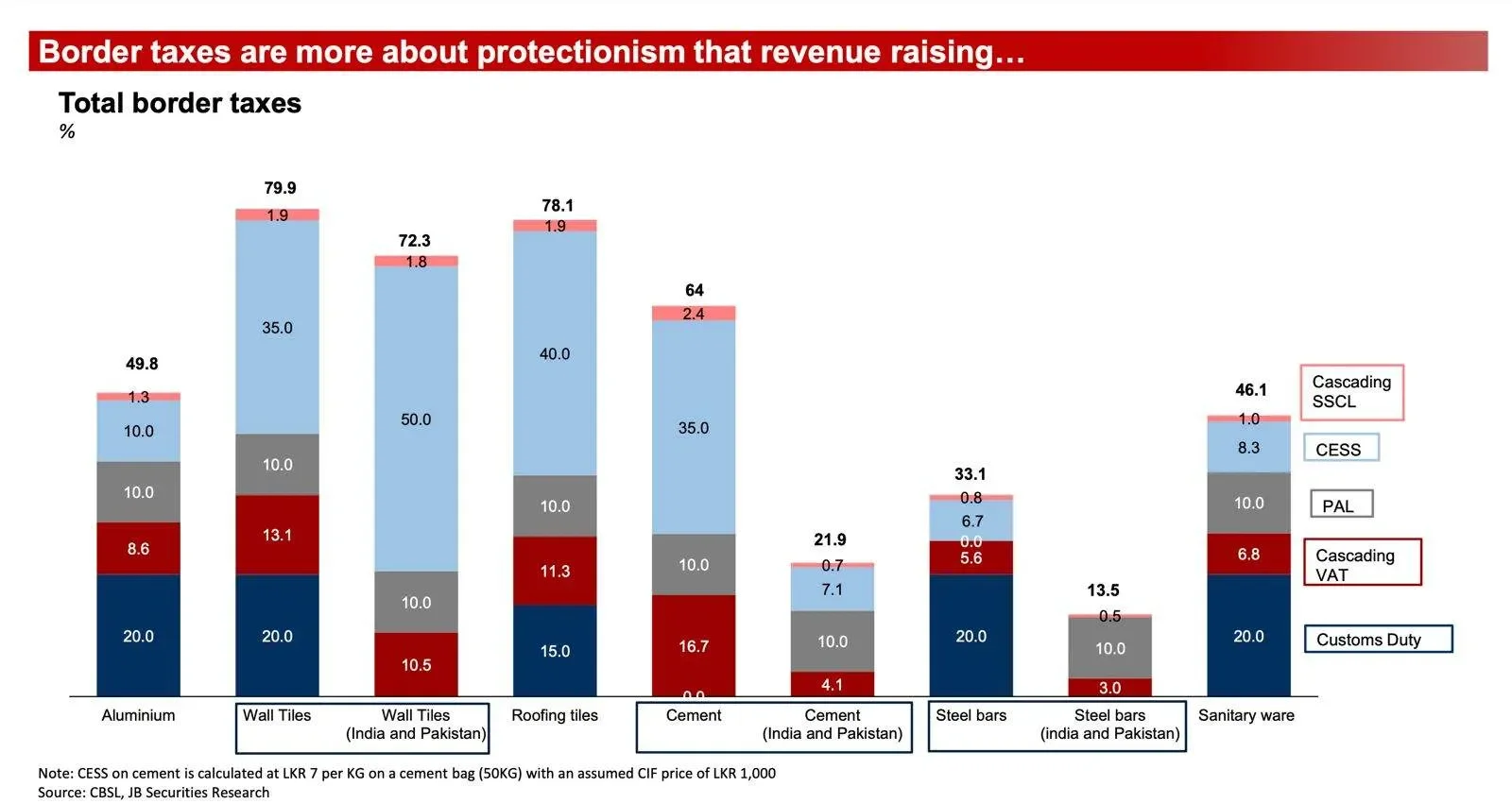
Sri Lanka’s cost of construction is higher than the region. Worse, the tariff rates on basic construction materials are so high that one can only describe them as inhumane. Housing is a basic need, especially in a disaster. Yet we continue to push up prices through taxes and para-tariffs that make rebuilding unnecessarily expensive for families and for the State.

Consider just a few examples. The total tariffs on steel bars is 33%. The total tariff for cement is 64%. Tariffs on wall tiles are 80%. Sanitaryware is 46%. Aluminium is about 50%. When these numbers sit on top of a massive rebuilding effort, it becomes obvious that a large share of what the Government allocates for construction-related rebuilding ends up as taxes and para-tariffs embedded in prices.

Some may argue that these tariffs help raise revenue to redistribute to cyclone-affected people. But the reality is different. Many of these tariffs are not designed primarily as revenue measures. They are designed to block competition.

Just think about it: why would anyone import when there is an 80% tariff rate? Yet in some sectors, imports still happen even at such rates, because even after paying the tariff, the imported product is cheaper than some local items protected behind these same barriers.

That should tell us something uncomfortable. If the Government does not reduce construction-related tariffs, a significant portion of ‘relief’ becomes indirect support for unproductive, protected businesses. In other words, the country attempts to rebuild after a disaster while keeping policies that quietly inflate the bill and reward rent-seeking.

During the crisis, there was a powerful story that Welikada Prison inmates contributed one meal for those affected. Even prisoners were willing to compromise. Now imagine, at the same time, the State maintaining a policy environment that creates room for excessive profits for protected sectors in one of the worst crises Sri Lanka has faced. That is not just bad economics. It is morally indefensible. It will not pass the test of any moral compass.

There is also an international dimension that the Government cannot keep dodging. The World Trade Organization (WTO) does not permit customs duty in excess of 30%. Sri Lanka imposes the Ports and Airports Development Levy, the Commodity Export Subsidy Scheme (CESS), Value-Added Tax (VAT), and Social Security Contribution Levy (SSCL), all of which have a cascading impact.

These layers are used to find loopholes in WTO guidelines, but the economic outcome is simple: higher prices, lower competitiveness, and a heavier burden on citizens at the worst possible time.

So the question of whether the Government is willing to change tariffs on construction is not just a test of the influence of certain rent seekers. It is a test of common sense and a test of our humanity. If we are serious about rebuilding after the cyclone, the Government must remove these additional tariffs and bring the cost of construction down for all those affected.

If we fail, we will not only fail families trying to rebuild homes. We will fail as a nation trying to recover with dignity.

Electricity reforms at risk

By Dhananath Fernando

Originally appeared on the Morning

  • Don’t let amendments derail investment and progress

A new conversation is unfolding around electricity sector reforms in Sri Lanka. After years of debate, there has been broad political consensus on two core principles:

  • The urgent need for investment in the sector

  • The structural reforms necessary to attract that investment – specifically, the unbundling of generation, transmission, and distribution

The logic is simple: generation, transmission, and distribution are fundamentally different businesses, each with unique asset types, risk profiles, and operational needs. Only by separating them can we improve transparency, increase efficiency, and create space for private capital to flow into each segment.

While there was promising alignment in this direction, the latest developments suggest we may be reversing course, creating uncertainty for investors and risking long-term progress.

The new amendments: One step forward, two steps back?

The 2024 Sri Lanka Electricity Act made an important move by further unbundling generation by source – hydro, coal, thermal, and wind – recognising that each comes with distinct technologies, operating models, and investment requirements. For instance, managing a coal plant requires an entirely different skillset and infrastructure than managing a wind farm.

However, the proposed new amendments roll back this approach by consolidating all generation entities under a single holding company. This re-centralisation undermines the very rationale for unbundling in the first place. It introduces operational inefficiencies and reduces cost transparency, making it harder for regulators to set fair and efficient tariffs.

Even more concerning, the amendments propose that the Government retain 100% ownership – effectively shutting the door on private capital.

The real cost of Govt.-only investment

If the Government intends to invest in electricity infrastructure, it must do so by borrowing through Treasury bills or bonds, adding to the national debt and worsening our already precarious debt-to-GDP ratio. Credit rating agencies will take note, likely downgrading Sri Lanka’s sovereign rating.

More critically, the cost of capital for the Government is around 9% – a prohibitively high rate for infrastructure investment. Every rupee spent here is a rupee less for health, education, or social safety nets.

Let’s not forget: in 2023, the Government injected Rs. 126 billion into the Ceylon Electricity Board (CEB). In 2024, the CEB posted a Rs. 144 billion profit, but only because of that prior cash infusion. Continued State dominance in investment only perpetuates a cycle of dependency.

Why private capital is not forthcoming

Even borrowing from domestic banks is becoming difficult. The Central Bank has capped bank exposure to the electricity sector at 25% of Tier 1 capital (and 55% in aggregate), with strict timelines to reduce this by 2030. These prudential limits are vital for financial system stability, but they also restrict the flow of private lending to the sector.

Another common route – borrowing with a Treasury guarantee – has also become costlier. Under the 2024 Public Debt Management Act, every Treasury guarantee must now carry a risk-based premium. When the CEB explored borrowing $ 50 million from the Asian Infrastructure Investment Bank, the risk premium alone was 4.8%, pushing the total cost of borrowing even higher.

Grid capacity and the renewable energy paradox

None of these challenges exist in isolation. Without urgent investment in transmission and distribution, additional solar or wind generation is meaningless – the grid simply cannot handle the load.

In a recent discussion with Advocata Institute, International Solar Alliance Director General Ashish Khanna emphasised the critical need for grid upgrades and private sector participation. Even Sri Lanka’s Prime Minister participated in early dialogues on a country partnership framework to this effect.

Yet, the new amendments – with their insistence on 100% State ownership and a two-year delay in further unbundling – send precisely the wrong signal. Investors see this as a red flag, not a green light.

Global implications and geopolitical costs

The concerns are not limited to domestic stakeholders. Leading development partners – including the World Bank, Japan International Cooperation Agency (JICA), and Asian Development Bank – have already expressed reservations about the proposed amendments.

We must remember that Japan is a key member of the Official Creditor Committee and one of Sri Lanka’s most consistent development partners. Our multilateral creditors hold a large portion of Sri Lanka’s foreign debt. Their support will be critical not only for the power sector, but for our entire economic recovery as well.

At a time when we are exploring regional grid connectivity and aspiring to meet 70% of energy demand through renewables, these regressive amendments risk turning vision into mere wishful thinking.

The electricity sector does not operate in a vacuum. It is tied to our economic recovery, fiscal health, investment climate, and geopolitical standing. The proposed amendments, while perhaps well-intentioned, threaten to undermine years of consensus-building and policy progress.

We urge policymakers to reconsider. The reforms must be guided not by bureaucratic convenience or outdated control models, but by pragmatism, transparency, and investor confidence. If we fail to course correct now, the cost won’t just be measured in kilowatt hours – it will be measured in lost opportunities, rising debt, and a future dimmed by indecision

Overcoming structural barriers to achieve export growth

By Dhananath Fernando

Originally appeared on the Morning

Sri Lanka has been trying to solve its export puzzle for a long time, with a new export target set at $ 36 billion by 2030. 

As of November 2024, the country had approximately $ 11.6 billion in merchandise exports and $ 3.1 billion in services exports, totalling around $ 16 billion. Over the next five years, exports are expected to double, requiring an annual compounded growth rate of approximately 14%.

Many policymakers define Sri Lanka’s export challenge as a lack of diversity in the export basket, limited access to international markets, or insufficient value addition. While these factors are valid, the core issue is that Sri Lanka is not competitive. 

This lack of competitiveness is not due to an inherent incapability but rather the result of policies and structural inefficiencies that have rendered the country uncompetitive. Often, this fundamental issue is misdiagnosed as a lack of targeting, leading to constant shifts in focus towards different sectors or products every three years without addressing the root causes of uncompetitiveness.

Addressing competitiveness 

Addressing public policy challenges is inherently complex, as solutions impact various stakeholders, making change management difficult. 

One of the primary mistakes governments and policymakers make is attempting to target specific sectors for export growth. Instead, focus should be placed on sectors where Sri Lanka has a competitive advantage. 

The only way to determine competitiveness is through practical application – by actively engaging in export activities rather than relying solely on theoretical projections. In the modern economy, competitive advantage extends beyond specific products to elements such as design, lead times, and supply chain efficiencies – factors that may not be immediately evident to a single decision-maker.

The global trade landscape is shifting from finished products to parts and components within value chains. However, when the Government plans around traditional industry categories, it often overlooks this evolving reality. 

For any product or component to be manufactured competitively, key resources – land, labour, capital, and entrepreneurship – must be accessible and efficient. Sri Lanka’s export underperformance, poor diversification, and lack of market access stem largely from bottlenecks in these factor markets. 

When essential factors of production do not function effectively, innovation stagnates, restricting export diversification and the development of components for various products, including value-added goods. 

If businesses can achieve higher margins through value addition, they would naturally do so. If they choose to export raw materials instead, it suggests the presence of barriers, misaligned incentives, or a competitive disadvantage in value-added production.

To illustrate this, consider the hypothetical case of exporting iron ore. A country rich in iron ore but burdened with high energy costs will find exporting raw ore more advantageous than converting it into steel. Conversely, a country with lower energy costs, proximity to industrial zones, and high steel demand will have a competitive advantage in steel production. 

This principle applies across all industries – cost structures, infrastructure, and resource availability dictate competitiveness.

A complex problem   

Compounding the problem is the interconnected nature of these issues. Solving one aspect alone will not fix the broader export challenge. 

In Sri Lanka’s case, high energy costs place any export industry at a price disadvantage. Subsidising energy is often proposed as a solution, but ultimately, taxpayers bear the cost. 

Similarly, labour costs remain high due to regulatory barriers. For instance, if a major tech company wanted to relocate its regional office to Sri Lanka, the country lacks an adequate pool of IT graduates. Addressing this would require either allowing foreign professionals to work in Sri Lanka or significantly upskilling the local workforce.

Export development also requires capital and entrepreneurship. Capital can be acquired through debt or equity, but debt financing is currently not a viable option for Sri Lanka. Equity investment remains possible, but attracting such investment necessitates improving Sri Lanka’s investment climate. This highlights the urgent need for reforms within the Board of Investment (BOI). 

Additionally, facilitating foreign entrepreneurs’ ability to enter Sri Lanka – through streamlined visa processes and work permits – is essential. The Department of Immigration and Emigration must play a role in this.

For capital to flow, investors require developed lands with ready-to-use infrastructure, minimising lead time and operational delays. Without addressing these factor market inefficiencies, traditional export strategies will continue to fail. The global export market is now highly fragmented, with the future lying in the production of components and participation in global value chains rather than focusing solely on finished products.

Ultimately, the export sector is too complex for any single individual or institution to plan entirely. It is an organic, competitive field where businesses strive to add value through quality and cost efficiency. 

The role of the Government should be to facilitate this process by removing barriers and creating an environment conducive to competition. If the right conditions are in place, export growth will naturally follow and Sri Lanka will achieve its ambitious targets.

Invest to progress, not to regress: Bridging the infrastructure gaps in Sri Lanka

Originally appeared on the Daily FT, the Morning, Lanka Business Online, Groundviews, Ada Derana Biz English

By Tiffahny Hoole and Janani Wanigaratne

Sri Lanka is going through a crisis of a magnitude that has never been witnessed in its economic history. The country is in disarray as people wait in lines to purchase essentials. Official reserve assets have plummeted to a $ 1,920 (1) million by May this year and the debt to GDP ratio has reached an all time high of 104.6% by 2021. (2) The country is struggling to meet its domestic needs while having fallen into a debt default for the first time in its history. Why did Sri Lanka’s debt obligations escalate to the point of an economic crisis? Debt taken on to finance unproductive infrastructure is a part of the problem. (Debt was also taken to finance recurring expenditure including interest on past debts and subsidies to SOEs). 

Professor Amal Kumarage, one of the leading experts on transport infrastructure in Sri Lanka says, “Sri Lanka’s inability to service debts is a clear indication of inefficient infrastructure investment. Over 50% of the foreign loans in the past decade were for different transport infrastructure projects that have not delivered the anticipated economic outcomes. The professionals who promoted unfound optimism in economic analysis of these projects to please the political masters must come forward and accept their responsibility for contributing to this crisis.”

Since the end of the civil war, there has been a longstanding commitment towards developing large-scale infrastructure projects (See table 0.1). (3)In the first eight months of 2020, Sri Lanka’s public expenditure on infrastructure development amounted to Rs. 98 billion. (4) The Ministry of Finance aims to maintain public investment at an average of 5-6% of the GDP per annum till 2025. (5) In terms of performance however Sri Lanka infrastructure falls short – it ranked 61 out of 141 under the overall infrastructure performance indicator by the ‘Global Competitiveness Report 2019’. (6)  

Sri Lanka does have an infrastructure gap but it must invest in the right projects. The World Bank (2014) reports that Sri Lanka still needed $ 36 billion worth of investments to close its infrastructure gap, which amounts to 40.5% of the GDP in 2018. (7) To avoid wasteful investments, Sri Lanka requires a fact-based project selection process and an optimised operation and maintenance system for existing large-scale infrastructure projects to close this gap.(8) This would also reduce the country’s spending significantly. Among the numerous factors that fuelled this crisis, lavish investments in infrastructure of limited benefits seems to have played a crucial role. 

Useful infrastructure projects should enable the best return to public investment with higher efficiency, increased safety and minimal environmental damage. It should also have a positive spillover effect which may range from generating employment and increased foreign direct investment to improved tax revenue.

How are large-scale infrastructure projects financed? 

In an effort to close the gap between existing and required infrastructure, the Government resorted to foreign loans. Foreign borrowing amounted to $ 1,710 million in the first eight months of 2021.(10) This accounts to an increase of 16% of foreign financing disbursement in comparison to the previous year.(11) Sri Lanka’s disbursement commitments consist of loans from multilateral agencies, such as the World Bank and the Asian Development Bank, and bilateral partners including China, Japan and India(.12) 

With the provision of foreign loans to finance large-scale infrastructure projects among numerous other borrowings, Sri Lanka’s debt to GDP ratio has reached 104.6% in 2021. Based on the high foreign loans obtained, in conjunction to Sri Lanka’s current economic status, there seems to be a strong indication that large-scale infrastructure projects severely indebted the State. If so, where did Sri Lanka go wrong? 


Lack of preliminary procedure 

Taking on multi-million dollar investment projects is a complex task. Large infrastructure projects need to pass the test of utility in order to serve long-term demands before public money is spent.(13)

This means, thorough scrutiny is mandatory to enable the gains of large-scale infrastructure to be fully realised. This would include looking at the interest rates, grace periods and maturity periods provided. It also requires a comprehensive understanding of the type of loan provided. These can be achieved through conducting proper feasibility studies and risk assessments which will shed light on the project’s potential to service debt and its sustainability in the long run. For instance, loans obtained through multilateral agencies such as the World Bank and Asian Development Bank require a competitive bidding process to select a contractor. (14) In contrast, projects funded by bilateral agencies are through tied loans.(15) This means that bidding is limited to contractors from the lender’s country.916) During the period of 2005-2018, 28 out of 35 high value bilateral loans were procured without a competitive bidding process.(17) The inability to gauge all available contractors at competitive rates to construct large-infrastructure potentially results in poor quality infrastructure at a cost of very high prices.(18) 

The National Procurement Agency was a statutory body that handled competitive public procurement. However, right before the height of Sri Lanka’s investment spree in 2008, it was removed. In lieu of this, the Standing Cabinet Approved Review Committee (SCARC) was set up in 2010 to approve projects without public tendering or parliamentary approval. This creates additional concerns over the commercial viability of the project approved.(19)

Take for instance the Colombo Port City. Soon after SCARC approval, it was heavily criticised on the claims that its Environmental Assessment Impact was compromised. Further fuelled by the opposition from the fishing community, the project was temporarily suspended. The interim review of these concerns cost the Government $ 143 million as compensation. If proper procedures were followed, these costs could have been circumvented.(20) 

Public infrastructure or political infrastructure? 

Investments in large and complex infrastructure projects have also been a fertile ground for corruption, thereby increasing the risk of creating ‘White Elephants’(.21) Rather than considering the economic value of obtaining loans from foreign lenders, governments utilise large-infrastructure projects as a tool to win the votes from the public. In the event such projects are not completed within their term, successive governments are inclined to halt its operations.(22) This leads to unconsummated, poorly built infrastructure with limited benefits to the people.

Gaps in information: Calling for increased transparency

An effective mechanism of ensuring public money is spent to the best of its ability is to increase the access to information. There is a significant gap in data available to the public on large-infrastructure projects in Sri Lanka. For instance, a comprehensive breakdown of the loan amount, its repayment and interest rates are inconsistently provided in the Ministry of Finance Annual Reports. Selected projects financed through bilateral agencies have been completely omitted. Furthermore, information pertaining to the project’s appraisal and performance is not publicly available. This hampers the ability for the public to conduct an analysis on the investment made. The public must relegate to submitting Right to Information applications to the relevant implementing agency. However, comprehensive responses are rare.  Nevertheless, investment on large infrastructure is a necessity. It has been assessed that 1 dollar worth of infrastructure investment can raise GDP by 20 cents in the long run.(23) Furthermore, infrastructure development can facilitate trade and foreign direct investment. 

In order to ensure that the benefits of each and every infrastructure project undertaken is fully realised, it is vital to set up a comprehensive framework with active public policy, transparent and competitive procurement, proper evaluation and an in-depth financing structure.(24) Hard infrastructure should be accompanied by soft components such as policies and regulations in order to facilitate efficient performance.(25) Therefore, a long-term plan for national infrastructure that is publicly available has the potential to pivot the feeding ground of corruption to the stepping stone of development. 

Refernces:

1CBSL

2CBSL

3
https://www.ips.lk/talkingeconomics/wp-content/uploads/2012/09/pb10_Infrastructure-Challenges.pdf

4
https://www.treasury.gov.lk/api/file/0d77beee-4e42-478b-9089-7f09be23a0e0

5
https://www.treasury.gov.lk/api/file/0d77beee-4e42-478b-9089-7f09be23a0e0

6
https://www.cbsl.gov.lk/sites/default/files/cbslweb_documents/publications/annual_report/2020/en/13_Box_02.pdf

7Chinese Investment and the BRI in Sri Lanka

8
https://www.mckinsey.com/business-functions/operations/our-insights/bridging-infrastructure-gaps-has-the-world-made-progress

9CBSL Annual reports from various years

10
https://www.treasury.gov.lk/api/file/16e9c6ec-7a13-4220-a8a7-1427c5d14785

11
http://www.erd.gov.lk/index.php?option=com_content&view=article&id=94&Itemid=216&lang=en

12
http://www.erd.gov.lk/index.php?option=com_content&view=article&id=94&Itemid=216&lang=en

13
https://www.echelon.lk/a-circus-of-white-elephants/

14
https://www.veriteresearch.org/wp-content/uploads/2021/07/VR_Eng_RR_Feb2021_Opportunities-to-Protect-Public-Interest-in-Public-Infrastructure-1.pdf

15
https://www.veriteresearch.org/wp-content/uploads/2021/07/VR_Eng_RR_Feb2021_Opportunities-to-Protect-Public-Interest-in-Public-Infrastructure-1.pdf

16ibid

17ibid

18Key Informant Interview

19‘Locked in’ to China: The Colombo Port City Project

20‘Locked in’ to China: The Colombo Port City Project

21
https://www.veriteresearch.org/wp-content/uploads/2021/07/VR_Eng_RR_Feb2021_Opportunities-to-Protect-Public-Interest-in-Public-Infrastructure-1.pdf

22
https://www.chathamhouse.org/sites/default/files/CHHJ8010-Sri-Lanka-RP-WEB-200324.pdf

23
https://www.mckinsey.com/industries/public-and-social-sector/our-insights/four-ways-governments-can-get-the-most-out-of-their-infrastructure-projects

24
https://www.adb.org/sites/default/files/publication/177093/adbi-wp553.pdf

25
https://www.adb.org/sites/default/files/publication/29823/infrastructure-supporting-inclusive-growth.pdf

Janani Wanigaratne is a research intern at the Advocata Institute. She can be contacted at janani.advocata@gmail.com. Tiffahny Hoole is a former researcher at the Advocata Institute. She can be contacted at tiffahny.advocata@gmail.com. The Advocata Institute is an Independent Public Policy Think Tank. The opinions expressed are the authors’ own views. They may not necessarily reflect the views of the Advocata Institute.