
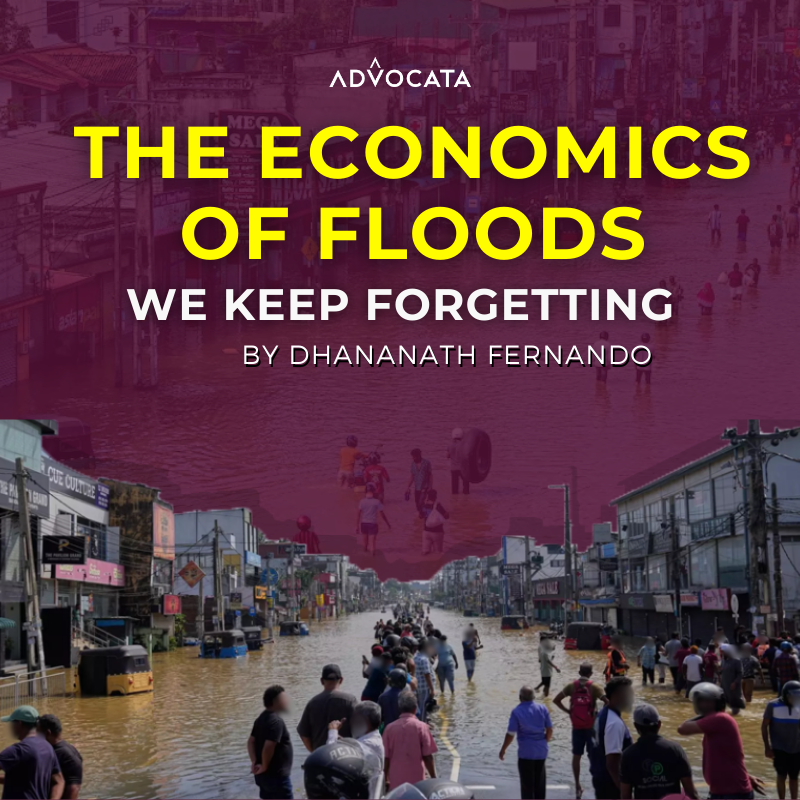
By Dhananath Fernando
Natural disasters and national emergencies do not arrive every day. But when they do, if we are unprepared, the damage can shape our lives for years. As floods intensify across the country, we hope our readers and all Sri Lankans are safe. Our thoughts are with everyone affected.
A familiar pattern repeats during every crisis. In the middle of the emergency, there is no shortage of commentary, ideas, and expert panels. Yet once the water recedes, our attention recedes with it. Reports gather dust, committees dissolve, and we wait for the next disaster to teach the same lesson again.
But natural disasters have an economic side that we rarely discuss. Managing them is not a simple Government-versus-private sector debate. It requires everyone – State, private sector, communities, and individuals – to play a part.
The first pillar is identification and prevention. This lies mainly with the Government. Investing public funds in proper disaster management systems is essential, not optional. A modern system must include accurate weather forecasting, river and reservoir monitoring, rapid communication tools, and tsunami alert networks.
With climate change intensifying extreme weather, Sri Lanka must prioritise floods, landslides, and coastal hazards. The encouraging news is that many global partners stand ready to help, if we can present a credible plan and maintain continuity in implementation.
The second pillar is understanding risk and preparing people. After the 2004 tsunami, Sri Lanka built some capacity: drills, awareness programmes, and clear guidance in risk zones. These efforts are not perfect, but they show we can act when we learn from tragedy.
We now need the same commitment for floods, landslides, and droughts. Risk maps must be updated regularly, zoning laws enforced, and evacuation routes rehearsed. But identifying risks alone does not guarantee safety.
The Koslanda landslide is a painful example. The area had been identified as high risk and equipment had been issued, yet the system failed. Telling people to evacuate is easy. Convincing them is difficult. Many fear theft, losing their valuables, or damage to their homes.
In every major flood near the Kelani River, we see hesitancy to leave, even when the danger is clear. For a family with limited assets, their home is everything. Walking away without assurance of security feels impossible.
This is where community-level solutions matter. Secure storage points, community-managed watch systems, and support from local Police can give people confidence to evacuate early. Temporary safe locations must be identified, tested, and publicised long before an emergency. These systems do not require large budgets, only coordination and trust.
The third pillar is insurance as a financial buffer. In Sri Lanka, the first responders are the armed forces, Government officers, and volunteer groups. Their role is essential. But in a well-prepared system, insurance absorbs a significant part of the financial loss.
Insurance is not only about payouts. When insurers assess a property, they analyse its disaster risk. This creates clear price signals. High-risk zones face higher premiums, discouraging settlement in vulnerable areas. Better data allows insurers to price risk accurately, which encourages investment in monitoring and early-warning systems. It creates a virtuous cycle where good information has real economic value.
Sri Lanka’s insurance penetration is low, and it is unrealistic to expect every household to be covered. But even partial coverage builds resilience. Insurance spreads risk, supports recovery, and funds the very information systems that reduce future losses.
Disaster management, the rule of law, and proper regulation are core responsibilities of the State. When government performs well here, the whole country benefits. Unfortunately, over successive administrations, the State has often done what it should not do, and failed to do what only it can do. Unlike many other areas of governance, disaster management has no private sector substitute.
Ignoring the economic logic of disaster preparedness is itself a silent disaster. If we continue to treat floods and landslides merely as humanitarian events, and not as recurring economic shocks that can be managed and reduced, we will keep paying the price in lives, in property, and in opportunities lost.
Disasters may be natural. Their impact, however, is shaped by the choices we make long before the rains begin.