Attracting foreign exchange: Are we on the right track?

Untitled design (1).png

In this weekly column on The Sunday Morning Business titled “The Coordination Problem”, the scholars and fellows associated with Advocata attempt to explore issues around economics, public policy, the institutions that govern them and their impact on our lives and society.

Originally appeared on The Morning


By Dhananath Fernando

What should be our mandate for the coming Sinhala and Tamil New Year? We have to be psychologically prepared to work harder and develop the ability to drive and lead in the best of times as well as the worst of times that are about to dawn on the horizon. Amidst the COVID-19 battle and a quarantined Sinhala and Tamil New Year, the recent figures by the Department of Census and Statistics indicate that our per capita GDP for the year 2019 (which is a reasonable measure to evaluate the standard of living) is at $ 3,852 per annum, a drop from $ 4,079 in 2018 (In USD terms, this is a 5.5% drop compared to 2018 and a 3.9% increase in LKR terms). In 2015, our GDP per capita was $ 3,842. In USD terms, we have pretty much slipped to where we were five years before.

Just to bring our performance into perspective, Japan’s GDP per capita is around $40,000. The standard of living in Japan is 10x as Sri Lanka. Our GDP growth rate is estimated to be at 2.3%, another 0.3% drop from the initial estimation of 2.6%. What this means is Sri Lanka will take 30 years to double our living standard if we are to move at this pace. And even then, we will be falling 5x behind Japan’s present standard of living. We are heading towards a difficult and challenging time period with a bad start. We can overcome this only by working together locally and forging partnerships globally. We have to find opportunities in this crisis and navigate by adding more value to our goods and services which the global market seeks. Our mandate in this New Year should be to be competitive, serve market opportunities, and capitalise on the limited opportunities before us. However, this is easier said than done. In this context, the decisions we make and the messages we push will determine where we are heading towards and the fate that awaits us in the not-so-distant future.

Measures by the Central Bank

It is no secret that Sri Lanka requires foreign exchange to pay back our import bills and the loans that we have taken. We import almost double what we export, hence the balance in the current account – or in common man’s term, imports exceed our exports. This trade deficit has to be narrowed, and this is the challenge. Over the years, instead of implementing the required reforms to make our exports more competitive and to close the gap, our constant strategy has been curbing imports to narrow the trade deficit. Today, we have arrived at the point of no return. With little growth in exports and debt beyond our means, the Sri Lankan taxpayer has racked up debt of about $ 16 billion payable by 2023. The Government took to implementing a futile policy of banning the importation of non-essentials including vehicles. Our rupee has depreciated nearly 70% over the past decade. On 8 April 2020, the Sri Lankan rupee passed 200 against the dollar. Given the ongoing crisis, we are left with few options to save precious foreign reserves as raising money from the market at the present risk premium is almost impossible. However, data indicates that the Central Bank continues with quantitative easing – printing money or adding more money into our financial system – which is the main reason for our currency to depreciate. On 24 February 2020, the Central Bank of Sri Lanka made a Rs. 24 billion profit transfer; on 13 March, the Central Bank injected Rs. 50 billion by buying government securities; and on 17 March, the Statutory Reserve Ratio (SRR) was brought down to 4% from 5%, which injected a further Rs. 50 billion to the Sri Lankan economy. The meaning of the statutory rate cut is that all licensed commercial banks earlier had to maintain a mandatory reserve of 5% of their total deposits with the regulator (deposit liabilities), but now have to maintain only 4%. This money will most likely be utilised towards relief measures provided by the Government. As we continuously highlighted in this column, the Yahapanala Government made the same mistake of imposing import controls and providing cash injections to the system, which resulted in the rapid depreciation of the rupee. The value of the rupee is a market function and trying to distort (it) by intervention is not advisable. In this case, with the devaluation of our rupee, the prices of food and medicine will go up, thereby increasing poverty levels.

Appealing for foreign currency deposits

On 2 April 2020, the Governor of the Central Bank appealed to domestic and international well-wishers on behalf of the Government of the Democratic Socialist Republic of Sri Lanka to deposit foreign exchange into Sri Lankan banks with an assurance that no questions would be asked on the financial trail of the funds. In the appeal, the Governor of the Central Bank mentioned that the money would be accepted without any hindrance from the Central Bank and the banking system and will be exempted from exchange control regulations and taxes for three months from 2 April 2020 onwards. At the point of writing this article, the Central Bank has not published further guidelines; only the statement by the Governor is available. However, it is of paramount importance that these measures do not impact Sri Lanka’s ratings by rating agencies as this would further erode our capacity to work with international donor agencies and financial markets. We have to be cautious not to open space for money laundering while we take decisions at this serious moment to attract more foreign currency. As a result of the serious efforts by the Central Bank of Sri Lanka, we were delisted in the grey list of the Financial Action Task Force (FATF) in October 2019. The FATF is the global policy setter on anti-money laundering and countering the financing of terrorism. A delisting from the FATF grey list is a positive indication to the market to attract quality investments which look for a credible financial system. At the same time, we have to be vigilant not to breach the code of conduct and ethical guidelines of international donor agencies, as there is a high possibility of Sri Lanka knocking on their door as a fallback option. In 2001/2002, a similar tax amnesty scheme was brought by then Minister of Finance K.N. Choksy and the proposal was reversed soon after the new Government was elected in 2004. There are no short-term solutions to mitigating long-term macro issues. Time and time again, it has been proven that curbing imports is not the solution and monetary prudence is the way to stabilise the rupee. The motivation behind these measures is understandable as our foreign exchange income is very tight, but in this new Sinhala and Tamil New Year, we must ensure the cure is not worse than the illness.

The opinions expressed are the author’s own views. They may not necessarily reflect the views of the Advocata Institute or anyone affiliated with the institute.

Sri Lanka’s weak public finances will exacerbate economic shocks from COVID-19

Covered in the Daily News and published in the Daily FT, Lanka Business Online and LMD

By Fellows of the Advocata Institute

The country will have to borrow heavily and go in for a new IMF program

Sri Lanka’s shaky public finances are about to receive another blow from the fallout of COVID-19. The most crucial aspect of a pandemic is always the human cost, but the spread of the virus has important repercussions for the economy. Studies indicate that pandemic impacts a country's economy through several channels, including the health, transportation, agricultural and tourism sectors. As borders are closed and global markets slow; trade is impacted, so exports suffer.

Sri Lanka’s already-battered tourism industry will be further hit  and the order books of some of the key exporters will suffer in the next quarter.  As international supply chains contract exports may remain constrained, even when markets reopen as components and raw materials may remain in short supply. The supply chain impact will affect even domestic producers as imported raw materials run short. Agriculture depends on imported fertiliser, pesticides, planting materials and chemicals. Local factories source raw materials, components and spare parts from overseas and may be unable to work at full capacity.   

As cashflow dries up and debts mount, many businesses will find it difficult to cope. During the global financial crisis of 2008/10, an estimated 90,000 Sri Lankans lost their jobs due to downsizing amongst manufacturing firms, especially in the apparel sector. The impact of the current crisis has the potential to be worse because unlike the financial crisis, this pandemic is not confined to advanced countries. Developing countries were affected due to the loss of export markets but their domestic markets were unaffected. This pandemic is affecting both developed and developing countries.  Daily wage-earners will see their already uncertain incomes further dampened. Small businesses will be among the hardest hit.  

This would mean that growth will slow further. The budget deficit will take a double hit from falling revenues and increased expenditure. Lower levels of activity mean lower levels of tax collection. As sales and imports decline, the collection of VAT and import taxes will decline. As business profits fall, income tax collection will fall. Meanwhile, government spending on health (from testing kits to hospital costs) and relief measures will rise in response to the pandemic. The budget deficit will thus widen and the government will need to borrow more.  Sri Lanka’s interest bill this year alone will be Rs 1 trillion.

Even if public finances were robust, this would pose a significant challenge, but Sri Lanka’s finances --  sickly to begin with -- were weakened by recent tax cuts. The fallout is difficult to estimate but a recap of the principal issues is useful to assess the available policy options.    

Sri Lanka obtained an IMF facility of US$1.5bn in June 2016. This is the 16th instance when it turned to the IMF since joining the fund in 1950 - an indication of the systemic and long-running nature of the underlying problems. The overall objective of the recent IMF programme was to “reverse a two-decade decline in tax revenues and put public finances on a sustainable medium-term footing”. The programme aimed to increase government revenue to reduce the budget deficit and therefore the public debt (as deficits fall, the need to borrow reduces). 

In the popular imagination, IMF programmes are associated with austerity: cutting government expenditure which negatively impacts social and welfare spending. The reduction in expenditure closes the budget deficit at the expense of the welfare programmes. Under the previous ‘Yahapalana’ regime, Sri Lanka did the opposite: increasing taxes to cover the deficit. Expenditure was left untouched and in fact, continued to increase.

Unfortunately, the bulk of government revenue comes through the form of consumption taxes particularly VAT, so much of the burden of increased tax fell on the general public anyway, provoking intense displeasure. Income taxes were also increased, angering the business community. The government thus succeeded in antagonising a remarkably diverse set of constituents and became exceedingly unpopular.

Public finances did improve somewhat but were never very strong. With the attacks in April 2019 things started to slip again.  The IMF review in November 2019 noted that “the fiscal targets are no longer within reach, due to the significant revenue shortfalls”.

Following the Presidential election of November 2019, the new government announced sweeping tax cuts in December. Given the unpopularity of the tax increases, responding to public frustration could hardly be faulted,  but the breadth of the cuts was astonishing. Corporate income tax was reduced from 28% to 24%,  VAT was halved from 15% to 8% with a high vat-free threshold;  withholding tax, nation building tax and economic service charge were scrapped. The objective was to kickstart a floundering economy but the cost –around a quarter of government revenues or 3-4% of GDP destabilised public finances.

On 7th February 2020, the IMF noted that: “Preliminary data indicate that the primary surplus target under the program supported by the Extended Fund Facility (EFF) was missed by a sizable margin in 2019 with a recorded deficit of 0.3 percent of GDP, due to weak revenue performance and expenditure overruns”. According to the fund, Sri Lanka’s 2020 budget deficit could rise to 7.9% of GDP, the highest since 2015. Given the pandemic,  this will look optimistic. The reported deficit for 2019 was 6.5% but according to the Ministry of Finance “the actual budget deficit for 2019 should have been over 8 per cent” as around Rs.367bn of expenditure remained unpaid and unaccounted at the year end. 

Meanwhile the rating agencies Fitch and S&P downgraded the outlook on Sri Lanka’s debt to ‘negative’ from ‘stable’.   Sri Lanka’s already wobbly public finances must now cope with the added economic shock of COVID-19. 

Dealing with the public health emergency and the associated human cost should be top of mind for policymakers. Yet clear-eyed economic thinking will be equally important and will have a direct bearing on the human cost, particularly for our society’s most vulnerable.  This is why weighing the relative costs of a lockdown or a complete curfew is important. 

The biggest headache for the government will be managing foreign debt. The Central Bank’s freshly minted medium term debt strategy is based on assumptions that no longer hold -- 5 percent GDP growth over the medium term, inflation of 5 percent and a budget deficit of 3.5 percent. With the medium term strategy in ruins can the government rollover the maturing debt? 

Gross reserves stood at US$7.9bn equivalent to 4.6 months of imports in February 2020. External debt repayments are around US$5.6 bn in 2020. This has been partially refinanced by a US$500m loan from China which has reportedly promised a further US$700m. The country will be looking to raise a further US$2-2.5bn at least if it intends to repay this year’s debt while maintaining a minimum reserve of three months imports.  

With its public finances in shambles, the IMF programme derailed and inevitable debt downgrades expected from rating agencies it is impossible to return to the market to borrow. The yields on Sri Lanka’s sovereign bonds maturing this year have spiked.  At the time of writing, investors were asking for a 101 percent increment on the current yield, bonds maturing next year are at 44%. A new IMF programme will restore confidence to the markets but that would mean a return to painful tightening. Appealing for further bailouts is thus the most attractive option.

Sri Lanka is among the countries that have called for debt relief. The call has been supported by the World Bank and the International Monetary Fund (IMF). Although the call is for the poorest of countries,  there are signs that these organizations will consider countries recently transitioned into upper middle income category like Sri Lanka. Some commentators have even suggested that the government should simply default.  While this may appear simple, it is risky and even restructuring of commercial debt: deferring or reducing repayments is viewed by the markets as a default event, which means it will be difficult to return to the markets for a while. It also delivers a shock to the economy with declines in GDP, investment, and private sector credit being common. The financial sector may be affected leading to bank failures.

An IMF study in 2002 covering restructurings by Russia, Ukraine, Ecuador and Pakistan in 1998-2000 showed as a result of the restructuring:

 “The decline of real income and financing was transmitted to domestic demand. Confidence plummeted and private investment was curtailed sharply. Private consumption followed, albeit with a lag, as for a while households drew down their available savings. Public consumption was also scaled down reflecting efforts to consolidate public finances. Despite exchange controls, exchange rates depreciated sharply reflecting the shortage of foreign funds resulting from capital flight. The domestic demand contraction and import substitution helped improve current accounts. The exchange rate depreciation passed quickly to prices and inflation surged. Wages lagged, inflation wiped out the value of deposits, unemployment rose, and households suffered significant real income losses.”

Sri Lanka thus finds itself in a tricky position with little room to manoeuvre.  These problems are not due to COVID-19 alone, although it has made matters much worse.  The pandemic has only precipitated the policy weaknesses that were building up over decades into a single giant shock encompassing growth, fiscal and external sectors at the same time. 

This was also the case in the countries in the IMF study referred above where following a relatively short history of access to international capital markets, the macroeconomic situation was destabilised by domestic policy shortcomings and exogenous shocks: weak oil prices for Russia and Ecuador, international sanctions following nuclear testing for Pakistan, the El-Niño effect for Ecuador, Russia’s turmoil for Ukraine, in addition to an unfavourable external environment after the Asian crisis.

In the short-term bailouts will be necessary,  but it is only a temporary measure, postponing the issues for a later but not too distant date. Whilst further bi-lateral loans from China are a possibility,  given the global nature of the COVID-19 crisis, further bi-lateral aid may not be a realistic option. With it’s $1 trillion lending capacity, an IMF program provides perhaps the only realistic option to access further borrowing.  

Politicians and citizens who have been living in a state of denial must wake up to the grim realities. Pre-election bravado and long touted conspiracy theories must give away to level-headed thinking and negotiations with global financial institutions. Economic management should be done in consultation with all other statutory agencies that are empowered to play a role. 

Mistakes could be costly and run the risk of turning the COVID-19 outbreak from a severe public health crisis into a devastating economic crisis.  

Containing, reactivating, and managing: Sri Lankan economy’s triple challenge

Untitled design (1).png

In this weekly column on The Sunday Morning Business titled “The Coordination Problem”, the scholars and fellows associated with Advocata attempt to explore issues around economics, public policy, the institutions that govern them and their impact on our lives and society.

Originally appeared on The Morning


By Dhananath Fernando

There are many questions wafting around and these questions need solutions. In a crisis, we may not have the perfect answers for most of our questions, but we have to keep our eyes open for alternatives. The problem at hand requires a wider social discussion and ideas for pragmatic action within our capacity which fit the current context.

Problem 1:

Containing the spread of the virus as well as ensuring food and other essential supplies reach 5.3 million Sri Lankan households is the need of the hour. An urgent day-to-day operational strategy is required and this needs to be complemented by fast decision-making at a macro level.

Problem 2:

Re-activating the economy and covering the losses due to the lockdown. This too requires a short to medium-term strategy and poses the most challenging task.

Problem 3:

Managing macro-level financial commitments and stabilising the economy. The third problem requires diplomatic relations alongside negotiation with international donor agencies and bilateral international partners.

Problem 1: Economic angle of stopping the spread of the virus and providing essential supplies

According to the World Health Organisation (WHO) and health experts, testing as much as possible followed by contact tracing of the positive cases is the recommended formula for success. “Trace, test, treat,” they say. However, this approach may change depending on the phase of the pandemic. According to the Government Medical Officers’ Association (GMOA), Sri Lanka is at the third phase where cases from the community or small clusters have been reported.

Other countries have succeeded in using the testing method, with South Korea being one such example. They organised drive-through testing facilities and centres and now have the distinction of being the country to have conducted the most number of tests for Covid-19 per million people. (Sri Lanka has currently tested only 2,277 cases, or 87 per million people. Countries such as South Korea have tested 410,564 cases or 7971.04 per million people.)

They also came back strongly following the Patient 31 incident (a patient who attended a religious observation with a few thousand people, causing a sharp rise in the reported cases of Covid-19 in South Korea over a short period).

To increase the testing capacity in Sri Lanka, the Government opened testing facilities for the private sector under the condition the tests can only be conducted for in-house patients and would not be conducted as a laboratory operation. However, Vidya Jyothi Prof. Vajira H.W. Dissanayake highlighted the need to have more collaboration with private hospitals and university laboratories in order to scale up Sri Lanka’s testing capacity.

This same recommendation applies for the distribution of food and essential items to households. The Government setting up a new delivery channel at this point in time will be costly. The faster route is to utilise the existing private sector delivery channels to distribute food from farms to households. The Government’s initiative in partnering with existing food delivery companies is a move towards the right direction. We need to expand more from farmers to wholesale shops and wholesale shops to retailers.

As a piece of advice, the Government should not move in the direction of imposing price controls on vegetables to avoid market shortages, which we are currently experiencing in the case of tinned fish and dhal. The Government should refrain from setting up price ceilings or making promises to the farmers to buy all the vegetables in the market as this will distort the price elasticity of supply and impact the quality of the produce, as well as negatively impact small businesses, delivery channels, and small newly formed ICT (information and communication technology)-based food supply operations.

Problem 2: Reactivating the economy

Reactivating the export businesses requires recovery in international supply chains and production networks as well as recovery in the local economy. It was estimated that during the global financial crisis in 2008/10, Sri Lanka lost about 90,000 jobs. The global financial crisis was confined to one part of the world and we felt the impact of secondary shocks.

The Covid-19 pandemic has affected almost all countries and so a serious impact can be expected. Providing a stimulus package or giving the option for EPF (Employees’ Provident Fund) members to take 20% of their money have been put forward as proposals.

The important focus is to have businesses with the capability of bringing in foreign exchange as this has become the need of the hour. We have had high hopes for the tourism sector and have invested resources into this sector, including a campaign with international media agencies to scale up the industry from $ 4 billion to $ 10 billion.

For this year, our hopes on tourism have been dashed given the obvious global dynamics. In export industries, there are no short-term solutions and the Government has allowed a special pass system to operate certain export industries. Having working capital for export industries to operate till the markets come back to normalcy has to be the priority, and next, reforms on export development to improve competitiveness must be the long-term game.

As a suggestion post-Covid-19, we can declare a six-day work week to compensate for possible losses. The Government can consider declaring some holidays as working days, providing space to observe one’s religion on religious holidays.

Problem 3: Managing macro financial commitments and stabilising the economy

It is evident that the Central Bank and our economy is at an absolutely serious juncture of not having adequate foreign exchange (or US dollars in layman’s terms) to pay for our imports and settle upcoming debt repayments.

Central Bank data indicates that it has sold about 12 tonnes in gold reserves. On Thursday (2), the Central Bank announced the halting of imports except essentials, pharmaceuticals, and fuel. They further made a public appeal to deposit foreign currency in the Sri Lankan banking system and that all deposits will be exempted from exchange control regulations and taxes.

While we expect well-wishers will bring the money back into the system, it is critically important that the Government negotiates bilateral loans with neighbouring and supporting countries. Unfortunately, all countries may require urgent cash injections, but given the size of our economy, there will still be space for negotiations, hopefully with no strings attached.

In the meantime, we need to negotiate our loan repayment plan and reschedule wherever possible with international donor agencies. The near-zero interest rates in the US will provide further space for rescheduling.

Finally, as a fallback option, the Government has to start discussions with the International Monetary Fund (IMF) for a bailout programme to support our debt repayments of more than $ 5.8 billion this year and approximately more than $ 8 billion from 2020-2024.

Submission to the Expert Committee to Evaluate the Millennium Challenge Corporation


In April 2018, Sri Lanka was awarded a compact grant of USD 480 Mn by the Millenium Challenge Corporation. The Millennium Challenge Corporation (MCC)Compact presents Sri Lanka with a much-needed source of funding and should be accepted without further delay. The Government of Sri Lanka has been a part of this grant process and has recognised the issues of transport and access to land, and the constraints they place on growth.

READ THE COMPLETE REPORT


The other side of the Government’s relief measures

Untitled design (1).png

In this weekly column on The Sunday Morning Business titled “The Coordination Problem”, the scholars and fellows associated with Advocata attempt to explore issues around economics, public policy, the institutions that govern them and their impact on our lives and society.

Originally appeared on The Morning


By Dhananath Fernando

This has not been an easy time. We are moving through the third week of Covid-19 in Sri Lanka following the identification of the first local patient. Medical experts have advised us to continue social distancing in the critical weeks to come. Fortunately, no deaths have been reported so far and a few patients have successfully recovered as of 27 March 2020. That’s a big relief. I am sure no Sri Lankan ever thought that one virus could have caused such damage, but it has.

According to the Government Medical Officers’ Association (GMOA), we are in the third phase of the crisis. The Government and healthcare experts are doing a commendable job of putting a stop to the spread of the virus. This covers the healthcare side of the matter. The other side of the coin is the economic management that must complement healthcare measures.

As we are still in the eye of the storm, the short-term consideration of having enough essentials to put food on the table has been the focus. Before the spread of Covid-19, the Government announced a new direction on delaying debt collection and tax collection across different economic sectors for state and commercial banks, which included providing a moratorium for settling personal loans and vehicle leasing instalments. At the same time, the Central Bank directed banks to halt the provision of facilities to import vehicles and non-essential goods amid the value of the Sri Lankan rupee falling to a record low. On Thursday (26), the President requested that international agencies restructure debt repayments for countries that are most vulnerable, like Sri Lanka.

The Government’s relief package and the measures needed should be assessed based on the cost that the crisis cause our economy.

Measuring economic impact

In my opinion, when measuring the economic impact on our economy, we can zoom in on four sections. Since we are still riding out the storm, it will be too early to make an accurate estimate of the impact, but we can keep tabs on the matter. I have considered only variables that are measurable, leaving aside the cost of human lives; nothing is more valuable than the life of a fellow human being.

The cost associated with battling disease

For an $ 88 billion economy, and a country with a high debt-to-GDP ratio, the unexpected cost of healthcare and pandemic management falling in a critical year for debt settlements can have severe consequences. The setting up of quarantine facilities, attempts at expanding hospitals to battle Covid-19, and concessionary packages that have been provided for the most vulnerable segments in society are the main cost centres that fall within this category.

The cost due to loss of productivity and economic activity

Not every person can work from home, and the loss of productivity in agriculture, industry, and services will cost Sri Lanka as significantly as other economies. Our low economic growth amidst the tax cuts that were provided earlier this quarter further highlight the seriousness of this matter.

The loss due to the barriers on economic integration 

The costs incurred by industries and the economy due to the disruption of economic integration are the final section that should be considered. Consumption will be very low in key European markets and in the US (our main export markets that contribute to about 35% of our total exports), which will affect demand. On the supply side, the time taken to replenish supply chains from China and other countries, especially for the apparel sector, will further impact our economy, as well as the rest of the world.

Import controls are not advisable

Imports of sri lanka

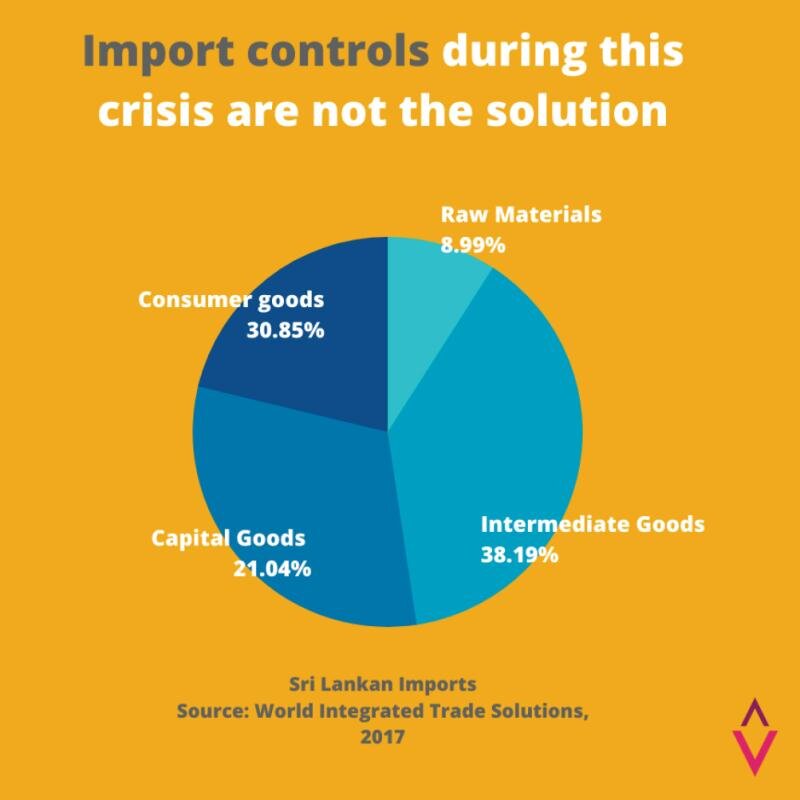
Many governments across the world announced stimulus packages for their economies. In Sri Lanka, the Central Bank gave directions to halt the importation of non-essential goods. This was taken as a measure to defend our currency and to bring our import bill down, but there is very little empirical evidence supporting the defence of a currency through import controls. In the Sri Lankan import basket, about 9% accounts for raw materials, another 38% for intermediate goods, and about 21% for capital goods. Petroleum is the main import, followed by raw materials for the apparel industry. Pharmaceuticals are included amongst the 30% of consumer goods imported.

import controls are not the solution

Imposing import controls in the first place in defending the currency gives a wrong signal to industries and investments at a time when we need them the most. Similar measures taken by the previous Government and other governments in the past ended with the rapid deterioration of the currency and, ironically, the reserves that were used to defend the soft peg. We have to back our currency with precious metal such as gold (gold standard) or a stable currency, which is called the hard peg (a fixed rate, normally with a hard currency like the US dollar), which can be managed by a currency board (we currently run a soft peg where money can be printed without being backed by hard currency). Most developing countries shun currency boards as it imposes monetary and ultimately fiscal discipline. In the meantime, it is indicated that the Central Bank has printed about Rs. 100 billion between 13-24 March 2020 and this will be the main reason for the currency to fall further.

Secondly, an essential good for one person may be a non-essential good for another person, and vice versa. For example, a can of tinned fish may be essential for one household but for a vegetarian household, it would not even be considered an option. Many similar cases arise when governments try to intervene in defining essentials and non-essentials.

Difficulties in targeting the informal sector

In the Government’s stimulus package, a systematic targeting concern arises regarding the informal sector in the economy.  Most businesses operating in Sri Lanka fall within the micro, small, and medium sector, and a considerable amount are not registered. The Government will not be able to capture these under any stimulus package, so we have to be prepared for the impact it will have on our economy. Small-time tailors, barbers, car mechanics, fruit and vegetable sellers, furniture shops, and many businesses operate within this informal sector. They do not operate within the system of formal bank facilities through commercial banks or non-banking financial institutions (NBFIs). Instead, many work with loan sharks with loans having interest rates of 10-12% per month with an efficient collection system and a 100-day repayment period with interest and capital. For example, if I take a loan of Rs. 100,000 with a 90-day repayment period at 10% monthly interest, there will be a collection representative every day in the evening at my doorstep and I have to pay 1,500 daily (1500*90 = 135,000). In Moratuwa, where I live, where the furniture business is the main industry, I can just walk in with a cash cheque dated for three months and even get a couple of millions in less than 15 minutes. There are separate cheque collection shops in my area. Therefore, the Government will face the challenge of targeting this stimulus package to minimise the cost of loss of productivity, particularly in the informal sector.

In summary, there is an “announcement effect” and a confidence effect created by the relief package announced by the Government among the people who are not a part of the informal economy, but policymakers should take note that there are also vulnerable sectors that shoulder a large portion of our economy which has an impact on our daily life.    

Lock-downs need not be curfews

Originally appeared in Daily FT, Daily Mirror, Lanka Business Online and Economy Next

By Aneetha Warusavitarana

On March 12, the World Health Organisation (WHO) declared the new coronavirus, COVID-19, to be a pandemic. With cases in Sri Lanka reaching over a 100, the government of Sri Lanka has taken several measures to prevent the spread of this disease. One such measure was enforcing an islandwide curfew.  


The risks posed by COVID-19 to the health and safety of our population are considerable and the measures to prevent the congregation of people and spread of the disease are commendable. A lockdown may certainly be warranted, yet a highly restrictive and prolonged curfew may prove to be counterproductive. As witnessed on Tuesday, March 24,  the short window given for basic necessities such as groceries,  medicine and other supplies, proved to be not only inadequate but also counterproductive to the objective of imposing a curfew in the first place. 


The government lifted curfew from 6:00 a.m. to 12:00 noon, allowing people to purchase their essentials. This temporary lifting of curfew highlighted the flaws in the solution. With limited information as to when the next curfew would be lifted, people panicked and shops were inundated. It was not unusual to hear of someone who stood in line for six hours, practising social distancing, only to enter a supermarket that was crowded with people and filled with empty shelves. Crowds were so great that the fear is that the number of infections in the country will now rise in the weeks to come. 

Planning the shopping of an entire country or even one province is not an easy task and right now, people do not know when the curfew will be lifted next. As of Wednesday (March 25), curfew in Colombo, Gampaha, Kalutara and Jaffna has been imposed indefinitely – there is no wonder that there was panic buying


Limited information exacerbating problem
Limited information on the government’s next steps is making the problem worse. The inherent problem with a curfew is that it cannot be imposed indefinitely. People need to have access to essentials – their food and their medicine. The curfew itself was imposed with almost no prior warning, which meant that the population panicked, hitting the shops and buying groceries that far exceeded their immediate requirement.


While this hoarding of goods has been publicly criticised, one can understand the fear that drives this behaviour. Planning the shopping of an entire country or even one province is not an easy task and right now, people do not know when the curfew will be lifted next. As of Wednesday (March 25), curfew in Colombo, Gampaha, Kalutara and Jaffna has been imposed indefinitely – there is no wonder that there was panic buying. 


The government’s solution to this issue is to allow delivery services to run, while also organising a government-led distribution system of essentials to all families in these areas. The Presidential Task Force will coordinate this effort, mobilising the ‘grama niladari’, divisional secretariat, agricultural officers and ‘samurdhi’ officers.  The motivation behind this is commendable. The question that remains is whether this will be feasible and whether this is where the government should be dedicating limited resources.


Is there a more effective alternative?
The government has reassured the public, stating that there are no food shortages in the country. Empty shelves in the supermarkets are simply a result of panic buying and this appears to be true. A model that has been deployed in other countries with some success is the implementation of a lockdown and not a curfew. 


Under a lockdown, essential services such as banks, grocery stores, supermarkets, convenience stores, pharmacies and food delivery services, remain open. People are allowed out of their homes to purchase groceries, etc. with strict guidelines on social distancing being enforced.  


The government has already taken steps in this direction, with pharmacies and commercial banks remaining open and delivery services allowed to run. The next step would be to include grocery stores and supermarkets under the category of essential services. 


Looking at the example of South Korea, a success story in the handling of COVID-19, the South Korean government did not enter a complete lockdown. The government instead allowed limited movement of people but rapidly expanded their testing capacity, which helped drop the rates of infection.  


There is the concern that as Sri Lanka’s testing capabilities are not comparable to that of South Korea, we may not be able to replicate their model with an equal degree of success. 
There are other models that we can be considered in this case. In America, stores have allocated separate hours for the elderly to shop during, in order to limit exposure for this vulnerable group of the population. In New Zealand, where a little over 200 cases have been reported, the country has entered lockdown, allowing only essential services to run. 
Given the issues we have seen with curfew in Sri Lanka, the government could consider a variation on a traditional lockdown, where people are allowed to access essential services – with limitations on the number of people who can enter a shop at a time or allocating time slots for people to purchase goods. This could free up government resources currently being allocated to mass food delivery and allow these resources to instead be utilised in our healthcare sector. 

Shut down, not curfew (2).png

Social distancing but economic convergence

Untitled design (1).png

In this weekly column on The Sunday Morning Business titled “The Coordination Problem”, the scholars and fellows associated with Advocata attempt to explore issues around economics, public policy, the institutions that govern them and their impact on our lives and society.

Originally appeared on The Morning


By Dhananath Fernando

The novel coronavirus (Covid-19) has taken the entire world by surprise. For Sri Lanka, this is the third time in recent history we’ve had to fight a non-terrorist enemy. Firstly, the 2004 Indian Ocean tsunami crashed on our shores, then a dengue outbreak a few years ago, and now this virus. Simultaneously, we had a 30-year-long terrorist war, followed by the Easter Sunday attacks just under a year ago. In summary, there seem to be more national emergencies than ever before.

During crises of this nature, sentiments are expressed that isolation as a country and self-sustenance are the best solutions to avoid such external shocks. It is natural to jump to this conclusion when our survival is threatened by such external factors.

However, a good story to remember at this time is one from the Buddhist Jathaka story “Sammodana Jathaka” – the story of the hunter and the flock of birds. The hunter was a threat to the flock of birds and the birds kept flying in individual directions and getting caught in the hunter’s net. After this happened a few times, the birds strategised; all flew together in the same direction towards the net, dragging it with their beaks towards a tree, and escaped. Although it seems that economic isolation, self-sustainability, and de-globalisation are the solutions, the reality is that in a world more interconnected than ever before, it is the opposite.

Economic hit

The impact of Covid-19 is unique since this is a global challenge. The economic impact of Covid-19 would be severe, both locally and globally. On the demand side, due to the closing down and locking down of cities, there will be a drastic drop in consumption. On the supply side, there will be a steep drop as the world’s factory, China, which contributes to 16% of the world’s GDP, has been severely impacted and supply chains and production network linkages are dysfunctional at the moment.

For Sri Lankans, our apparel trade will be at risk due to lower consumption in international markets (Europe and America), being unable to continue operations for the fear of contagion and facing serious difficulties in maintaining supply chains as a result of disruption within the global production network. The same will be true for most of our food exports and many other items in our export basket.

Our remittances will continue to decline given the impact of the virus in the Middle East, Europe, America, and Canada. This chain reaction continues down to the level of people not being able to pay their vehicle leasing instalments or defaulting on bank loan instalment payments. For the economically marginalised, electricity and water supply will become unattainable.

Unemployment will be higher and non-performing loans will increase. Tourism will be further affected and all supply chains connected to tourism will continue along the same downward trend. Inflation will rise, given the government interventions. The Sri Lankan Government will face serious questions on how to manage our fiscal position and keep the heavy public sector afloat in this crisis. It is estimated that it will take about six to eight months to return to normalcy and we should not forget that economies have not yet fully recovered from the Global Financial Crisis.

Price control no solution

Rs. 65 dhal sounds great for everyone until you realise the small shop at the top of your road is now getting less than half of what they usually do. (1).jpg

Last Tuesday (17) night, the President announced some relief measures on the economy and precautionary measures on halting the spread of the virus. The Government’s facilitation of the quarantine process is commendable for passengers entering the country from outside. However, imposing price controls on face masks, dhal, and tin fish will not help the poor. This will simply move stocks off the shelf faster.

No seller wants to sell anything at a lower price than its actual cost. The price range of Mysore dhal in the first week of March was in the range of Rs. 124-200 and the price of a tin of fish is around Rs. 220-300 for 425 g. Therefore, it is nearly impossible to sell dhal and tin fish at a controlled price of Rs. 65 and Rs. 100 respectively. The consequences would be that either the sellers will stop selling these to avoid legal repercussions, which will hit the poor and rich both as they will have nothing to buy at the shelf, completely distorting the market, or sellers will continue to sell at a higher price, defeating the Government’s purpose.

A similar situation occurred regarding the controls imposed on face masks, and these are already no longer available at pharmacies. What the Government could have done instead is reduced the import tariff on both tin fish and Mysore dhal, as they have now belatedly done on face masks, leading to price benefits passed on to the consumer and ensuring supply. Can you believe we pay an approximate tariff of 35% on all imported tin fish?

On Thursday CBSL ordered to suspend facilities provided for import of motor vehicles and non-essential goods to defend our currency. This will again impact the poor and the needy the most. In this age vehicles are not only used by the high-income earners but the micro and small entrepreneurs to run their businesses. They will get impacted badly so as will their employees. Those who use SUVs will manage.

Time for global co-operation

Constant and confusing news feeds have combined to make us feel that as countries, we should isolate. However, this is a time we all have to come together as a global community. To overcome this economic impact, we need the rest of the world to recover from this pandemic and co-operate more to avoid future challenges. We need our suppliers based in other parts of the world to recover and to be back on their game for us to kick off our operations. We need the purchasing power for our products to be better, to move faster in European and American markets. Once a vaccine for Covid-19 is finalised by scientists with greater capacity than ours, we should be able to trade and purchase it for our people. This pandemic is a good reminder that in isolation we cannot face all challenges. We are now reminded of the importance of freedom and franchising our freedom with responsibility.

In combating Covid-19, China donated medical equipment to Italy and the US. It was said that a quote by Roman poet Anneo Seneca was included amongst those supplies: “We are waves from the same sea.”

In a similar fashion, Japan donated some medical supplies to China and it was reported that the following Chinese poem was written on the wrapping: “We have different mountains and rivers, but we share the same sun, moon, and sky.”

Let this Covid-19 outbreak remind us that we all are waves from the same sea, and we all share the same sun, moon, and sky.

We hope you're safe!

A message from Advocata:

*|MC:SUBJECT|*


Hi,

I hope that you, your family and loved ones remain unaffected by the pandemic we have at hand. Life is a collection of seasons. The good times and the bad. Unfortunately, we don’t get to choose what we want to live through. You’ve got to go through darkness to find light at the end of the tunnel. Beyond our current reality, the economic aftermath brewing in the next few months will make things more challenging, and we need to be psychologically prepared. The question is how are we going to face this, and how are we going to overcome the impact this has had on our lives, our businesses, and our economy? 

When our survival is threatened, especially in the case of a global pandemic like the coronavirus which originated miles away from home, it’s so easy to question why the world is as interconnected as it is in the first place. We’re all self-isolating, social distancing and quarantining right now and with that emerges strong sentiments of anti-globalization, anti-interconnectedness, and pro-self-sustenance. 

I hope we don’t get caught up in these sentiments, even after the threat of the virus is long gone. If Covid-19 has taught us one lesson, it's that we are now interconnected more than ever. From climate change to the ongoing crisis, it's more evident by the day that what one individual or country does, will affect the rest of us. In the same way, progress in one will also mean progress in the rest. 

In the months since the novel coronavirus rose from a regional crisis to a global threat, countries have been advancing their research in science to find drugs and vaccines to treat or prevent the virus. We are thankful for these efforts, from the tiny island nation of Sri Lanka because a successful trial of the vaccine, means that the rest of us too can bear the fruits of this. 

Chief Seattle said it eloquently a century ago, “Humankind has not woven the web of life. We are but one thread within it. Whatever we do to the web, we do to ourselves. All things are bound together. All things connect.” Closely connected and seamless global production networks made our lives better. Most emerged out of poverty and had access to better healthcare and economic benefits. This is a time we need to support each other and work together as a global community. We need to work towards the reactivation of factories, services, and economy, together. 

We all are passing a real acid test of our public and economic policy. The impact of the decisions we make now, will last generations. Only time will tell us how strong we are together and the need to work as a global unit to address challenges that are yet to come.  We are waves of the same sea and though we have different rivers and mountains, we all share the same sun, moon and the sky. 

Stay safe, our thoughts are with you and your loved ones.


Dhananath Fernando

Chief Operating Officer,
Advocata Institute.

The Advocata Institute is an independent policy think tank based in Colombo, Sri Lanka. We conduct research, provide commentary and hold events to promote sound policy ideas compatible with a free society in Sri Lanka. 

Connect with us!
Twitter
Facebook
Website
Instagram

Election in the time of pandemic: Electronic voting offers no solution

Originally appeared on The Daily FT

By Prof. Rohan Samarajiva

At a time when people are being urged to maintain social distance to prevent transmission of COVID-19 and elections have been announced, it is natural to think of electronic voting from remote locations as a solution. 

Many reasons exist for modernising the way votes are cast, including the enfranchisement of our expatriate workers and the speeding up of the counting of votes. But what is most attractive at this time is the possibility of eliminating the need for people to congregate and thereby increase the risk of disease propagation. 

Electronic voting machines versus electronic voting
Most prominently, India, which conducts the world’s largest election, has used electronic voting machines (EVMs) over multiple elections. EVMs automate a single component of the voting process. Voters would still have to come to designated locations and have their eligibility to vote and their identities established in conventional ways. 

EVMs can be designed to allow persons with disabilities to exercise their right to vote. They can reduce errors in tabulation and speed up the release of results, but they do not eliminate the need for people to congregate. They are also not a solution to the problem of allowing expatriate workers to vote.

Properly validated EVMs are all that are required for this particular solution. There is no requirement even for data connectivity. The EVM can store the votes and can transmit them when connectivity is available. The concern is about whether the EVMs have been manipulated and whether there is an audit trail in case questions are raised at a later time. 

There are solutions to the identified problems. But given the tendency of our political actors to raise questions about jilmart for no reason other than unhappiness with the outcome, it is best that EVMs be approached with caution with primacy being given to trust issues. 

Voting from remote locations
Electronic voting, also described as internet voting, is a more radical solution in that it changes many elements of the voting process. Here, the need to bring voters to specific locations during specific time periods is reduced and possibly eliminated. Within a defined time period (which can be much longer than the usual few hours), persons can cast their votes from wherever they are, including from foreign countries. 

The verification of eligibility and identity will no longer be done by the examination of identity cards, the reading aloud of names, the checking of lists by observers and so on. The voter will be in a distant location not under observation by any official. There would have to be fool-proof technological methods to verify eligibility and identity. 

There is a country that conducts elections using electronic voting: Estonia. I have met Estonian citizens who have voted in national elections while they were travelling in foreign lands. Electronic voting depends on two preconditions: the existence of advanced digital identity authentication systems and the ability to connect to the election system using the Internet. Estonia, one of the most advanced nations in terms of ICTs, satisfies both criteria. 

Over the years, the number of persons voting remotely in Estonia increased to the highest proportion: 44% in 2019. That means that even with the remote voting option available, more than half the voters chose to go a polling booth to exercise the franchise. Electronic voting will not easily displace conventional voting. It is wrong to think that electronic voting is a quick fix to the problem of conducting an election amid a global pandemic.

An incremental approach
But we do need to work on technological solutions to the problems faced by Sri Lankan citizens temporarily resident in foreign countries and by those within Sri Lanka who are living or working in locations other than where they are registered to vote. Trust is of paramount value. Therefore, it would be best to start small and gradually expand. 

The most logical starting point is voting for the workers registered with the Sri Lanka Bureau of Foreign Employment. They are legally required to be registered. 

When they register, it would be possible to issue a smart card that is capable of authenticating identity in a manner like in Estonia. 

Remote internet-based voting is the only fair and comprehensive solution for citizens living in foreign countries. Putting polling booths in Sri Lankan embassies is not a feasible solution, because the distances voters would have to travel to cast their vote would be enormous in many cases. 

For example, the embassy in Saudi Arabia is in Riyadh. It would take over eight hours of driving to get there from Jeddah, for example. And Saudi law does not mandate granting of leave to vote in foreign elections. 

Once remote voting using electronic means has been tried out successfully, the solution can be extended to those in government who now use postal voting, and then to private-sector employees who now have to take time off to vote and so on. 

If the internecine squabbling among Government entities that has so far stymied efforts to introduce identification and authentication services for citizens can be brought under control, the process can be fast-tracked so that all citizens can exercise the right to vote at times and from places of their choosing. But none of this will help with holding an election in April 2020.

Stop ragging our economy

Untitled design (1).png

In this weekly column on The Sunday Morning Business titled “The Coordination Problem”, the scholars and fellows associated with Advocata attempt to explore issues around economics, public policy, the institutions that govern them and their impact on our lives and society.

Originally appeared on The Morning


By Dhananath Fernando

The issue of ragging dominates national conversation every time an unfortunate incident of such a nature takes place, such as the recent incident at the University of Sri Jayewardenepura. After a few weeks pass, a new topic takes over and the former conversation dies down, but ragging as an activity continues in universities…and so does the vicious cycle.

The tragedy of ragging is that students have died – some by committing suicide and some as a result of violence that is often part of the rag – while many more live with emotional wounds that cannot be cured. These are only the known, reported cases. The damage caused by ragging is probably more far-reaching than what we could imagine. Many students continue to have mental health issues, maybe not even realising that the rag is the reason behind what they go through.

The reason behind ragging is easy to explain, and it is the same reason behind many social issues. “The system has been politicised.” Let’s take a look at this statement – what does it mean to politicise a system? At a surface level, “politicisation” means that a political party or an affiliated organisation of a political party is taking control over things. But at a deeper level, it is far beyond that.

Within the university system, there have been many attempts to prevent ragging. For a while, military training was provided by the Government for all students. There exists a separate office in most universities called the “Marshal Office” to identify students involved in ragging and to maintain university security. All solutions are completely disconnected from the actual problem; if the solutions provided worked, we would not be having this discussion.

Our university system is disconnected from our economy and does not follow any incentive structure to produce dynamic graduates who would be in demand. That is the fundamental reason behind many unnecessary activities occuring within our university system. One of the reasons Sri Lanka is viewed as an uncompetitive location to set up a business is the lack of graduates who suit the demands of the labour market. Our universities are stagnant institutes and the flow of knowledge, ideas, and culture is restricted on several levels.

It is true that we have produced great scholars, academics, and scientists, but we should not concern ourselves with the handful of those who reach the top – they are the outliers in this scenario. We should focus our attention on what happens to the rest. Sri Lankans tend to focus on these outliers and brush the majority of the students under the rug; a case in point would be the students who successfully pass their Advanced Level (A/L) exams, qualify to enter university, but are not admitted. For the 2016/2017 academic year, only 19% of the students who qualified to enter university were admitted. It’s time we shifted our focus to the source of the problem. (See table)

2067a636_35089_P_3_mr.jpg

Ragging is just reaping what has been sowed. Flaws within the university system have provided space and opportunity for certain political forces to step in and exert their influence. Lecturers, political appointees, and policymakers have to be held responsible for this. While I clearly stand against those who are behind ragging and believe that whoever is responsible should be brought before the law, we also need to fix the system as a whole. Unless our university system is overhauled and restructured in a manner that equips students with the skills demanded by the economy and provides a qualification that translates into skills and knowledge that can be leveraged for gainful employment, we are unlikely to see a solution.

I was a member of the Students’ Council of the Faculty of Science at the University of Colombo when I was a student there. I represented the Faculty Board as the Student Representative for more than two years. The Faculty of Science was considered to produce the cream of the crop, with graduates going on to study at the best universities abroad – but the reality was far from this. The faculty was decades behind the rest of the world.

Once one of my friends compared his father’s lecture notes with the notes given by our current lecturer, and the notes were exactly the same. Either the university has been teaching a subject which has not evolved in the modern day or the lecturer has not been evolving with the subject. Can we expect innovation to take place and to produce graduates in competitive industries to compete at a global scale if this is the situation in our lecture halls? How can the Government justify its expenditure on tertiary education when it funds an archaic educational system that clearly causes harm to its students?

In the Faculty of Science at the University of Colombo, there was no re-correction system after the exam. If a mark was given by the lecturer, that was it – you could not question the marks. I have come across many instances where some lecturers deliberately gave lower marks as a result of personal biases against students. One time, one of my batchmates asked the lecturer just to re-check whether the addition of the marks was correct as he was so sure about the answers he had provided. The lecturer said: “I can do that, but I have to demote your result from a C+ to a D- even if the marks were added wrong.”

If the university system does not promote transparency, how can we expect these students to be transparent when they join the labour force?

Selecting students for a special degree is another rat race. After the first two years, based on the student’s performance, they will be eligible for a subject stream in which they can specialise. In the Faculty of Science at the University of Colombo, the chemistry special degree is considered the most prestigious. Since the number of special degree opportunities is limited, it was common for students to hide some books in the library and even tear out pages in certain valuable books to make sure no one else gets the opportunity to study what they studied.

The competition varies based on the opportunities available in main universities in America. I recall an incident hat took place when I was enrolled where the Students’ Council President received a complaint from a molecular biology student that a mathematics student had been eligible for a molecular biology special degree as per the results of the Department of Examination. To put the issue in context, this is similar to an arts A/L student being accepted to the Faculty of Medicine. The subject streams are completely different. The impact was serious. Since this is a limited opportunity, the student who was next in the list lost the chance to do the molecular biology special degree. When we took this to the Dean and the heads of the Department, you would have been surprised at the solution they provided. They increased the special degree intake by one student and allowed the mathematics student to continue doing the molecular biology degree. I can provide 100 similar examples on the backwardness of the Faculty of Science.

There is no mechanism to evaluate the lecturers, their content, and whether they teach what is required by the industry and the modern-day world. When a system is stagnant and not based on proper incentives, the connected stakeholders become slaves and victims of the same system itself. And ragging is a byproduct of an outdated, unevolved system.

Identifying the reasons for government inefficiency is not that hard; 77% of our university graduates are employed in the public sector. This goes up the hierarchy from grama sewa niladaris to secretaries to key ministries and even to the Central Bank. So the people in senior positions in government institutions are coming from a background and culture of inconvenience and a system which is stagnant.

Imagine a similar incident taking place in a private university. The chances are very low because it is a competitive system. This doesn’t mean our private universities are part of a flawless, perfect system, but undoubtedly there are lessons we can learn. If you look at some private educational institutes, the students evaluate the lecturers and there is an incentive for the lecturer based on the student’s voting. To an extent, constant upgrading of content is included in the system.

The solution for ragging is beyond implementing strict punishments. While the importance of enforcing the law and ensuring the culprits are brought to justice cannot be understated, there is more that has to be done. Sri Lanka is in dire need of a university system that promotes transparency and an incentive system that updates the curriculum content to that of our economy. Just slapping a plaster on this issue will worsen the situation.

The cost of being a Sri Lankan woman

Originally appeared on Daily FT, Economy Next

By Nishtha Chadha

This year’s International Women’s Day theme is #EachforEqual - a concept grounded in the idea of ‘Collective Individualism’. Collective Individualism is the idea that each of us is part of one whole. Our individual actions, conversations, behaviours and mindsets go beyond the confines of our individual lives, and can have a significant impact on our larger society. Collectively, we have the capacity to create a gender equal world. 

Gender equality in Sri Lanka

Sri Lanka still has a significant way to go when it comes to gender equality. The Global Gender Gap Report 2020 ranks Sri Lanka 102 out of 153 countries in the gender equality index. Women’s economic participation and opportunity, educational attainment and political empowerment are major areas of concern, and only seem to be getting worse.

In 2006, Sri Lanka ranked 13th on the same gender gap index. In other words, over the last 14 years, the country has dropped 89 places on the index. Today, women are twice as likely as men to be unemployed, and barely 9% of Sri Lankan firms have women in top managerial positions. Only 5% of Sri Lanka’s parliament is made up of female representatives. 

Gender equality is not just a women’s issue, but a business issue. The World Bank Vice President for South Asia Region, Hartwig Schafer, has stated that Sri Lanka specifically could grow its economy by as much as 20 percent in the long-run by closing its gender gap in the workforce. Increasing women’s labour force participation can improve productivity by not only adding more people to the workforce, but also by enhancing diversity of thought in the workplace. 

So, why aren’t Sri Lankan women achieving their full potential?
A recent publication by the World Bank Getting to Work : Unlocking Women’s Potential in Sri Lanka’s Labor Force (Vol. 2)’, cites that cultural norms continue to be a pervasive barrier to increasing women’s labour force participation in Sri Lanka. Entrenched with gender stereotypes, these cultural norms have direct implications on women’s educational pursuits, career longevity, and ability to participate in decision-making roles. What’s important to understand about cultural norms, however, is that they do not exist in a vacuum. Gender stereotypes which limit a woman’s ability to access education and economic opportunities. 

One example of these discriminatory policies are the exorbitant taxes on menstrual hygiene products in Sri Lanka. Access to safe and affordable menstrual hygiene products remains somewhat of a luxury for many Sri Lankan women. A leading contributor to the unaffordability of these products in Sri Lanka, is the taxes levied on imported items. 

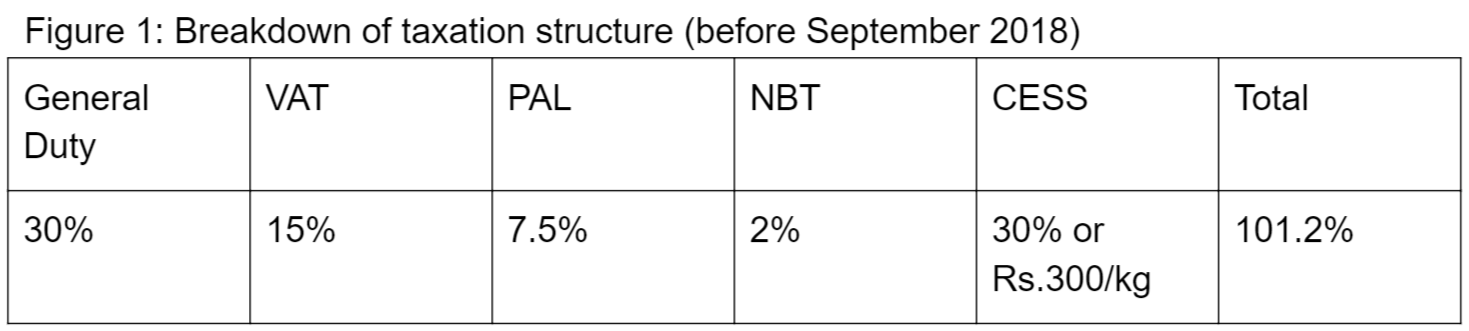
Sanitary napkins and tampons are taxed under the HS code 96190010 and the import tariff levied on these products is 52%. Until September 2018, the tax on sanitary napkins was 101.2%. The components of this structure were Gen Duty (30%) + VAT (15%) + PAL (7.5%) + NBT (2%) and CESS (30% or Rs.300/kg). In September 2018, following social media outrage against the exorbitant tax, the CESS component of this tax was repealed by the Minister of Finance. Yet, despite the removal of the CESS levy, sanitary napkins and tampons continue to remain unaffordable and out of reach for the vast majority of Sri Lankan women. 

breakdown on taxation structure

The average woman has her period for around 5 days and will use 4 pads a day. Under the previous taxation scheme, this would cost her LKR 520 a month.  The estimated average monthly household income of the households in the poorest 20% in Sri Lanka is LKR 14,840. To these households, the monthly cost of menstrual hygiene products would therefore make up 3.5% of their expenses. In comparison, the percentage of expenditure of this income category on clothing is around 4.4%.

The impact of unaffordability

The high cost of menstrual hygiene products in Sri Lanka has direct implications on girls’ education, health and employment. 

According to a 2015 analysis of 720 adolescent girls and 282 female teachers in Kalutara district, 60% of parents refuse to send their girls to school during periods of menstruation. Moreover, in a survey of adolescent Sri Lankan girls, slightly more than a third claimed to miss school because of menstruation. When asked to explain why, 68% to 81% cited pain and physical discomfort and 23% to 40% cited fear of staining clothes. 

Inaccessibility of menstrual hygiene products also results in the use of makeshift, unhygienic replacements, which have direct implications on menstrual hygiene management (MHM). Poor MHM can result in serious reproductive tract infections. A study on cervical cancer risk factors in India, has found a direct link between the use of cloth during menstruation (a common substitute for sanitary napkins) and the development of cervical cancer; the second-most common type of cancer among Sri Lankan women today. 

The unaffordability of menstrual hygiene products is proven to have direct consequences on women’s participation in the labor force. A study on apparel sector workers in Bangladesh found that providing subsidized menstrual hygiene products resulted in a drop in absenteeism of female workers and an increase in overall productivity. 

Slashing taxes for gender equality

Internationally, repeals on menstrual hygiene product taxation are becoming increasingly common due to their proliferation of gender inequality and the resulting unaffordability of essential care items, commonly known as ‘period poverty’. Kenya was the first country to abolish sales tax for menstrual products in 2004 and countries including Australia, Canada, India, Ireland and Malaysia have all followed suit in recent years.

If Sri Lankans are serious about creating an equal platform for women and girls to achieve their full potential, ‘Collective Individualism’ is certainly the key. Gender equality can no longer be just a ‘women’s issue’. It’s an ‘everyone issue’. Each and every Sri Lankan has a responsibility to demand real action from their policymakers, to promote gender-sensitive policies and abolish taxes like this, which actively limit a woman’s ability to achieve her full potential. 

Tax on sanitary napkins

By reducing the rates of taxation, the cost of importing sanitary napkins and tampons will simultaneously decrease and stimulate competition in the industry, further driving prices down and encouraging innovation. The conventional argument in favour of import tariffs is the protection of the local industry. However, in Sri Lanka, sanitary napkin exports only contribute a mere Rs. 25.16 million, or 0.001%, to total exports. 

Increased market competition would also incentivise local manufacturers to innovate better quality products and ensure their prices remain competitive for consumers. Other common concerns pertaining to the issue of low quality products potentially flooding the Sri Lankan market if taxation is reduced are unlikely to materialise, since quality standards are already imposed by the Sri Lankan government on imported products under SLS 111.

If menstrual hygiene products are made more affordable it is likely that more Sri Lankan women will be able to uptake their use, allowing them to attend more school days, work more consistently and, by extension, access more opportunities. Moreover, with more products entering the market, women will have expanded consumer agency, allowing them to purchase products that address their specific needs without being economically burdened for it. This would remove a significant barrier to women's empowerment and create a wide-scale positive impact on closing Sri Lanka’s present gender gap. 

Gender equality can only be achieved when we begin dismantling the structures that disadvantage our most vulnerable counterparts. Abolishing Sri Lanka’s menstrual tax may just be one small step towards achieving this. The Advocata Institute has launched an online campaign titled ‘the costs of being a woman’, which highlights taxes that disproportionately affect women. With every discriminatory tax and policy that is abolished, the collective impact could be transformative. 

That is what #EachforEqual is about - sharing the responsibility to create a more equal world for each and every one of us. 

Are Sri Lanka’s women really free to work?

Untitled design (1).png

In this weekly column on The Sunday Morning Business titled “The Coordination Problem”, the scholars and fellows associated with Advocata attempt to explore issues around economics, public policy, the institutions that govern them and their impact on our lives and society.

Originally appeared on The Morning


By Dhananath Fernando

Around 20 years ago as I recollect, there was a discussion on Sri Lankan radio about whether it was fair for women to wear trousers or jeans. This was a topic of conversation that was raised at a time when a female president led the country; a country that had produced the first female Prime Minister in the world.

When I was at Colombo University, the topic “Should women wear trousers?” was assigned for a debate during the ragging period. Though we have seen some progress on this topic, the manner in which we, as a society, treat women has not changed drastically.

Walking in the shoes of women is a difficult concept to consider as a man. Today, we can see women voicing out multiple social and economic issues that they have faced. As men, we should be using our privilege to give women a wider platform and have them at the forefront in driving social and economic development.

Women in Sri Lanka are unfortunately often expected to carry the brunt of the care burden, regardless of whether they also engage in paid labour or not. However, what many do not realise is that this is a twofold struggle. Women not only have to balance all this work, but also endure the emotional toll that comes with it. Generally, they find themselves shouldering the logistical burden of co-ordinating and delegating any tasks that they do not take on themselves. This burden is already an unreasonable expectation. Women’s domestic labour should in fact be classified as an unpaid business. However, we are only adding to this problem via high tariffs on items such as LP gas cookers and washing machines. Most women are limited by their domestic labour, and the degree of freedom and choice that they have outside of this often depends completely on the affordability of tools that ease their burden.

The worrying fact is that our economic policy is what limits the freedom of women in many cases. At my previous office, my colleague used to celebrate her mother’s birthday for a week and her celebration was simple each year. She would bring home food for dinner for a week so that her mother would not have to cook dinner during that birthday week. I asked her: “How is not allowing your mom to cook for a week a treat?” She replied: “If you know how painful it is to run a kitchen every day you will realise what a good treat it is to take rest for a week.” I realised that she was absolutely right. Sri Lankan women are giving up their paid jobs in order to take on the domestic burden of their households.

It is no surprise that Sri Lanka’s female labour force participation declined from 41% to 36% from 2010 to 2016 when our economic policy is doing its part to keep women out of the labour force.

The fundamental question we have to ask here is whether our women have truly been given the freedom of choice, or whether this choice is hindered by our policy and social ecosystems. If women wish to choose a career outside of their home, do they actually have the ability to make that choice? This should be a basic right. The conversation on economic rights needs to go hand in hand with that of social rights. How have we set our economic parameters? Let’s take a look at our tariff policy and how it impacts the lives of Sri Lankan women.

High tariffs on household electronics

tarriffs on household electronics

It was saddening to see the amount of household durables that most Sri Lankan women who work in the Middle East buy at airport duty-free shops. It is a clear indication of the high tax applied on daily household durables such as washing machines and cookers.

Are we not restricting women’s freedom by making these household durables unaffordable for them? According to data by the Department of Census and Statistics, only 20% of all Sri Lankan households use a washing machine. Washing machines might not be within budget for the rest of the 80% of households, but high tariffs are definitely a reason why the numbers of those using washing machines are so low. The time saved from washing clothes could have easily been used for paid external work, limiting the domestic burden that tends to fall on women. This same rationale applies to other household durables such as refrigerators and cookers.

High tariffs on sanitary and childcare products

Another category that is making life more difficult for a woman is unfair taxes on sanitary napkins and baby diapers. As childcare within a household generally falls on women, both of these goods are essential items that need to be purchased. Regarding taxation on sanitary napkins, Advocata’s strong punchline said it all: “‘I love having my period and paying tax on it,’ said no woman ever.” According to research by Advocata, a woman spends approximately Rs. 600 every month, and Sri Lanka has about 4.2 million menstruating women. While the tariffs on sanitary napkins have been reduced, they are still around 52%. It should not be hard for us to walk the talk of empowering women by bringing down the tariff rates on such simple matters. Can we be proud to say, as a country, that we have a 52% tariff rate on our menstruating women?

Surprisingly, baby diapers are also taxed at 52%. This is a double whammy on women. Caring for an infant requires spending a significant amount of time washing kids’ clothes and making them comfortable. Having diapers which are unaffordable is just another hindrance.

Social and economic pressure women are under

I do not have the luxury of space in this column to elaborate further on how we are making women’s basic needs expensive and limiting their freedom; we cannot be proud of the situation that the women in our country are in. They continue to be held to unreasonable expectations, including shouldering the domestic burden within a household. We need to work towards alleviating both the social and economic pressures that women are under. Women deserve the freedom of choice. Women have the ability to engage in paid work if they want to. We need to ensure that women also have an equal opportunity to choose paid work if they want to. So this will be yet another Women’s Day without true freedom for women.

Is Sri Lanka getting old before getting rich?

Untitled design (1).png

In this weekly column on The Sunday Morning Business titled “The Coordination Problem”, the scholars and fellows associated with Advocata attempt to explore issues around economics, public policy, the institutions that govern them and their impact on our lives and society.

Originally appeared on The Morning


By Dhananath Fernando

Life is often said to be a continuous battle between time, money, and energy. When we were kids, we had time and energy, but were limited by our lack of access to money. When we started working and earning money, time was difficult to find. As we walk the journey of life, we will come to a period where we may have time and money, but not energy.

Let’s apply the same variables to Sri Lanka as a country to see where we stand in terms of money, time, and energy. The picture is, unfortunately, shocking.

A consistent 4% increase

Our current gross domestic product (GDP) per capita is about $ 4,000. If our per capita GDP achieved a sustained growth of 4% (our 2018 economic growth is 3.2%), Sri Lanka would reach Malaysia’s current level of income per capita by 2038 and Singapore’s current level of income per capita by 2080. Even if we achieved a 6% real per capita growth, it will be 2031 before we reach Malaysia’s current level and it would take till 2060 to reach where Singapore is today. Even if we pull our act together right now, it will take close to a generation, about 30 years, to see the light at the end of the tunnel.

As a nation, we have an ageing population and 21% of our population will be over 60 in 2030. This percentage is said to increase to 28.6% by 2050. Compare that with the population over 60 in 2015 – it was just 13.9%.

If we keep political flags aside, our current mayhem is a result of bad policy choices that we have made and supported for the last 70 years. It is easy to point fingers at politicians and they surely must take accountability for their actions, but the deeper question is: Aren’t the politicians that we are electing and their policies a reflection of our choices?

The wealth of a country and its people is often considered over time. A person classified as “poor” by current standards still has a lifestyle better than an emperor would have had a few centuries ago. But this doesn’t mean the poor person is an emperor today. The world has moved in giant leaps and the real challenge is to be comparative with current standards. Unfortunately, us Sri Lankans live in a bubble of constant reflection of prosperity in past millennia and focus solely on recreating the glories of a bygone era. There is nothing wrong with tapping into knowledge in history and learning from it, but we need to recalibrate these lessons and understand that the context and the consequences are completely different now. Trying the same formula which worked for us millennia ago nowadays will not make us rich before we get old.

Every time a discussion on open trade and competition is started, most of our fellow Sri Lankans march to the streets demanding protectionism. The consequences are evident. Our trade openness has dropped to about 37% from 78% over the span of a few decades. We still believe having higher import tariffs will improve local production and competitiveness in the market. Hiding from competition in this way is the same as trying to win a Cricket World Cup without playing a single match with an international team.

The extent to which we have hidden from competition is at an absurd level. Would you believe me if I told you that most of our daily household products are protected by unreal custom duties and protectionist taxes which drive our cost of living through the roof? This is in a country where more than 50% of its population finds it difficult to earn even $ 3 a day.

Ravi Ratnasabapathy has highlighted the absurdity of taxes on commonly used household products in a column in the Echelon business magazine. The import taxes for cereal add up to 101%, fruit juices to 107%, noodles to 101%, aftershave to 120%, toothpaste to 107%, etc. The list is too long to continue.

The big question is what this Government could do to make our people rich before they get old. First, we have to understand that all the economic problems we face are interconnected and that there are no isolated solutions. A summary of problems is listed below:

  1. Low GDP growth rate

  2. Low export growth

  3. Balance of Payment problems

  4. Low transformation of export basket

  5. Low foreign direct investment (FDI)

  6. Low immigration

The Government has to take a combined approach and implement a rapid reform process if we are to have even the wildest chance to move an inch forward from where we are right now. At this point of time, the Government seems to churn its wheels through personality-driven power and dynamic individuals whose focus is on getting things done fast. In the first place, the Government needs to understand there is only so much development that can be sustained through a personality-driven approach.

For example, trying to ease traffic congestion through the use of Military Police is a short-term solution. The long-term answer to this problem is the introduction of a high-quality public transport system. But to improve public transport, certain reforms are necessary, such as the introduction of competition to railway operations, easily obtainable route permits for luxury buses, and price openness in order to develop innovative transportation options and products.

Without an understanding of long-term solutions, government intervention in bringing more buses under the Ceylon Transport Board (CTB) and shuffling the train timetable will not bring sustainable results. Instead, this will burn the Government’s energy and precious time.

The same applies for all of the above economic issues. The Government should address low-hanging fruits such as the implementation of a proper visa regime for foreigners who wish to work in Sri Lanka, and allow for foreign spouses who are married to Sri Lankans to work here. Having diversity means introducing more innovativeness into the system.

The second step to addressing these economic issues is fiscal consolidation and the cutting of existing red tape which affect business. President Rajapaksa announced his support for eliminating unnecessary regulations during his Independence Day speech, and the time has come to walk the talk. The barriers for imports and exports are still enormous, ranging from obtaining a loan to getting a license.

These regulatory and legislative barriers need to be addressed. We are then left with no other option but further fiscal consolidation. Unnecessary political recruitments have to be frozen and government expenditure needs to be tightened. Very importantly, the Government has to start somewhere and look beyond rosy elections through to bitter deliverables. Things will only get darker as the clock ticks on.

To be honest, getting rich before we get old is only a dream for our generation. The question is: Do we want our kids to get old before they get rich too?

Sri Lanka: State control or self-control?

Untitled design (1).png

In this weekly column on The Sunday Morning Business titled “The Coordination Problem”, the scholars and fellows associated with Advocata attempt to explore issues around economics, public policy, the institutions that govern them and their impact on our lives and society.

Originally appeared on The Morning


By Dhananath Fernando

We Sri Lankans love when the State controls almost everything in life. It almost seems genetically coded for us to expect the State to control our education, jobs, electricity, prices of staple goods, prices of vehicles, religion, and whatnot. Our politicians take advantage of this inherent thinking and pretend they have the ability and competency to control everything. That is why every election has become a heavyweight competition on the free giveaway of jobs and commodities. From the day Sri Lankans are born, till the day they die, a bigger part of our lives is controlled by the State, and there is very little the individuals have to say about it.

As a result, Sri Lankans do not have any decision-making power in their lives and they really do not have a say in their own lives. Life as we know it is a series of making decisions. Decisions we’ve made in the past are the reason why we are who we are and where we are today. Decisions we make today will determine our tomorrow. The only way to navigate your life the way you want it is to take control of the decisions you make. In other words, this is the act of controlling one’s self and the factors one has a say in – “self-control”.

Mahatma Gandhi eloquently once said: “Be the change that you wish to see in the world.”

Even though we’re all very aware of this, our actions speak otherwise. Since the beginning of time, Sri Lankan society has constantly demanded for more “state control” as opposed to “self-control”. People’s expectations are such that the government must take care of their employment, provide for their children’s education, their healthcare, and needs, operate hotels, run airlines, telco companies, and media stations, and should be the sole provider of infrastructure development. Did you know that 77% of our university graduates are employed in the public sector? This is funny because a graduate employed in the private sector would earn 60% more than a graduate employed in the government sector.

Sadly, what people don’t see is the cost they have to pay for their demand of state control. The state salary bill itself is very expensive for a country like Sri Lanka where the state salary per annum per citizen is about Rs. 29,809. If we consider the state salary per household per annum, it is as high as Rs. 119,238.

Further complicating the state of affairs from what it is already, state control has reached its peak in Sri Lanka where even the prices of day-to-day goods and services are dictated by the government. Advocata’s report titled “Price Controls in Sri Lanka” and the accompanying documentary highlight how price ceilings on the sale of certain goods result in market shortages, and the sale of lower quality products resulting from producers having to cut down on the cost of production of these goods.

A recent price control on pharmaceutical products has created market shortages on 11 essential pharma products. The Government recently had price controls on masks due to the coronavirus outbreak as well as more price controls on vegetables and staple food, but nothing really worked on bringing the prices down. Instead, it was reported that some medical products were not on the shelves.

It is said that when you try to control one thing, you lose control of everything. And that’s exactly what’s taking place in Sri Lanka. If you recall, we had a price control on hoppers just after the previous Government came into power. The list was so long that even tea prices at small tea shops were controlled, and later they extended the list on imposing price controls on bottles of water too. These control measures are absolutely impractical to monitor and impose. Throughout history, it is evident that government price controls have not brought about any positive results and have only worsened the situation.

As a result of the controlling mentality, consecutive governments lost control of the things they should have focused on. Our judiciary system, which needs serious reforms, has not even been touched for decades. Someone who has a land case would understand how long and painful the process is. Rather than setting up systems for efficiency and having a level playing field, the governments have spent time on trying to control things that aren’t controlled and has micromanaged macro issues.

“The man who chases two rabbits catches neither” is a good reminder to all governments that try to control too many things instead of promoting and developing the culture of self-control.

The extreme ill-effects of “state control” are visible in our export sector. In the last 10 years, Sri Lanka has only had seven new Harmonised System (HS) Code additions to our export basket. During the same period, countries like China have added 76 codes to their basket, while Thailand added 70 and Vietnam added 48. The more we compromise on self-control for state control, the more we distance ourselves from prosperity.

The solution to all this is simple: Hard work and free exchange. Hard work, on the one hand, is a characteristic of self-control. Free exchange, on the other hand, helps foster a competitive business environment that encourages a nation and its citizens to strive for prosperity. If we can’t control how we work and strive for development, we’d be kidding ourselves to assume that a state could do it for us.

Like Pythagoras once put it, “no man is free who cannot command himself”.


Back to the Basics: Achieving our FDI targets?

Untitled design (1).png

In this weekly column on The Sunday Morning Business titled “The Coordination Problem”, the scholars and fellows associated with Advocata attempt to explore issues around economics, public policy, the institutions that govern them and their impact on our lives and society.

Originally appeared on The Morning

By Aneetha Warusavitarana

As we enter the middle of February, Sri Lanka does not appear to have a clear plan in place for foreign direct investment (FDI) for 2020. Last year, the Government set a target to attract Rs. 3 billion in FDI by the end of the year; this however did not come to pass. After the Easter Sunday attacks, the Government downgraded the target to Rs. 1.5 billion, reflecting the drop in investor confidence following the terror attacks.

Can Sri Lanka hit.jpg

Attracting FDI should be a priority for Sri Lanka right now. As a region, growth in South Asia has slowed down, and we are no longer the fastest growing region in the world. In Sri Lanka, we will have to face challenging economic realities; the tax cuts introduced as a stimulus for the economy may or may not pan out as expected, and it is likely that government expenditure will continue to rise in the lead-up to parliamentary elections.

Our recent graduation to upper middle-income status has also shed light on the living standards of many in the country. The poverty line for upper middle-income countries is far higher than the official poverty line used in Sri Lanka. When the country’s poverty numbers are recalculated for the new poverty line of $ 5.5 per day, our poverty rate skyrockets from a respectable 4% to a horrifying 40%. Of course, this number should not be taken at face value; a little under half of our population did not suddenly plunge into poverty at the point of our transition to upper middle-income, and living standards are similar to what they were last year. However, it is a good indicator of how far we have to go as a country for Sri Lankans to have economic realities associated with upper middle-income countries.

Economic growth

The solution to our woes is of course economic growth; the catch is that growth appears to be quite elusive at this point, with GDP growth for 2020 estimated to be 3.7%. The country is also a little strapped for cash with debt repayments and uncertainty as to what our tax revenue will look like. What Sri Lanka needs at this point is FDI.

Attracting FDI into Sri Lanka should be a priority for the Sri Lankan Government, not simply because it is a source of foreign exchange for the country, but because the benefits of FDI go far beyond that of increasing inward capital flows. FDI is a link to international markets that Sri Lanka would otherwise have limited access to, and with that link comes the transfer of knowledge, skills, and knowhow. Entry into global value chains through FDI forces firms to improve productivity and increase competitiveness. The World Bank succinctly captures the benefits of FDI for high-growth firms in developing countries by identifying two main channels: (a) Contractual linkages between foreign and local firms that promote the formal transmission of knowledge and practices that may help domestic suppliers upgrade their technical and quality standards, and (b) the demonstration effect, where domestic firms imitate foreign technologies or managerial practices.

The investors’ side

Sri Lanka has to go far beyond setting targets for FDI if we are to attract it in the numbers that we need. We need to understand what investors are looking for, and then ensure that Sri Lanka has met that criteria. The World Bank’s Global Investment Competitiveness Survey is a tool that can help governments design policy and prioritise reform that investors will recognise and value. The survey captures 754 interviews with executives of multinational corporations (MNCs) that have invested in developing countries, and identifies the determinants to attracting FDI.

When speaking about FDI in Sri Lanka, focus is often solely on attracting FDI, with great effort being expended to answer the question of how to get investors to see Sri Lanka as a lucrative destination for investment. This is of course important, but we need to go beyond this if we are to retain FDI, and see the investment grow. One of the top five findings from the survey was that more than a third of investors reinvest all of their profits into the host country. This means that investors will be looking for policies in the host country that will help them grow their business, and not just policies to facilitate their initial setup.

Another key finding from the survey was the importance of having economic stability and a transparent, predictable policy regime. Three-quarters of investors have experienced disruptions in their operations as a result of political turmoil. A quarter of these investors then either cancelled or withdrew their investment.

Next steps

Achieving long-term policy stability is not an easy task; it will require considerable political will and commitment to long-term growth over a quick short-term win. Focus has to move beyond quick-fix investment incentives. The report highlights that incentives are not the most important determinant for a potential investor, according to the survey. They rank fourth in importance, below transparent governance, investment protection guarantees, and ease of establishing a business. Of course, this is not to say that incentives should be removed wholesale. They are a criterion, but possibly not the most important one.


Other people’s money: Lessons from the Airbus corruption case

Published in the Daily FT

By Prof. Rohan Samarajiva

An insightful writer I follow had written that the corruption revealed in the Airbus case, technically described as a deferred prosecution agreement, is intrinsic to capitalism or to the market system. The implication is that it may not be intrinsic to not-capitalism, usually described as socialism. But all one has to do is to read Kautilya’s Arthashasthra, from 321-298 BC, to understand that corruption transcends the market system.

Big purchases, big bribes

Within our memory, major aircraft purchases were made by the National Carrier of Sri Lanka on three occasions. The first was during the Premadasa presidency, when much was made over the pricing of Airbus aircraft procured for the National Carrier and the interest rates of the financing arrangements. 

Then Emirates made major purchases as part owners and managers, both before the 2001 airport attack that destroyed half the fleet. No controversy ensued. 

The third instance was in the waning days of the Mahinda Rajapaksa presidency, when contracts for multiple Airbus aircraft and a VIP kit were entered into. There was no controversy at the time, but questions were raised after 2015 when large penalties in excess of Rs. 17 billion had to be paid for not completing the purchases. The real controversy has erupted only now with admissions of specific acts of bribery by Airbus. 

Though the European court documents did not name the recipients of the bribes, the Attorney General sought the arrest of Kapila Chandrasena, the CEO at the time, and his wife. 

In a related development not much discussed in Sri Lanka, the private Malaysia-based budget carrier Air Asia announced that its Chief Executive Tony Fernandes and Executive Chairman Kamarudin Meranun would leave their positions immediately until investigations were completed on an Airbus sponsorship worth $ 50 million for a sports team owned by them. The Air Asia contracts were larger than SriLankan’s and so were the associated payments from Airbus.

Principal-agent problem

In both cases, executives (agents) entrusted with managing airlines on behalf of the owners (principals), the Sri Lankan State in one case and private shareholders in the other, are alleged to have acted to the detriment of the principals, for personal gain. This is a manifestation of the principal-agent problem. Agents always have more information than the principals and their interests are different from those of the principals. How to ensure agents act in the interests of the principals is the problem. 

The executives entrusted with prudent management of other people’s money are alleged to have breached that trust by not getting the best possible deal from Airbus. Airbus may have transferred the bribes, but the actual payers were the owners of SriLankan and of Air Asia. If not for the bribes, the airline owners would have obtained greater value for money from Airbus or its competitor.

Why did these actions occur? One must begin from the larger context of market structure.

Assume a workably competitive market with privately-owned firms. Here, if executives pay inflated prices or accept lower quality, their firm will be disadvantaged. The firm will lose market share and/or profits will be eroded by the higher costs. The owners will not keep pumping in capital because of they have hard-budget constraints. They will fire the executives and/or wind up the firm. Air Asia has chosen the former path even though Tony Fernandes was the visionary founder. 

In privately-owned firms, bribe-induced non-optimal procurements will be rare because the principals have strong incentives to set in place mechanisms to minimise bad behaviour by agents. One could ask why it took so long for the Air Asia board to act on Fernandes and Meranun. The explanation must lie in the complexity of the airline business which exacerbated the information asymmetry and allowed the agents to mask their less-than-optimal purchasing decisions. The principals suffered the consequences, earning lower returns than they would have if proper controls were in place.

In SriLankan Airlines the true owners have no seat on its Board. They are the citizens of Sri Lanka, who have designated certain politicians as their agents. At one time, these politicians decided to operate a State-owned airline. Other politicians at various times appointed persons to the Board of the airline as their agents to efficiently manage it. These agents serve as the principals to the executives who actually manage the airline. So, it’s not a simple principal-agent relationship but a concatenated series of such relationships, ending in a principal who is incapable of exercising effective supervision. 

If the airline loses money, the Board members are not affected because the money at risk is not theirs. The politicians also do not have own funds at risk. The politicians, their agents the Board, and the Board’s agents the senior managers, all take decisions that affect other people’s money. Intrinsically, there will be fewer incentives to set up effective controls. The general public, whose is money is being mismanaged, are not part of the decision making. Their only recourse is voting out the politicians at the next election. But elections are not decided on single issues.

In the effort to find a third way between State ownership which was failing and markets which they were opposed to ideologically, the socialist rulers of the former Yugoslavia claimed that it would impose hard-budget constraints on State-Owned Enterprises (SOEs). 

In fact, the constraints were never hard. There were always reasons for exceptions: national security, welfare of consumers, avoidance of unrest that could be caused by layoffs, etc. All these reasons and more have been heard in the case of the endless infusions of public funds into SriLankan, the latest being the need to have the ability to evacuate citizens from foreign lands. 

What can be done?

The first-best solution is to avoid the use of taxpayer funds in firms such as airlines that operate in competitive markets. In other words, they should be privatised. These businesses are complex. If they are not operated efficiently, the risks of losing money are high, as evidenced by the demise of private airlines all over the world. 

The information asymmetries that must be managed to ensure effective control of agents are difficult enough even for private owners. But they have incentives to work at it because their money is at risk. When public funds are being used no such incentives exist. If owners fail to control their agents as was the case with fully private Air Asia, they suffer the consequences in the form of foregone profits and lower share prices. Their losses are of no concern to the public. 

Partial private ownership is a second-best option. There was no fuss when Emirates management bought aircraft for SriLankan. Some public funds were at risk but Emirates which owned 43% of the airline was the decision maker. If the CEO bought aircraft in return for bribes paid to his wife’s company, Emirates would lose money along with Treasury. It had incentives to create good controls. The proof was in the dividends paid to Treasury during the period of partial ownership and management by Emirates.

The last-best solution is continued State ownership. If this option is adopted, one would have to rely on procedures, not on self-interest. Honest, diligent individuals would have to be found as managers and as Board members. They would appoint tender board and technical evaluation committees that follow strict procurement rules designed to ensure financial probity. Just to ensure that all these actors were indeed honest and diligent, oversight bodies would be empowered. Parliamentary committees would exercise oversight of everything. 

Described above is how Government agencies are supposed to operate. Government procurement rules when implemented properly do work. But they are slow and cumbersome. They are unlikely to be optimal for the nimble operations needed in complex competitive businesses such the airline business. The money that is not lost to pilfering CEOs may be lost simply by the inability to meet the requirements of a competitive business. Air India’s accumulated losses in the past decade amounted to $ 9,730 million, despite there not yet being any evidence of bribes paid by Airbus.

The best course of action is to align the incentives of owners so that proper controls are implemented. That requires privatisation, complete or partial. It is simply not possible to run a fully State-owned airline in the competitive era without burdening the public.  

Presidential promises and business registrations

Untitled design (1).png

In this weekly column on The Sunday Morning Business titled “The Coordination Problem”, the scholars and fellows associated with Advocata attempt to explore issues around economics, public policy, the institutions that govern them and their impact on our lives and society.

Originally appeared on The Morning

By Aneetha Warusavitarana

On Independence Day, the presidential address touched on several topics, ranging from public administration and corruption to eradicating poverty in the country. Reforming the current system in order to promote an environment where Sri Lankans could thrive and prosper was a promise made – a large part of which was economic freedom. While the President veered clear of more controversial topics, this focus on reform was promising.

“Outdated laws, regulations, taxes, and charges that prevent people from freely undertaking self-employment, traditional industries, or businesses need to be revised swiftly. We will work towards removing unnecessary restrictions imposed on the public to better ensure their right to live freely.”

If the Government follows through on this commitment, it would require a considerable amount of work. While significant changes were introduced to the tax system of the country with relative ease, legal and regulatory change will be more difficult to come by. We have a host of outdated laws, and one industry is often governed by several acts – creating considerable confusion.

For instance, the coconut industry is governed by the Coconut Products Ordinance, the Coconut Fibre Act, and the Coconut Development Act. Each of these Acts address different aspects of the coconut industry, from the export of products to land use. Legal reform is notoriously time and labour intensive, and we are unlikely to see legal reform, unless it is driven by clear political will. Regulatory change is easier to bring about, and is a good starting point for the improvement of Sri Lanka’s business environment.

Small businesses

Last October, the Advocata Institute commissioned an islandwide survey of micro and small entrepreneurs, covering 1,500 respondents. The aim was to better understand the legal and regulatory barriers that these enterprises face. Sri Lanka has seen successful reform in the area of business registration, with the country moving up on the Ease of Doing Business index. The impact these reforms have had on small businesses was reflected in the survey findings, with 67% of respondents stating that they had registered their businesses. When this number was broken down further, we found that rates of registration did not fluctuate drastically between micro and small enterprises, with 66% of micro and 76% of small enterprises having registered their business.

While these numbers are promising, there is still room for improvement. Bringing businesses into the formal sector gives them opportunity and access to finance, knowledge, and markets that they are excluded from when they exist in the informal sector.

However, businesses have good reasons for being hesitant to formalise. In cases where the cost and time associated with registration are too high, it may make more sense for businesses to postpone registration until they are more established. Excessive regulation is also a key factor; when numerous documents and approvals are required, the costs associated with registration rise and act as a deterrent to formalisation.

Barriers

Among the unregistered businesses, only around one-third had tried to register their business at any point. The survey results indicate that this group of individuals may not necessarily have prohibitive barriers that prevent them from registering their businesses, as they have rarely gone beyond getting information from a municipal council or divisional secretariat, have prepared documents halfway, or have simply asked friends about the process or checked the website. This could indicate that there needs to be better information provided at divisional secretariats or municipal councils, or assistance provided to help these individuals register their businesses. It could also simply be a lack of interest in pursuing registration at this point in time.

One reason provided as to why they have not registered their businesses, which appears to be a more concrete barrier, is the issue of space and the requirement for a rent agreement. When these unregistered enterprises were asked if they were aware of the documents required for registration, 65% of respondents were aware that a name registration certificate was required and 61% were aware that grama niladari approval was required. Only 48% were aware that a rent agreement was required for the premises.

Requirements

The need for a rent agreement or copy of a deed at the point of registering the name of the business, while appropriate for a larger business, is less so in the case of these small and micro enterprises. A majority of the micro and small enterprises interviewed in the survey do not have a designated office space. 42% of small enterprises and 48% of micro enterprises operate from residential premises. If they are the owners of the premises, then the process is slightly simpler – the original deed and a notarised copy are required. If not, the original rent agreement and a notarised copy are required. At face value, this requirement may seem inconsequential. However, it does appear to be unnecessary and poses another hurdle for entrepreneurs.

A rent agreement or a deed is not necessarily a requirement for registering a business across the world. Looking at the case of New Zealand, it is only required that a company director enters in a valid address which will be cross checked against the New Zealand Post Database to ensure that the address is accurate. In the case of Hong Kong, registering a business only requires an incorporation form, a copy of the articles of association, and a notice to the business registration office. New Zealand and Hong Kong are in the top three most economically free countries in the world, and set a precedent that we could all follow.

Way forward

97% of micro businesses and 85% of small businesses surveyed register their business as sole proprietorships, with only 3% of the businesses surveyed registering themselves as partnerships, and 2% registering themselves as private limited companies.

Given this, removing the requirement of a rent agreement or deed for this type of registration could be a viable solution. The process of registration of private limited companies has been eased through the Government’s e-RoC portal, and reform should now focus on easing the process for our smaller businesses.


Post-independence reflections: Gaps in our freedoms

Originally published in Daily Mirror, and Daily FT.

By Erandi De Silva

Seventy two years ago, Sri Lanka gained independence from the shackles of British rule. This meant the autonomy to govern our people, the freedom to create and maintain our institutions and the ability to carve our own political narrative. Beyond political liberty, independence also restored our control over land, resources and Sri Lanka’s economy; we obtained the prerogative to our prosperity. 


Reflecting upon the speech delivered by President Gotabaya Rajapaksa on Independence Day, it is clear that the modernisation of restrictive and out-dated systems, ensuring the increase of efficiency within the local institutions and curbing corruption are well within the new government’s mandate for the country. Upon welcoming this anniversary and amid the dawn of a new decade, it is important that we do more than celebrate the past – it is time to reflect on the extent to which we have secured our future.


The most recent revision of the Economic Freedom of the World Index ranks Sri Lanka at 104, out of a total of 162 countries. While our ranking places us at the lower end of the spectrum, we fare exceptionally poorly on the ‘Legal System and Property Rights’ indicator with an overall score of 4.91 out of 10. It is clear that Sri Lanka has taken certain measures and improved our overall score for Economic Freedom throughout the past few decades and consistently increasing its ratings, apart from the slight deviation from 2015-2017. However, our pace towards such progress and reform has been sluggish compared to that of other countries and our regional competitors. This is reflected in our overall rankings on the index as they have consistently deteriorated from 1980 (ranked 68) to 2017 (ranked 104), even as our scores inched higher over time.  


Given the relative progress and prosperity of other nations that have scored and ranked higher on the index (such as Singapore, Malaysia, Thailand and India), it is evident that Sri Lanka has to prioritise similar reforms – starting with our most vulnerable areas – in order to improve our economic and political future.

 
Main problem areas
Under the ‘Legal System and Property Rights’ indicator, our lowest performances are for the sub-indicators ‘legal enforcement of contracts’ and ‘impartial courts’, where we score 3.61 and 3.74 out of 10, respectively. Sri Lanka’s legal system is notorious for being riddled with corruption, lack of transparency and inefficiency. 


In 2018, the Justice Ministry revealed that 697,370 court cases had been brought forward from 2017, in addition to the cases filed that year itself; at the end of 2018, a total of 775,620 cases that were due to be settled were still pending in court.  


Despite the effects of the 19th Amendment to the constitution that significantly curtailed the excessive control and influence of the executive, alleged corruption and manipulation of the judiciary has still been prevalent due to the persistence of political appointments and the intimidation and transfer of judges upon behaviour that is unfavourable to those in power.  
Therefore, the ability to hold politicians and officials accountable has remained challenging, especially in the lower courts, leaving civilians untrusting of and unsupported by the legal system. 


Furthermore, the time and cost required to enforce a contract through Sri Lankan courts is considered extremely arduous and time-consuming, compared to the processes of other economies within our region; we rank 164/190 with an overall score of 41.2/100 for ‘Enforcing Contracts’ under the Ease of Doing Business index published by the World Bank.


The state of property rights in the country is similarly complicated and ruptured. While there are many delays and inefficiencies in procedures such as registering property, some of these issues are often linked to issues within the legal system as well.


The inability to quickly settle minor disputes over land ownership and the struggle to find relevant records within out-dated systems of data collection further deteriorate our standing in terms property rights. Sri Lanka scores particularly low on the sub-indicator ‘Quality of the land administration index’ under ‘Registering Property’ for the Ease of Doing Business index 
(scoring 5.5/30).


Impacts of our weak systems
Apart from affecting the general security, autonomy and free-will of individuals within our country, Sri Lanka’s inability to maintain and improve the status of its legal systems and property rights has had significant impacts on the state of our economy and future prosperity as well.

At the end of 2018, there were.png


The perceived instability and corruption within the legal system often lead potential investors and business away from the country due to their doubts about the strength of the rule of law and its enactment. The likelihood of commercial disputes being prolonged and unjustly handled by the courts further harms our prospects of attracting local and foreign commerce into Sri Lanka. The inefficiencies of the legal system also render it an unreliable solution to the woes of local entrepreneurs and small businesses, acting as a legal barrier to their growth and development.


Moreover, the disputes, bureaucracy and technicalities that convolute property ownership in Sri Lanka further deter the emergence and growth of new businesses and entrepreneurs that could enrich our economy. For example, the inability for many individuals, such as farmers, to secure titles to their land severely curbs their ability to invest and make full use of the property they cultivate within. 


It also inhibits the growing land markets and the potential to use land as collateral within the country. Such issues squander the potential of our youth, resources and skills and ultimately hinder the progress of our entire nation.


Pathway to reform
Given the above problems and their precarious effects on our economy, it is clear that Sri Lanka needs to prioritise reform for its two most vulnerable areas that have long been neglected by politicians and those in power. 


Readdressing the promises brought out by the former Digital Infrastructure and Information Technology Minister Ajith P. Perera, in September 2019, one major leap in streamlining and reforming our legal system would be looking towards digitisation. While it would be a long-term investment and a difficult step for Sri Lanka, it would be a crucial step that may concurrently curb the corruption, manipulation and inefficiency of our current system as well as improve upon the system’s transparency and accessibility to the public.


As Dr. Laksiri Fernando presented in 2019, digitisation of the court system “could not only expedite legal proceedings, crime control and civic justice” but also “ensure common standards throughout the country” in terms of how proceedings take place and how all citizens are treated within the court system. Human errors and language barriers may also be overcome while reducing the time and cost of legal proceedings for both the government and civilians.


Furthermore, the digitisation of legal records, including those related to land ownership, could prevent the misplacement and damage of relevant documents in the case of necessity. The ‘e-land’ initiative by the Registrar General’s Department to enable the digital protection and registration of legal documents pertaining to movable and immovable properties may be considered a good first step. 


In his speech, the president acknowledged the importance of an independent judiciary “for the well-being and advancement of any democratic society” as well as affirmed the need to revise systems that prevent people from freely undertaking self-employment or engaging with businesses.  While this admission on the need for reform is commendable, it is necessary that we ensure it more than mere rhetoric that placates us as weak institutions persist over time. 


A completely functional digital court system may still be quite a challenge that will require constant dedication and fruitful efforts in order to be successfully implemented. In the meantime, it is crucial that the government takes all possible measures to focus on the improvement of our legal sector and the fortification of our property rights as they are fundamentals to ensuring the protection of individual liberty as well as the state of our economy. 


Free from the limitations of our colonial past, land and time are priceless resources that are well in our hands; Sri Lanka’s progress is now contingent upon our prioritisation. Ultimately, a nation is only as independent and free as its people are; if Sri Lankans cannot be promised security through law and access to land, it appears the fight for freedom is still ongoing. 

Achieving export target through National Export Strategy

Untitled design (1).png

In this weekly column on The Sunday Morning Business titled “The Coordination Problem”, the scholars and fellows associated with Advocata attempt to explore issues around economics, public policy, the institutions that govern them and their impact on our lives and society.

Originally appeared on The Morning

By Aneetha Warusavitarana

After a series of tax cuts and promises of expenditure tightening, the Government has now turned its focus onto export growth. It is perhaps about time this area was given some attention, especially as it presents the Government with an avenue from which much-needed foreign exchange can enter the economy.

Minister of Industrial Export and Investment Promotion, and Tourism and Civil Aviation Prasanna Ranatunga has emphasised on the Government’s target of $ 18.5 billion in export revenue. In a welcome move, and breaking precedence, the Government has decided to continue with the National Export Strategy (NES) created during the tenure of the previous Government, a step that bodes well for policy consistency in the country.

The export narrative presented in the Government’s manifesto was one that focused on boosting domestic production for exports and carrying out import substitution. It identified that high tariffs on the imported inputs to stifle domestic production and economic growth, and committed to reduce tariffs on raw materials and intermediate goods.

Achievable targets?

Even though the policy consistency is promising, we still need to meet this target of $ 18.5 billion in export revenue. The question that remains is whether the Government has taken the steps to make this target a reality. The NES has a clearly laid out plan of action for the six key focus areas identified. However, we cannot think of creating export growth without a holistic look at the country’s trade position. Our location is often the first thing that comes to mind when one thinks of international trade, but we have done little to reap any benefits from being the “Pearl of the Indian Ocean”. The recently released (human) Freedom in the World report tracks countries’ freedom to trade, among several other indicators. While Sri Lanka is still fairly low in overall rankings for human freedom, placing at 110/162, we perform poorly on the indicator “Freedom to Trade Internationally”, especially on the sub-indicators on tariffs and regulatory trade barriers, where we score 6.3 and 5.2 out of 10, respectively .

Some of the recent tax reforms have reduced taxes at the border as well, but Sri Lanka’s tariff system remains convoluted and opaque; even once this hurdle is cleared, the bureaucracy has to be contended with. Speaking of export growth is all well and good, but exports are simply one component of a strong international trade regime. If Sri Lanka does not have a foundation that supports and incentivises international trade, we are unlikely to witness export growth of this nature. Implementing some reforms mentioned in the Government’s manifesto, especially those on the lowering of tariffs, would be a strong first step.

A quick-fix solution?

While the NES has identified six focus areas for innovation and export diversification, it also places emphasis on easing regulations and improving Sri Lankan exporters’ ability to diversify, innovate, and comply with international standards. The Government would have to commit to creating a predictable and transparent environment for exporters, bringing down the costs of conducting business in Sri Lanka, improving the export competitiveness of domestic firms, and reforming some of our more archaic laws. Reform in the Customs Department is at the heart of this. There have been some preliminary steps in this direction, notably the launch of the Automated System for Customs Data (ASYCUDA), but there is much more to be done. Reforming the Customs Ordinance is vital; the NES states that a new Customs Act, which is in line with international standards for trade facilitation, has been drafted. However, it has not progressed beyond this stage.

These are not easy reforms to implement, and they are far from a quick-fix solution. They do, however, promise to create meaningful change that can translate into the export growth the Government is targeting.

Sri Lanka, left out of South Asia?

Apart from addressing these ground-level barriers to export growth, another avenue that can be explored is free trade agreements, and the Sri Lanka Export Development Board (SLEDB) has brought its attention here. Under the India-Sri Lanka Free Trade Agreement (FTA), we have seen the country reaping the benefits of international trade. Sri Lanka’s exports to India have grown faster than India’s exports to Sri Lanka, and Sri Lanka has experienced diversification in the goods it exports to India, with a shift from agricultural products like cloves and areca nuts to boats and ships.

The case is the same when considering the impact GSP+ (Generalised Scheme of Preferences) has created on the economy. Trade agreements are far from a “quick fix”, with trade negotiations being notoriously drawn out, and a source of strong opposition in Sri Lanka. The last agreement we signed was the first one in a decade, and the Government should take care to ensure a lapse of that length does not repeat itself.

Even though South Asia has been replaced by East Asia and the Pacific as the fastest-growing region in the world, the potential in this region is significant and should be leveraged for our benefit. While the world watches on as Brexit takes place, the Asian region is heading in a more promising direction. The Regional Comprehensive Economic Partnership (RCEP) has 15 participating countries in the Asia-Pacific region and includes almost one-third of the world’s population and global domestic product. This is an ambitious target, but we should at the very least explore bilateral trade agreements with our neighbours, and give our export industries easier access to these markets.


Reducing govt. spending with 100,000 new jobs?

Untitled design (1).png

In this weekly column on The Sunday Morning Business titled “The Coordination Problem”, the scholars and fellows associated with Advocata attempt to explore issues around economics, public policy, the institutions that govern them and their impact on our lives and society.

Originally appeared on The Morning

By Aneetha Warusavitarana

From unannounced inspections of government offices to broader commitments to bring the public service to its former glory, the catchphrase for our new Government is efficiency. In the case of some policy measures, the Government has stood by their statements,and has taken steps to curtail the excesses and inefficiencies of the State. The most recent step towards achieving this was highlighted by a presidential circular which limited the allowances and official vehicles of chairpersons, while also directing state entities to reduce unnecessary expenditure, and create a 25% saving from their approved budgets. While it remains to be seen if these cuts in state expenditure will materialise, the sentiment can be applauded.

Efficiency in the public sector combined with a reduction of government spending plays a bigger role for the Government, and goes beyond the objective of providing quality services to the public. It is common knowledge that while we are now upper middle-income, the country has to face some challenging economic realities. There are significant debt repayments that have to be made, and the projected growth rate for the economy is not promising at 3.5%.

Recent tax cuts have raised concerns that the drop in government revenue will exacerbate the problem rather than improve it. Sri Lanka has been downgraded by two major credit rating agencies; Standard and Poor’s (S&P) and Fitch Ratings, both of which have stated the tax cuts and an expectation that fiscal consolidation will be left on the wayside as one of their rationales behind the downgrading.

Countering these claims, the Government has argued that the tax cuts will provide a much-needed stimulus to the economy, and will trigger economic growth. It also argues that the loss in revenue will be offset by a reduction in public expenditure as excesses of the State are curtailed and spending is prioritised. Efficiency is a key component in the Government’s argument that the country’s macroeconomic status will be a promising one in the coming years.

100,000 jobs we can’t afford

With parliamentary elections around the corner, the pressure to secure a majority is mounting, and the Government has announced that it will provide 100,000 jobs in the government sector – a surefire way to secure votes. This increase in government jobs is in contradiction to its aim to reduce government expenditure; these new entrants into the government service have been promised a salary of Rs. 35,000, creating an increase in government expenditure that we can ill afford. Salaries already constitute the second largest source of government expenditure, and this has long-term implications as pension commitments grow.

The provision of these jobs is part of the work carried out by the Multi-Purpose Development Task Force. The objective of this task force is to empower families that are eligible for Samurdhi benefits, but do not receive it. The programme will absorb unskilled individuals who have either low levels of formal education or no formal education at all. These individuals will be recruited to fill vacancies that do not require specific qualifications at schools, hospitals, and other state institutions. Candidates will also be absorbed into sectors of masonry, carpentry, agriculture, fisheries, and forest conservation, with training provided.

Why is Sri Lanka flushing tax payer money down the drain_.png

Confusingly, the Government expects to reduce annual expenditure on agri-product imports by Rs. 2 billion through this employment scheme. Even if this increase in employment will boost agricultural productivity to a level in which the country saves on imports, this saving will not entirely offset the increase in expenditure on salaries.

Even though the objective of economic empowerment is commendable, there are once again questions that need to be raised. Targeting of families for Samurdhi benefits is notoriously poor, and there is no guarantee that the Government will be able to target individuals for this scheme any better. There are better and more effective ways to create meaningful economic empowerment – investing in vocational training programmes tailored to labour market gaps in the private sector would, for instance, be a workable alternative to handing out jobs.

Bloated government service and corruption

While this increase in government jobs is not in line with promises to continue fiscal consolidation, there are also more worrying consequences to this decision. The Government has promised to crackdown on the corruption that runs rampant in the government sector, but beyond that by increasing the size of the state sector, the Government is increasing opportunity for corruption. In instances where a country’s institutions are weak, self-interested individuals have greater opportunities to engage in rent-seeking behaviour.

Additionally, at this point in time, the Government should be focused on placing limits on the government service – greater numbers most rarely result in increased efficiency, and leaving efficiency aside, this is a step that the Treasury can ill afford.

Given that efficiency in the public sector and limited government expenditure are part of the Government’s plan to turn around the economy, as well as ensure economic stability if not growth, these hires are not only short-sighted, but are also economically damaging.