An island of potential?

Untitled design (1).png

In this weekly column on The Sunday Morning Business titled “The Coordination Problem”, the scholars and fellows associated with Advocata attempt to explore issues around economics, public policy, the institutions that govern them and their impact on our lives and society.

Originally appeared on The Morning


By Aneetha Warusavitarana

Micro, small, and medium-sized enterprises (MSMEs)are constantly a part of policy discussions. They are described as the backbone of the economy, an important source of employment, and drivers of innovation and change. Successive governments have identified these enterprises as a focus for government help and have acted on this. We have seen a variety of loan schemes especially targeted at these enterprises under a variety of different names. More recently, we have witnessed the Government introducing a credit support scheme for small and medium enterprises (SMEs) in an attempt to assist struggling businesses.

But what do we know about our micro and small enterprises?

When one thinks of a micro or small entrepreneur, what comes to mind is the grocery at the corner of your road the vadai cart at Galle Face or the small tailoring business you run to for a last-minute adjustment. While Sri Lanka’s “start-up” ecosystem is growing, and we are witnessing an increase in tech start-ups and other innovative microenterprises, this is a fairly accurate description of what Sri Lanka’s micro and small entrepreneurs look like.

In October 2019, as part of a larger research project, the Advocata Institute commissioned an islandwide survey of 1,500 micro and small entrepreneurs across the sectors of industry, services, and trade. The purpose of the study was to understand and identify the barriers that these enterprises face during the course of setting up and running their businesses. Apart from the focus on barriers and obstacles, the survey also looked into the motivations and expectations of these entrepreneurs to understand why they decided to strike out on their own and where they see their business in the future.

Why do Sri Lankans start their own businesses?

A majority of these entrepreneurs were motivated by a desire to run their own business and try out a new idea, a need to support their family, or a belief that they could make more money working for themselves than for someone else. When asked, 43% of women cited a need to support their family as a driving factor behind their decision, compared with 28% of men. Among men, a desire to run their own business was the most common reason provided, with 40% stating so. Only 12% of the respondents started their own business because they couldn’t find employment elsewhere and only 11% because they had no other means of survival.

While this paints a picture of people driven by a desire to strike out on their own and take risks, those in lower socioeconomic classes were more likely to start a business for reasons of survival – because they lost a previous job, couldn’t find work elsewhere, or simply needed to support their family.

Across the island, entrepreneurs were overwhelmingly positive about the future of their business, with 91% certain that they can make their business a success. Interestingly, when asked if offered a salaried position as an alternative, only 15% said they would close their business and take up the position, while 67% stated that they would not take up the position and the remaining 18% were uncertain. Given the opportunity, only 15% would leave Sri Lanka to work abroad, with 60% disagreeing with that statement. It is clear that our entrepreneurs have a rosier outlook on the business climate than most economic pundits, and have a determination to make their business a success.

What stands in their way?

Sri Lankan Entrepreneurs

When asked how their business has performed over the last two years, although their outlook was positive, 40% of entrepreneurs said performance has been alright, but could do better. 32% ranked their performance as either poor or very poor, while only 28% perceived their business performance to be good or very good.

The reasons they provided ranged from high competition, unsupportive government policies, and the Easter Sunday terror attacks to a lack of market access and business networks and an excess of regulations and restrictions. The question of what is holding our small and micro entrepreneurs back is one we tried to explore in greater depth through the survey. Sourcing finance, low sales, and difficulties in finding space were the most common problems cited.

How do we help these businesses?

Finance is often where governments intervene, with an aim to help or assist these enterprises. Under the credit support scheme introduced by the Government, performing and non-performing loans of up to Rs. 300 million are eligible for a capital moratorium, but interest payments will continue to be charged.

While this scheme provides relief for small and medium entrepreneurs, it does address the issue that these entities struggle to find access to finance. Focusing on how this problem could be eased, and how information could be better disseminated on options available, may be a better angle to take.

Stimulus could add to perilous public finances: Dr. Sally

Published in The Daily FT.

By Chandani Kirinde

The stimulus packages put in place by the new Government for various sectors are not sustainable, with the extra layer of spending adding to the already perilous state of the country’s public finances, well known economist Dr. Razeen Sally said.

“The budget deficit and the current account deficit required an IMF bailout. The IMF conditions are being broken, which means another crisis is in the works. There is ever more spending with ever more entitlements. The tax concessions mean there is probably going to be even less revenue coming into the exchequer and all these problems in the macroeconomic front are going to be prevent Sri Lanka getting out of its rut, however well certain projects may get done, Dr. Sally said in an interview with Daily FT.

He said some of the welfare measures announced by the Government may be election gimmickry with the upcoming Parliamentary Election in mind but reversing them after securing a victory was going to be difficult.

“This is an extra layer of spending entitlements which are going to be difficult to reverse because your vote banks are there.”

Dr. Sally said those in power don’t understand this going up to the very top. “The best of them, on a good day, understand projects but not these complicated policy issues and the importance of building up institutions to get the job done over a period,” he said.

Asked about the appointment of more technocrats to some key Government bodies since taking office, Dr. Sally said while having better technocrats was good, there were no easy technical fixes.

“However good an appointment maybe, whether it’s the head of the Tourist Board or the Board of Investment (BOI), without other things changing, the outcomes are not really going to change. If you have an economy that is on the brink or spills over into a macro economic crisis where a new bailout is required, if you have continuing corruption, if you have as part of the bargaining game within the family some bad appointments made somewhere, say two or three bad appointments in return for one good appointment, that’s still not going to change the problem of SriLankan Airlines or the Ceylon Electricity Board (CEB) or the Ceylon Petroleum Corporation (CPC) where you have the really big losses,” he said.

On the plus side, he said the new Government would get some projects done which the last Government could not do whereas the Rajapaksas and particularly Gotabaya Rajapaksa had a track record of getting big projects. 

“But what I think they don’t understand are policies and institutions because they have been making things so personalised,” he pointed out.

Dr. Sally also said that with the return to power of the Rajapaksas, he feared the country would be back to illiberal democracy and authoritarian populism.

“Our institutions are so fragile the little that was accomplished by the last Government was not on the economy certainly, where they did a worse job than the Rajapaksas; it was more on a liberal political space, so I think that’s going to go,” he said.

He said the new man in charge, President Gotabaya Rajapaksa, was different from his brother Mahinda Rajapaksa in his style of governance and it would certainly resonate with a big portion of the population.

“The big man culture in Sinhala society in particular, which probably exists in other parts of Sri Lankan society too, is strongly rooted in Sinhala hierarchy. Every so often there is this yearning for this big man to come in and cleanse society, sweep things clean, and sort out all the big problems. We’ve seen it happen from the day after the election and not only among the Sinhala Buddhists but also among some Muslims, who, having being arch opponents of the Rajapaksas before the elections, have now become enthusiastic supporters because he is different from Mahinda,” he said.

He said this yearning for the big man propelled J.R. Jayewardene and then Ranasinghe Premadasa to high office too.

“If any person takes a step away from these events, we know this is not a good permanent solution because big men have their own flaws and they abuse power and most importantly they don’t nurture institutions, they destroy them, they make things worse, they make society worse and disputes within society worse.”

Asked if the preference for big man politics was a global phenomenon given Modi in India and Trump in the USA, Dr. Sally said that while it was happening in many places, there were reasons to fear it more in Sri Lanka than in many other places.

“In the West, where institutions are stronger, there are checks and balances. In the USA there is the Trump phenomenon, but the institutions have survived Donald Trump reasonably well. The media, the Supreme Court, strong state governments, vibrant civil society – we don’t have that as such or are much weaker.”

On developments in India, Dr. Sally said that what differentiated Sri Lanka from its closest neighbour is that India was big and diverse. 

“Even though Modi and the present incarnation of the BJP is getting more of a Hindu agenda through than before, it is a too big and a complicated place whereas 20 million people in a small space, two-thirds of them Sinhala Buddhists, it means you can take over the institutions and wreak damage much more and much more quickly; that is my fear.”

He said there was a difference between Lee Kuan Yew and Singapore and the Modis and the Rajapaksas of this world or even the Putins in Russia. 

“Lee Kuan Yew was populist, he was charismatic, he was ruthless and in his prime he was a dictator of sorts, but he was highly unusual in that he built institutions to outlast him. He had that farsighted vision that Singapore wasn’t going to really turn the corner by him ordering this, this and this. That’s a city, it’s not a complicated country. It was about attracting the talent in his generation, delegating, saying ‘you do this, you do this, and we have a division of labour among us’ and gradually building up the institutions over three generations to survive his death, which is the story of Singapore. But as a big man politician he is exceptional.”

Dr. Sally, who is a visiting Associate Professor of the Lee Kuan Yew School of Public Policy of the National University of Singapore and worked briefly as an Advisor to the Finance Ministry, said he found working with the last Government a “complete waste of time” because it was “so spectacularly bad”.

He said they came in without any kind of plan as they didn’t expect to win that Presidential Election and what eventually materialised, more than halfway into their term, was a Christmas tree wish list.

“These are all the good things that are going to happen by waving a magic wand in in 2020 and 2025. So, there was never a credible plan with maybe a list of two or three priorities on which they really focused as opposed to 100 or 200 priorities.”

He also said that the last Government made some terrible appointments starting with Ravi Karunanayake (Finance Minister) and the then Prime Minister (Ranil Wickremesinghe) appointing his Royal College classmates and by the time there was some realisation about these bad appointments it was too late.

“We know that the JVP and the LTTE combined did a very good job of assassinating the best of Sri Lankans. What’s left is the dregs, particularly in the UNP, so there is very little talent left even if the party acquires some kind of democracy.”

He said the last Government went to the IMF and were told to do this or that. “This was again part of the problem. The IMF wrote the blueprint, the Government half adopted it and then it was easy for the other side to point to them as a way of selling out. It was never homegrown and then came the bomb blasts which showed the last Government was a genuine national security threat.”

Asked what reforms should be put in place by the new Government, Dr. Sally said public finances must be made sustainable which means reining in public expenditure, and simplifying the tax systems, not higher taxes but simpler taxes with a much bigger incentive for everybody to pay taxes other than get around it.

“We need a medium-term fiscal sustainability program going beyond the IMF program to rein in these twin deficits, to keep the currency stable and prevent going for another bailout. I think we still need another big deregulation agenda.”

He also said Sri Lanka would remain fairly entrenched in the China camp even though the President had declared his Government would remain neutral in its foreign relations, particularly given the geopolitics in the Indian Ocean region.

“Maybe more than his brother, Gotabaya Rajapaksa will try to be on friendly terms with India and maybe the West I am not sure, but I think the direction of movement is still towards China. It was the same under the last Government. They repaired relations with the last Government very quickly. That I think will continue but what will accelerate the momentum is that the Chinese have personal connection with the Rajapaksas which they didn’t have with the previous Government and they’ll be all too ready to bail out.”

He said the Rajapaksas come with baggage, vis-à-vis India and the West, on human rights issues and on minority issues which is inevitably going to complicate relations with the West and India while there were no complications seemingly in their relationship with China.

“We will be going further in the Chinese direction which of course means that whatever the rhetoric, Sri Lanka is not going to remain natural. Sri Lanka is in the China camp is far as politics/geopolitics in the Indian Ocean is concerned and thinking anything else is wishful thinking.”

Dr. Sally said he remained pessimistic. “I don’t follow the conventional wisdom of some people who are very bullish on the Rajapaksas.”


Price controls no solution to rice crisis

Untitled design (1).png

In this weekly column on The Sunday Morning Business titled “The Coordination Problem”, the scholars and fellows associated with Advocata attempt to explore issues around economics, public policy, the institutions that govern them and their impact on our lives and society.

Originally appeared on The Morning


By Dhananath Fernando

Rice farmers and the price of their rice have always been a political football. For a long time, our politicians and policymakers sold their grief, tears, fertiliser subsidies, and debt-ridden suicides for votes. Government intervention, without first identifying the unique complications of the rice market, has made the rice farmer poorer for decades. Because of such reasons, people engaged in farming have not been able to move out of the low-income rut and better their lives as long as they remain within the farming industry.

Simply put, have you ever heard of a rice farmer who managed to escape these issues and thrive within the last 20 years? The solutions that successive governments have provided for farmers over the years have been very shallow, and their intention to control the market appears to have gradually ruined it.

Here are a few of the solutions promised and provided by consecutive governments:

  • Imposing price controls on retail prices of rice

  • Pointing fingers at rice millers and all intermediates for imposing massive mark-ups

  • Promising fertiliser subsidies or just free fertiliser

  • Absorbing farmers’ debt through taxpayers’ money

  • Providing a certified farm gate price for farmers and government buying paddy

  • Building and implementing irrigation projects with taxpayers’ money

None of the solutions above really fit the nature or shape of the problem. While all these solutions have aspects that are attractive to the Government, imposing price controls on retail prices has been the most popular strategy by far. Conducting raids under the Consumer Affairs Authority (CAA) and filing cases against retailers who sell above the government-set price has also been a prevalent practice. Consecutive governments tend to drift towards imposing price controls as it can be easily enacted, even overnight, and can be marketed to consumers and voter bases as a tool that lowers prices. However, the reality is that price controls do almost nothing to bring prices down while ignoring a multitude of deeper problems that lie below the surface.

From the farmers’ point of view, the primary issue is the absence of an incentive to increase their crop. If the crop is increased, the price of rice in the market would come down, bringing them low incomes as supply grows; if the crop is low, the prices will go up, but due to price controls and low volumes, their income will still be meagre. These issues are exacerbated as any surplus production cannot be exported or turned into a value addition. Therefore, whether the crop is good or bad, the farmer is perpetually perched on the losing end. During bad crop seasons, the inclement climate, water supply issues, and fertiliser issues come into the limelight. Farmers often complain about the low prices offered by the mills during good crop seasons due to these larger problems.

The consumption of rice amongst Sri Lankans is approximately 108 kg per person every year, which is two times the global average rice consumption of 54 kg. However, our rice consumption has been stagnant over the years, which means that people have not been increasing their rice consumption and the population growth margin is the only way to increase aggregate consumption.

Although most Sri Lankans use rice as their main source of carbohydrates, if the rice crop is increased, the local market would be unable to absorb any excess supply, resulting in prices dropping very low in the market and making life more difficult for farmers. A potential solution for excess rice production is the use of rice as an industrial input, such as in the production of rice wine, but this would require industrial co-operation.

The only other option left would be to export rice, but the short-grain varieties that we cultivate locally have very little demand in the world market as demand is currently directed towards long-grain Thai rice varieties.

Additionally, our farming methods are those learnt and exchanged among peers and families such that most of the techniques utilised are extremely outdated and inefficient. In order to increase the crop, farmers continuously engage in the overuse of weedicides and fertiliser. Although it appears like the correct strategy to most farmers, this causes the total expenses of farming to shoot up, often leaving individuals trapped in debt. Sri Lanka has constantly bragged about our rice cultivation over a few millennia, but the harsh reality is that we use unsystematic and wasteful methods to produce an incredibly basic form of rice that accrues very little demand.

Furthermore, we contribute very little value addition to the original product and squander land and water, our most precious resources, in the process. Recent research has revealed that 1 kg of rice requires about 2,500 litres of water to be produced, but half of this is lost through seepage and percolation. As a result, only about 1,400 litres of water is actually used to produce 1 kg of rice. Even if we factor in a low cost of five cents per litre of water, producing 1 kg of rice appears no longer economically viable. All stakeholders seem to be working at multiple levels to increase productivity through regulations brought in with good intentions. However, these regulations have ended in disastrous consequences (Sri Lanka is at the 93rd position in rice productivity out of 119. Nepal is 67th and Thailand, 68th).

Another primary issue is that farmers have not been given the titles to the lands they cultivate in. This essentially means they do not have ownership rights over the land, blocking them from investing in establishing greenhouses, climate-resistant cultivation methods, or other innovative establishments within the space.

Many paddy lands have already been abandoned as farmers realise that it doesn’t make financial sense to cultivate rice anymore, and the labour market offers better options – especially for the youth. The downside of this trajectory is that it leaves land that could have been transformed into a useful income generator completely forsaken.

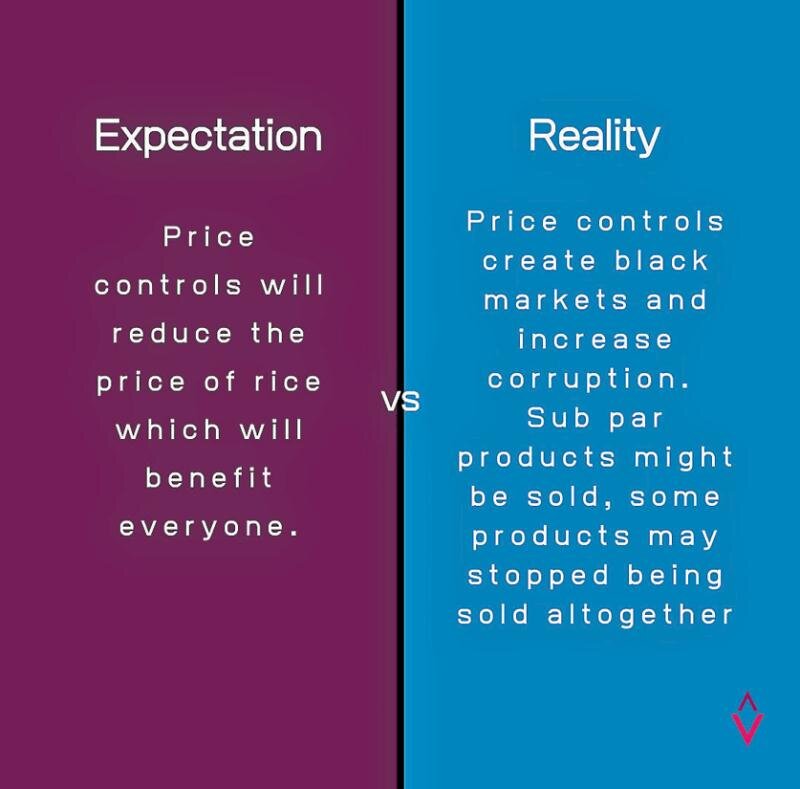
Price control expectation vs reality

Simply imposing price controls and ordering the CAA to carry out raids and fine retailers is not the right approach for this complicated problem. In fact, price controls only bring further market distortion instead of taking prices down. Price is meant to function like a thermometer in a market, measuring the temperature of demand and supply to provide an accurate rate. If your child has an infection, as a result of his or her immune system, the temperature will rise. Instead of treating the infection, what would happen if you manipulated the thermometer, reset it at normal body temperature, and attempted to convince yourself and others that your kid has magically recovered?

Artificially controlling the price is the same as manipulating the thermometer – it perverts and misrepresents the market while failing to address the problem at its root.

Price controls also create black markets and increase corruption. More rice may be stocked in stores in order to bribe and create a black market for rice. Another possibility is the release of inferior quality products into the market as producers attempt to lower their costs to match the regulated price. In certain cases, the product may go completely off the shelf as no retailer wants to sell it at a loss. The best way to get an estimation of the myth of price controls is to compare controlled prices on the CAA website and the Department of Census and Statistics’ weekly prices.

In conclusion, the idea that price controls imposed by the Government will benefit the farmer is nothing but a myth to please the crowd within our political theatre. However, in managing this political theatre, it is important to remember that behind the curtain, these policies are far from the solutions we need, and they will have dire consequences that affect many connected industries and consumers into the foreseeable future.


New year, same Sri Lanka?

Untitled design (1).png

In this weekly column on The Sunday Morning Business titled “The Coordination Problem”, the scholars and fellows associated with Advocata attempt to explore issues around economics, public policy, the institutions that govern them and their impact on our lives and society.

Originally appeared on The Morning


By Aneetha Warusavitarana

We entered 2019 on the back of a constitutional crisis, with the anticipation and uncertainty that accompanies any year which entails a presidential election. It is safe to say that a lot has happened in the year 2019. The country was devastated by the Easter Sunday bombings and had to slowly piece itself back together. The presidential election came and went and the country has a new President and Prime Minister. In a few short months, the general election will be held and the new Parliament will be voted in. It is a difficult year to take stock of and summarise, but looking forward, what can we expect for 2020? More importantly, what should we be expecting and how do we hold our Government to account?

Are we going to see an economic turnaround?

Will Sri Lanka play its cards right in 2020?

The country has witnessed quite a drastic turnaround with the introduction of a slew of tax cuts by the President within days of being appointed. The intention of these tax cuts is to ease tax burdens and provide a stimulus to the economy. However, the resulting drop in revenue has been estimated to be 2% of GDP. The Government has taken a few steps to counter this by raising excise duties and the Ports and Airports Development Levy. It has also committed to tightening government spending in the upcoming months, as it aims to maintain the budget deficit below 4%. Regardless, the Government appears quite ambitious in its goals for 2020, with economic growth targeted to double this year. The outlook presented by the Government is one that is fiercely positive.

Others are more sceptical. Sri Lanka’s sovereign credit rating has been downgraded to “negative” by Fitch Ratings, with the tax cuts cited as one reason for this drop. They also expect to see government debt increase in the medium term and argue that the tax increases will not be sufficient to counter the cuts that have been made. The increase in excise duty, for instance, will only cover 10% of the revenue lost by the VAT reduction. They do acknowledge that future policy steps could mitigate these concerns and while they expect the budget deficit to widen by 1.5% of GDP, they expect to see an increase in GDP growth by 3.5% in 2020 as well.

What does all of this mean to the individual?

Projections and policy statements are all well and good, but these numbers and percentages take time to translate into anything meaningful to an individual. The recent increase in the prices of vegetables has a greater impact to the voter than what is outlined in the paragraphs above. Sri Lanka’s graduation to upper middle-income status has not necessarily been felt by all Sri Lankans. According to the Household Income and Expenditure Survey (HIES), the mean household income per month is Rs. 52,979. An individual’s mean income per month is Rs. 33,894. An increase in these numbers would be something meaningful. The opportunity to work in decent employment and see an increase in wages is probably what would improve the living standards in this country.

The Government has however tried a different tack with this problem. Following in the steps of innumerous governments before them, they have promised to increase hires into the government service. In a novel twist, the Government has promised to employ 100,000 individuals, selected from families that are recipients of the Samurdhi benefit. The rationale appears to be to give jobs to those most vulnerable. While this is a worthy sentiment, the implications of this policy should be seriously considered. Despite the change in Samurdhi allowance from Rs. 3,500 to a salary worth Rs. 35,000 for each individual, this policy measure further expands the state which already accounts for roughly 14% of the labour force in the country. Salary payments are a substantial component of government expenditure, only coming second to interest payments on our loans.

As the Government appears to embed itself deeper into our economy and takes on such significant policies, it is important to remember that the brunt of their oversight increases the burden on taxpayers. Although it may not feel like it, macroeconomics do shape our everyday lives and if the Government is unable to continue on a path of fiscal consolidation with careful expenditure management, the impact will be borne by us.

New Year’s resolutions

At this point, it is difficult to predict where the country is headed. Given that the parliamentary elections are around the corner, it is possible that some ambitious policies like the moratorium on small and medium enterprise loans and the increase in government hires are simply to garner public favour. Policy direction may change towards the middle of the year. Regardless, there are a few things to consider and a few facts that are unlikely to change: We have debt repayments to make, and unless the Government wishes to default, there should be careful fiscal management to ensure that we are able to meet these commitments. The country is in dire need of economic growth. We need to attract investment and kickstart the economy. Sri Lanka needs to plan beyond four years if we are to escape the dreaded economic boogeyman: The middle-income trap.

A big part of achieving this is holding the Government accountable. In present times more than ever, this is vital. Sri Lankans, like all people, are not fond of paying taxes – a fact reflected in our low rates of collection. We do however pay them, in various forms and in varying degrees. This money that we hand over to the Government is what partly funds policy decisions, giving us the right to demand accountability and transparency. As we close off an action-packed decade and open this new chapter, it is crucial that we stay committed to ensuring that we get the future we were promised, and the future we deserve.


Partial privatisation: A happy middle ground?

Untitled design (1).png

In this weekly column on The Sunday Morning Business titled “The Coordination Problem”, the scholars and fellows associated with Advocata attempt to explore issues around economics, public policy, the institutions that govern them and their impact on our lives and society.

Originally appeared on The Morning


By Sumhiya Sallay

Reforming Sri Lanka’s state-owned enterprises has been part of the new Government’s policy agenda. With 527 SOEs, Sri Lanka has an excessive number of state-owned enterprises. Financial reporting of these enterprises has been low, and the Ministry of Finance has published the financials of only 54 of these state-owned enterprises, which have been classified as “strategic”. The losses of these 54 are staggering enough; in 2018, they made a net loss of Rs. 26 billion, thus making it clear that reform in this sector is badly needed.

The Government has committed itself to transforming them into profitable entities; a committee has been appointed to hire technocrats onto the boards of these state enterprises, and the committee has called for applications. While this is commendable, the reform agenda appears to end here; the next step of privatising some of the loss-making, non-strategic state enterprises has been taken off the table. This is made abundantly clear in the Government’s National Policy Framework, which states that it will enact laws to stop the privatisation of state enterprises.

If privatisation is off the table, what can be done?

The three main state enterprises – Ceylon Petroleum Corporation (CPC), Ceylon Electricity Board (CEB), and SriLankan Airlines – recorded a combined loss of 1.3% of GDP in 2018, compared to 0.5% of GDP in 2017. Given that the expected revenue loss from the recent tax cuts is an estimated 2% of GDP, it is clear that turning our state enterprises around would go a long way towards achieving the fiscal targets set by the Government.

If the Government has taken the option of privatisation off the table, but wants to actively transform state enterprises into profit-making entities, the option of private management should not be dismissed in the same breath as privatisation. Private management of state enterprises would essentially be partial privatisation. In this scenario, the Government would share ownership of the enterprise with a private company, and the management of the enterprise would be transferred to the private company. In the case of strategic enterprises, the Government could retain majority shareholding.

A government’s primary responsibilities towards its country and people should not be the management of business enterprises; the government has a responsibility to uphold the rule of law, ensure national security, and protect the rights of its citizens, and the management – or in this case the mismanagement – of state enterprises should not make the list. A government is the entity that sets the rules of the game; it details out the laws and regulations that govern businesses. When a government also enters the playing field, there is an inherent conflict of interest that occurs. Even if the government remains impartial, it does not have the necessary incentives in place to run a business successfully.

However, when a private entity manages a business, they would look at increased profits as the business is under their sole control, and any losses they make or issues they face would be their responsibility. The incentive is to minimise losses and make the business more productive. A private entity managing state enterprises would absolve the Government of having to invest in loss-making public enterprises and reduce government borrowing.

Privatization

Further, private management would bring down fiscal and administrative pressure of state-owned entities and remove the huge weight of having to manage state enterprises off the Government’s shoulders. This encourages the Government to work towards providing increased quality of living for the people through effective governance, rather than spending so much of its time and money on managing businesses.

The idea of partial privatisation, initially, may be a challenge to implement, but in the long run, it would result in highly effective results. This would also mean that there would be less political influence on the management of state enterprises.

It has worked before, so why dismiss it?

Looking back at partial privatisation in Sri Lanka, a significant achievement has been the liberalisation of the telecommunications industry. This was implemented in order to provide better services for customers through competition and industry development through private sector participation. Both customers and society as a whole benefited from it as there was a reduction in call charges (tariffs), improved telecommunications in rural areas, decrease in equipment costs, industry profit growth, increased government revenue, etc. This example of partial privatisation shows us the benefits not only the Government but also the people would gain. Taking into account these loss-making state entities and the debt repayments the Treasury will have to make over the next few years, the option of partial privatisation by the Government should be seriously considered.


Trouble at our borders

Untitled design (1).png

In this weekly column on The Sunday Morning Business titled “The Coordination Problem”, the scholars and fellows associated with Advocata attempt to explore issues around economics, public policy, the institutions that govern them and their impact on our lives and society.

Originally appeared on The Morning


By Erandi de Silva

Sri Lanka’s long-standing system of “para tariffs” is a regressive institution that is fairly unknown to the everyday Sri Lankan. A para tariff refers to a type of tariff that is levied on top of the regular Customs Duty that all our imports are subjected to. It is surprising to learn that most of our imports endure not only the regular Customs Duty, but also the Port and Airport Development Levy, “CESS” (Export Development Board levy), and VAT (Value-Added Tax).

Effects of our current tariff system

These taxes stem from revenue concerns and protectionist motives to protect specific local businesses and reduce imports. However, the unsavoury reality is that it deters international trade while making imported goods incredibly expensive for all Sri Lankans. Despite the Customs Duty that already amounts to 30%, once the para tariffs come in, the total tax on most goods – from food to personal care items – can increase anywhere from 50% up to 100%. This severely limits our ability to choose the products we want to consume and puts even basic items almost out of reach in terms of the price point for most people.

Another primary issue with the prevalence of para tariffs is the lack of transparency for the general public. While most are simply unaware of the complexity of these taxes and their effect on the cost of our goods, the current system makes it exceptionally tedious and confusing for ordinary citizens who wish to access and understand our tariffs, as the method used to calculate the total tariff of a good is unclear.

Moreover, as this convoluted system is incredibly difficult to grasp and manoeuvre, locals who attempt to ship in products or factor inputs for their own businesses or personal needs will be slapped with massive fees that they did not anticipate for their shipments. This increases their costs, making growth unlikely for local businesses that need imported inputs as well. This is highlighted in a 2019 study by Asian Development Bank (ABD), which reports that local exporters cited inadequate access to imported inputs at competitive prices as one of their top challenges.

Local producers who are not import-dependent also lack the incentive to improve their products and lower their prices as they have no foreign competition; they can price higher as imported products are artificially more expensive. This means our local products remain internationally uncompetitive and our imports are unnecessarily expensive, while producers increasingly rely on the Government to protect their profits. In short, this system is counterproductive – it both hinders affordable imports and the growth of many local businesses.

Guides for positive reform

If the Government truly cares about the quality of life of Sri Lankans, it would take steps to increase consumer choice and affordability as well as improve our local businesses. Trade liberalisation is by far one of the most effective methods of achieving these outcomes. Replacing our confusing system with a uniform tariff rate could be the first important step in this journey.

Given the issues elaborated above, it is clear that our current reliance on the overcomplicated para tariff system is detrimental to the country’s economic interests and future growth. It is time for a different approach, and to some extent, the Government has come to this conclusion. The National Policy Framework includes the point “reducing import taxes on raw materials and intermediate goods to promote domestic production” under its macroeconomic policy framework. While tariff reform has to be much broader for the country to reap real economic benefits, this is one component.

Chile, which is often championed for its move towards trade liberalisation after a long history of protectionism, experienced significant growth subsequent to the introduction of a flat tariff for imports. This reform to simplify border tariffs led to a better allocation of local resources as it prevented preferential treatment of particular industries and local producers. Therefore, the market evolved to be more competitive and local businesses found it easier to access the necessary imported inputs they needed. This helped steer growth in the export sector as well, causing the volume of total exports to rise at an annual rate of 8.1% from 1990 to 2003. Despite the initial flat tariff rate being relatively high, the implementation of a uniform rate itself stirred positive effects while also inspiring further liberalisation. The rate of the flat tariff was gradually reduced over time up until the year 2003, and Chile now boasts a uniform tariff as low as 6% along with multiple free trade agreements (FTA) that completely eliminate tariffs for the countries involved.

Tax iceberg

Even though Sri Lanka’s case may not be identical, it is evident that simplifying and integrating tariffs will reduce confusion, increase transparency, and remove red tape that stands in the way of better trade, which in turn bring more opportunities for economic growth. Although it is not necessarily the desired endpoint, if Sri Lanka wants to maintain its tariffs at a relatively high level, the Government could still eliminate the para tariff system and impose a single, uniform rate that encompasses the same level of protection for all local industries.

At the very least, this could still facilitate much better exchange at the border by bringing more clarity to the system and eliminating the current uncertainty about the total tariff value for a product. This reform could then improve our local businesses and export sector by increasing accessibility to imported inputs for local companies, as it did in Chile. In the long run, however, a uniform tariff will not single-handedly improve much if the rate of tax is still incredibly high; Sri Lanka would also have to gradually reduce the overall tariff rate and engage in other strategies to ease trade for the benefits of a more comprehensible tariff system to truly materialise.

If the Government takes the right actions, this could be the beginning of a positive trajectory towards a more functional and effective tariff system. The question is: “Are we ready to break down some walls?”


Will Gotanomics reform our SOEs?

Untitled design (1).png

In this weekly column on The Sunday Morning Business titled “The Coordination Problem”, the scholars and fellows associated with Advocata attempt to explore issues around economics, public policy, the institutions that govern them and their impact on our lives and society.

Originally appeared on The Morning


By Dhananath Fernando

As a country, Sri Lanka has seen its fair share of challenges. Since Independence, apart from the 1977 economic reforms, our economic reform agenda has been mediocre. Instead of taking bold decisions to improve competitiveness and keep pace with global trends, we adopted an inward-looking approach. We boast about our natural resources and claim that we are the pearl of the Indian Ocean but have not introduced the reforms needed to convert those resources into economic gain. Sri Lanka’s debt is a little over 82% of GDP (1), and rises to a 100% of GDP if one includes private sector loans. In other words, our borrowings exceed what we produce as a country each year. Poor economic growth, averaging 2.6% exacerbates the problem.

In this economic backdrop, Sri Lanka has decided to place its trust in a President who promised significant economic reforms, a mix of tax reforms, governance reforms, and some subsidies with the objective of bringing relief to the people.

The President has walked the talk during the last few weeks. A board has been appointed to select the heads for Sri Lanka’s loss-making state enterprises, and sweeping tax cuts have been provided to encourage all businesses and individuals to boost economic growth. Public conversation centres on whether these reforms are practical and the question of the day is: “Will this work or is it just a political gimmick for the upcoming parliamentary election?”

At surface level, hiring professionals based on merit will improve fiscal discipline and accountability in our state-owned enterprises (SOEs). The tax cuts will drive the supply side of the economy to boost growth, at least in the short run. However, this article discusses a few challenges to SOE reform in particular.

1. Challenge of recruiting the right people to SOEs

The appointment of a well-experienced board to appoint members to head SOEs and opening calls for applicants to include Sri Lankans living overseas is a step in the right direction. But the question that remains is whether our labour market has the capacity to fill positions for a very long list of SOEs. Turning loss-making SOEs around would require substantial reform. According to Advocata, the number of SOEs including subsidiaries and sub-subsidiaries, amount to 527. Even if you take a good 250 which are the critical institutes and appoint a minimum of three members to a board, this brings us to a total of 750 senior-level appointments. This is nearly a factory of people with a decent level of business acumen who are able to take some hard calls. Even paying market rates and finding people will be a mammoth task given the soft skill shortages we have in the country. Even starting with the 54 strategic SOEs would be a challenge.

Converting loss-making institutes which have strong links to trade unions is a harder job than getting a start-up off the ground. On the flip side, the Ceylon Electricity Board, SriLankan Airlines, Ceylon Petroleum Corporation, and Sri Lanka Transport Board account for the largest losses annually. The boards of these gigantic loss-making institutes will be crucial. The Government would have to leave political capital aside and support the reform process of these institutions if they are truly committed to turning them around. These four SOEs should be at the top of the reform agenda and the Government should not dilute its focus just because they will be challenging to reform. In the appointment process, the next step is to avoid hiring unqualified people who will continue the system of interference. To ensure this does not happen, it is key that the selection process is transparent.

2. Challenge of converting some loss-making SOEs which are beyond efficiency and the performance of senior management performance

Some of these SOEs are clearly beyond just the capacity of the management team. Some require further investment if they are to be turned around and the Treasury’s ability to do so is questionable. These entities have been bleeding out money at the expense of the Treasury and given the expected drop in revenue, further investment seems increasingly unlikely. Some SOEs need to cut down the cadre drastically if they are to even breakeven, and Voluntary Retirement Schemes (VRSs) should be considered in the restructuring process.

The manifesto of President Gotabaya Rajapaksa is clear – privatisation is off the table but the consolidation of certain nonstrategic SOEs is still a viable option. However, most of the SOEs will not be able to turn around solely on efficiency increments. The multitude of organisational layers and market drawbacks mean that effective reform will require time, investment, technological expertise, and serious revamping.

3. Overcoming corruption in the bureaucracy and poor level of knowledge in subject content by senior government officers

State Owned Enterprises

It is true we have genuine, knowledgeable civil servants but undoubtedly the numbers are few. In SOEs the symbiotic ecosystem of corruption of bureaucracy and board-level appointees is no secret. The effectiveness of the board depends on whether or not the bureaucracy supports the reform. Simply, they can make or break it. The ability for boards to intervene in the bureaucracy is uncertain. The pervasiveness of corruption is clearly a result of political appointments provided by consecutive governments for party supporters and henchmen. Given this, it is not only difficult to find clean bureaucrats, it is almost impossible for those individuals to navigate a system that is geared against them.

4. Challenge of ensuring fair competition with SOEs

Some SOEs are simply monopolies run by the Government. Sri Lanka Ports Authority is one example and there is no reason for them to make losses. It is important to re-evaluate the actual profit-making capacity in Government monopolies. In realistic terms only, the profits really do not showcase their economic gains since they do not operate in a competitive market place. At the same time, there could be some areas where the Government needs to operate even at a loss due to public interest and the absence of the private sector. Operation of buses in rural areas is one such example. The challenge would be transforming and maximising the profits of SOEs which are already in a competitive market place while ensuring a level playing field for the private sector.

For example, there are many players including small and medium-sized enterprises (SMEs) in the modern retail market due to urbanisation and the growing middle class. Government-owned Sathosa is also competing with them and the past record shows that some concessions are provided only to Sathosa, which are not provided to private businesses. If the state procurement process shifts to get supplies only from Government institutions, just the numbers of higher profits or lower losses, it will be a number gimmick and will not create meaningful growth. The same request has come multiple times by some parliamentarians due to lack of knowledge on the overall economy to get the supplies only from Government entities for Government institutes. Such measures will lead to higher corruption and discourage the private sector.

In other words, the board, to appoint new members for SOEs should follow up with a series of guidelines to ensure that principles of fair competition are upheld, that key performance indicators (KPIs) are monitored, performance contracts put in place, and that an effective incentive structure is put in place.

The President and the new Government should equally focus on continuing the investigations on corruption and misallocation of money so the new appointees will take it as a “responsibility than a reward” as per the President’s line of thinking.

In summary, the President’s decision to appoint a committee for the board appointments is a step in the right direction but is just an entry to the complicated problem. To convert the organisations, another series of reforms should follow at the earliest, as time is running out with an anticipated revenue loss, tax reforms, and our SOEs; an ICU patient constantly bleeding for few decades.


Tax cuts: Could Sri Lanka pull off a Georgia?

Untitled design (1).png

In this weekly column on The Sunday Morning Business titled “The Coordination Problem”, the scholars and fellows associated with Advocata attempt to explore issues around economics, public policy, the institutions that govern them and their impact on our lives and society.

Originally appeared on The Morning


By Dhananath Fernando

The tax concessions announced last week have taken our economic landscape by storm. There are conflicting opinions on this decision. While some businesses and experts commend the sweeping tax cuts, the revenue loss is a point of concern to others. Experts in the field have estimated that revenue losses could be as high as one-third of total revenue. A diverse range of headlines covering the issue question the practicality of these cuts, given Sri Lanka’s economic and fiscal situation.

While national conversation is currently centred on the tax cuts, there are also demands being made of the Government. An example would be the headline: “All Ceylon Transport Union writes to Prime Minister asking for a bonus.”

SOE and Tax infographic (1).jpg

This is indicative of the balance the Government needs to strike. The rationale for these tax cuts by the Government was to broaden the tax base and spur economic growth. This reform is expected to result in revenue loss in the initial years, which leaves the Government with no option but to curtail expenditure before considering further borrowing. But the All Ceylon Transport Union (ACTU) has indicated that they are not ready to tighten their belts. In fact, they have very high hopes for further benefits from the Government.

The Government could be compared to an entertainer juggling too many balls while the audience watches on. While everyone is enjoying the show, they shoot questions at the entertainer. How are you doing this? How long can you do this for? Is it a gimmick or is it real?

This article is a commentary on the potential challenges a government will face when having to juggle too many magic balls. At one point in time, Georgia found itself in a very similar position.

How did Georgia manage this magic act?

Georgia, a country with a population of 4.4 million people, made serious tax reforms from 2004 after reformist leader Mikheil Saakashvili came into power.

The categories of taxes were reduced to six from 22. Instead of a complicated tax system, a simple tax system was introduced. Value Added Tax (VAT), which was at 20% was brought down to 18% and Corporate Tax, which was also at 20%, was brought down to 15%. Dividend and Interest Income tax was also reduced to 5% from 10%. Income, VAT Corporate, Excise, Customs, and Property Tax were the only taxes applicable. All the other taxes were abolished. Ultimately, the result was that tax revenues increased by tenfold between 2003 and 2008. The country witnessed an increased inflow of foreign direct investment and real economic growth averaged 8%.

The caveat here is that above results were achieved not just by bringing the tax rates down. Their entire system went through a complete clean-up. An electronic tax payment system was introduced and strict laws were passed for tax evasion. In parallel to ongoing tax reform, the country also undertook regulatory reform in order to sustain tax income. For instance, 800 licenses were abolished and a digital property registry was introduced. The Government relaxed visa regulations for tourists to boost tourism numbers. Anyone who had a Schengen visa or was a tourist from a country which had a GDP per capita twice that of Georgia’s could freely enter Georgia, thereby boosting revenues.

Georgia expanded their reform agenda by adopting international standards which simplified and consolidated regulations. The Organisation for Economic Co-operation and Development’s (OECD) standards for pharmaceuticals, food, consumer products, and services were fully adopted and welcomed; special permits were not required for the OECD-approved goods and services to enter Georgia and the banking sector benefited from easier operations as a result of adopting these standards. In seven years, Georgia improved dramatically on its “Ease of Doing Business” ranking. In 2003, it was ranked 111th and by 2011 was 12th in the world.

Can Sri Lanka be the next Georgia?

Now, the big question is whether Sri Lanka could be Georgia in 2008, and in magicians’ language: Can we juggle these competing interests and achieve economic growth? The reform prescription Georgia followed was not rocket science. Reduced regulation, a low and simplified tax regime, proper contract enforcement, and the rule of law drive economic growth and businesses.

The newly introduced tax cuts may spur economic growth, but it has to be managed carefully. Sri Lanka is at risk of seeing its credit rating dropping, and given the expected rise in the budget deficit, the Government would also have to renegotiate the terms of the IMF bailout.

The next few years will be difficult, given the series of large loan repayments due till 2022. Widening the country’s tax base will take at least two to three years, and this should be supported with further reforms in the economy in order to stimulate business and trade. Whether we started juggling an extra ball at the right time is the question of the hour. The Government will have to commit to further reform and focus on limiting expenditure if these tax cuts are to be successful.


Addressing Sri Lanka’s debt: How to move forward

Untitled design (1).png

In this weekly column on The Sunday Morning Business titled “The Coordination Problem”, the scholars and fellows associated with Advocata attempt to explore issues around economics, public policy, the institutions that govern them and their impact on our lives and society.

Originally appeared on The Morning


By Sumhiya Sallay

Sri Lanka’s debt-to-GDP ratio is at a staggering 82.9% as of 2018, an increase from 76.9% in 2017. While the Ministry of Finance projects that these ratios will decline in the future, achieving these targets is of the utmost importance.

With a new Government in place, the country can expect to see new projects and policies introduced as the Government works on achieving their campaign promises. It is crucial that our loan commitments are a constant point of reference in this postelection period, where policies and projects that would shape Sri Lanka for the next four years are being evaluated and decided upon.

Our new title of upper middle-income country recognises the economic growth we have witnessed as a country. The challenge that lies ahead is sustaining this growth and clearing this hurdle of debt.

What can we do about our debt?

Sri Lanka debt

Total government debt is currently 82.9% of GDP, with the total debt service amounting to 14.5% of GDP. Government revenue as of 2018 was Rs. 1,920 billion, while government expenditure was Rs. 2,693 billion. The shortfall is clear, the Government has to borrow and borrow extensively to keep the country running. To elaborate further, the amount of money spent on debt servicing in 2018 amounted to 108.8% of government revenue. What is more alarming is the fact that the revenue-to-GDP ratio of Sri Lanka is one of the lowest in the world, and with the fast-growing emerging market economy, this brings much concern.

Bringing our debt-to-GDP ratio down will be challenging. The country will have to commit to a clear and stable monetary policy and maintain investor confidence. If these conditions are coupled with nominal growth in the economy, the result would be a fall in our debt-to-GDP ratio.

Of course, this is easier said than done, and borrowing from Peter to pay Paul is not a solution in and of itself. This needs to be accompanied with strong fiscal policy to ensure that the country gets a better grip on its finances.

Addressing expenditure

Given the recent tax cuts, it is clear that the country will have to balance this decrease in tax revenue with a corresponding decrease in government expenditure. The question is: How does a government manage their debt, taxes, and expenditure in a way that allows for economic growth while avoiding prohibitive rates of taxation?

Simply, some compromises have to be made and a delicate balance struck.

In order to achieve this balance, it is vital that we move away from ad hoc policymaking and the Government plans and works within a medium-term policy framework. In other words, the country needs to adopt a well-planned medium-term expenditure framework. This would mean that the Government would be able to plan projects and programmes taking into account a three-year resource envelope and fiscal obligations aligned with the allocated annual budget which would provide productive financial outcomes. This encourages the fiscal management of the Government’s revenue and expenditures, and thus helps control debt.

A medium-term expenditure framework (MTEF) sets out a rigid budget plan within which the Cabinet and central agencies ensure fiscal discipline when allocating public resources. This approach would set fiscal targets and allocate resources for strategic priorities within these targets, thus forming the basis of national priorities and expenditure prioritisation.

The MTEF aims to improve inter and intra-sectoral resource allocation by effectively prioritising all expenditures according to the Government’s socioeconomic programmes and committing towards allocating resources to only the most important projects.

This approach would monitor current expenditure estimates of policies and programmes and form a reference point for the upcoming years’ budgets. A MTEF would pave the way for policy and funding changes and thereby give time for ministries and agency managers to adjust and make better plans for their operations.

While following a MTEF is important, the Government could look at economic policies that would need adjustments to allow the country to repay loans, such as diversifying the labour market, supporting micro to macro businesses, re-regulating SOE finances, etc.

The Government could also create a policy environment that would encourage investment. While there are clear strategies that could be followed to manage our debt, this should be at the top of the new Government’s agenda, and our debt situation should guide policies on expenditure, borrowings, and taxation.

The Ministry of Finance projects that the country’s debt-to-GDP ratio will decline in the coming years, with an expected drop to 72% of GDP in 2022, but this is wholly dependent on Sri Lanka putting in place and adhering to a sustainable fiscal policy. Sri Lanka has an opportunity to overcome this challenge and it is vital that we grab this opportunity and adopt necessary policies.


Economic priorities for the new president

Originally published in Echelon*

By Ravi Ratnsabapathy

A new president has now taken office. How should he set about addressing the concerns of citizens? During the campaign, the candidates and their supporters announced what they plan to do if elected to office. However, most of these lack credibility as they pay no heed to the constraints in the economy.

THERE ARE THREE SIGNIFICANT PROBLEMS; THE FISCAL/ DEBT PROBLEM, EMPLOYMENT AND PRODUCTIVITY.

So after the celebration of victory is over the successful candidate should take a long cold shower, grab a stiff drink and become acquainted with some fundamental problems in the economy. Two months ago, former minister Milinda Moragoda helpfully provided a list of seven cold economic truths that presidential candidates must face:

  1. The Sri Lankan government spends twice as much as it earns in revenue. Therefore every year, the Government borrows both domestically and internationally to meet approximately half of its expenditure.

  2. It’s estimated that Sri Lanka requires only 750,000 to 800,000 government employees to provide the services needed by the public. However, the state employs over 1.5 million people. This is one of the highest public servants to population ratios in the world. Besides, to ease employment pressures, the government regularly absorbs the unemployed graduates of local universities. Further, there are now over 600,000 retired government servants, who receive pensions.

  3. Ninety percent of government revenues are required to be spent on servicing the national debt.

  4. Sri Lanka imports around twice as much as it exports.

  5. Sri Lankan Airlines, the Ceylon Petroleum Corporation, and the Ceylon Electricity Board have become dinosaurs and represent a severe drain on public finances. If left unchecked, these inefficient and costly enterprises can potentially cause the economy to collapse. Vested interests have long dominated these institutions, and no political leader has dared to restructure or reform them.

  6. Although Sri Lanka is considered to be an upper-middle-income country, two million families or nearly 40% of the population is on the Samurdhi welfare programme. A new generation of political leaders must have the courage to re-examine and modernise Sri Lanka’s welfare system.

  7. Twenty five percent of the Sri Lankan workforce is employed in agriculture. Experts say that in an economy such as ours, agricultural employment should be 15%. To manage this transition, Sri Lankan leaders will have to create higher-wage job opportunities in other sectors while bringing efficiencies into the farming sector.”

This is a good summary of critical issues. There are three significant problems; the fiscal/ debt problem, employment and productivity. The main problem is that the government spends far more than it collects in taxes and covers the difference by borrowing. As a result, the debt keeps rising every year, and because we borrow to pay both the capital and the interest, it increases even faster. It is exactly like a household living on a credit card but at a bigger and scarier scale. These problems have existed for decades but have progressively worsened and have now reached a difficult-to ignore point.

DESPITE CLAIMS TO THE CONTRARY, SRI LANKA IS NOT AN ATTRACTIVE INVESTMENT DESTINATION

In 2018, total debt service cost was 108% of government revenue, meaning all government revenue (plus a bit more) went to service debt! On average, between 2006- 18 debt service cost was 93% of revenue. What does the government do with this money? The most substantial proportion about 42% of revenue gets spent on salaries and pensions of public servants. Interest on debt absorbs another 37%, the remainder gets spent on various other services, but loss-making state enterprises consume a chunk of it.

This, in a nutshell, is the major problem. What does this mean for policy?

  1. Unless tax revenues are to rise (and who will ever vote for that?), spending must fall.

  2. State sector salaries and pensions are no longer affordable. Politicians cannot promise more state sector jobs or salary increases until finances are on a sound footing. At the least, recruitment and increments may have to be frozen and the difficult question of reducing employment in the public sector faced.

  3. Sri Lanka is producing graduates who expect a government job. During 2005-18, state sector employment grew from 850,000 to 1.3m, partly to “create” jobs for these graduates, adding to the debt problem.

    The average overall employability ratio of Sri Lankan university graduates is 54% according to a research paper (Nawaratne, 2012). Arts and management grads have higher rates of unemployment in the country and accounted for 76% and 36% of unemployed graduates (Kanaga Singam, 2017).

    The private sector experiences shortages of labour but complain that graduates lack skills. It is insane that the best of our students taught in our universities at public expense complete fifteen years of education but lack employable skills.

    About 55% of the graduates are from arts and management while only 28% are from science, IT and engineering. For a developing country, these ratios need to be in reverse.

    Primary and secondary education also have problems, not least a lack of school places and an excessive concentration of ‘popular’ schools in Colombo, leading to long commutes for children. Education is supposed to be free, but why do so many parents spend money on tuition? Why do many opt for private “international” schools or private tertiary/university education? These are symptoms of problems in quality and access. The broader question is: can the current system generate people for a knowledge economy?

  4. If public sector jobs are not available, then the onus is on the private sector to create them, which requires new investment. Sri Lanka suffers from low savings rates (around 21% of GDP in 2017/8), meaning it does not generate the same levels of domestic capital for investment that countries with higher growth rates have. To raise the growth rate significantly implies sustaining an investment rate above 30%. For example, Singapore’s investment rate averaged 35% between 1961- 96. This shortfall in investment must be met from overseas.

Despite claims to the contrary, Sri Lanka is not an attractive investment destination, as evidenced by low FDI rates. There are many issues to solve, including policy uncertainty, regulatory problems, land and infrastructure.

In the 1990s privatisations formed an essential channel for FDI, by opening new sectors for investment, notably in telecoms. Public-private partnerships in the port (SAGT and CICT) were also a success. Before the PPP arrangements, between 1997–2000 the volume of containers handled in Colombo port averages 1.7m TEU’s. SAGT started operating in late 1999, CICT in 2013 and by 2018 volumes grew to 7m TEU’s; 66% of which was handled by the two private terminals.

Privatisations and PPP’s are no longer popular, but if an investment is needed and the state is unable to borrow what other options are open? The problem with privatisations and PPPs is that if they are not done through transparent, competitive processes outcomes may be poor. This issue needs to be faced squarely. The recent closed-door deal with the ill-fated Colombo East terminal is not the way forward: the open bid of 2016 which attracted top international shipping lines and operators including the Ports Authority of Singapore was inexplicably cancelled.

The failure to create jobs is why so many of the most talented and motivated people migrate for work. We see contradictory statements by politicians, on one side celebrating the inflow of remittances, on the other bemoaning the social costs associated with migrant labour. No one seems to ask the hard question as to why the local economy cannot create enough jobs to absorb these people.

By some estimates almost 23% of the workforce is employed abroad, if not for this, unemployment would be close to 30%. The failure is not just investment but investment in high productivity jobs that will pay the high salaries that people want. Agriculture is the most unproductive sector of the economy, absorbing 28% of the workforce but generating only 8% of GDP. Politicians promise subsidies or guaranteed prices to ‘help’ this sector but is this feasible in the light of the fiscal and debt issues?

None of these challenges are easily overcome, but unless the reality is faced, Sri Lanka may be heading for multiple crises.


*this article was published in the November issue of the Echelon Magazine, prior to Presidential Elections.

Allocating ministries: scenario post-parliamentary election

Untitled design (1).png

In this weekly column on The Sunday Morning Business titled “The Coordination Problem”, the scholars and fellows associated with Advocata attempt to explore issues around economics, public policy, the institutions that govern them and their impact on our lives and society.

Originally appeared on The Morning


By Erandi de Silva

With the 2019 presidential election complete, some of the main policies that have been outlined include establishing a meritocracy, improving efficiency, and eliminating corruption. Although an interim cabinet has now been appointed, the upcoming 2020 parliamentary elections will ultimately determine the new government of Sri Lanka. Given this, it is necessary to take a deeper look at the structure and functionality of our ministry system.

Why should ministry allocation be a policy priority?

Sri Lanka had a total of 34 different ministries that each contain numerous departments under them. However, these ministries and departments are often arbitrarily created and grouped within a complicated structure that doesn’t make a lot of logical and functional sense (for example, the Ministry of City Planning, Water Supply, and Higher Education). Allocation of ministry positions in Sri Lanka is also often decided based on party seniority, and not on the minister’s educational background or familiarity with the subject area.

To make things more difficult, cabinet reshuffles are not uncommon as governments struggle to balance functionality and keeping their cabinet members content. With each reshuffle, ministry positions are moved around, ministries are renamed, and departments are relocated. This results in unnecessary institutional costs as government employers adjust to new reporting structures, new bosses, and new work priorities. These reshuffles damage inter-ministry relations and disrupt the flow of project work.

When ministry allocations defy logic and ministries are given mandates that encompass topics as diverse as telecommunications, foreign employment, and sports, prioritisation of work can be understandably difficult. Apart from the challenges that come with such a diverse ministerial portfolio, when the departments under them are allocated in a seemingly ad hoc manner, the problem is exacerbated. For instance, when departments that serve similar objectives are strewn across various ministries, it may hinder co-ordination and cripple the department’s ability to function well.

Ultimately, the system creates unnecessary confusion and inconveniences to both the public that require services from various departments and the public servants that find it very difficult to do their job. This not only blocks the general progress of development but also makes larger government projects to transform the economy tedious affairs.

Sustainable reform

Singapore, which is hailed as a bastion of modern development in Asia, now has merely 15 ministries in comparison to the 34 that existed in Sri Lanka. This suggests that when it comes to efficiency in the public sector, perhaps the phrase “the more the merrier” is not appropriate.

Of course, these observations have been made before. In early 2018, Dr. Sujata Gamage presented an alternate framework for clustering cabinet portfolios under 15 core subjects that can be refined and redefined as necessary. This clustering of portfolios is centred on subject area, and included practical changes such as the shifting of vocational training out of the portfolio of the Ministry National Policies, Economic Affairs, Resettlement and Rehabilitation, Northern Province Development, and Youth Affairs, and under the purview of the Ministry of Education. However, given the reality of politics in Sri Lanka, the number of portfolio positions demanded is possible to increase as governments distribute positions of power. Though this is not ideal, the system may still remain functional if these positions are created under the respective 15 core subjects.

While clustering is an important step, it will only facilitate better policymaking and implementation. It does not guarantee that the country will see the envisaged improvement in the government service. Addressing this concern, the Ceylon Chamber of Commerce has put forward further recommendations focused on the introduction of performance indicators. These indicators (which would be measurable and specific) would be set up for each ministry to ensure ministers are made accountable for the delivery of their key objectives. Making these indicators public at the beginning of each fiscal year would create a stronger culture of accountability in the government service. To push this reform further, ministerial performance on these indicators should also be a main criterion when allocating funds for the following years.

The introduction of performance indicators could ideally be coupled with the proposal advocating for a layer of technocrats (that are independently and impartially selected by a civil service commission) entrusted with daily administration duties under the ministers. This would ensure that ministers do not run astray with unrestrained power and that hasty election promises are weighed against legal, moral, and practical implications before being transformed into policy.

In light of these existing suggestions, and the evident complications of our current system, it is necessary that we streamline the allocation of our ministries by systematically grouping only the relevant departments that share a broader common objective together in order to create a clear mandate for each ministry and ensure proper channels of communication and co-ordination.

After parliamentary elections, the new government should move away from constant reshuffles in order to create policy stability and a continued flow of work within government. Finally, as President Gotabaya Rajapaksa himself pledged to support, cabinet ministers should be appointed upon a system of meritocracy. Their selection must be based on their level of competency and familiarity with the area of authority as opposed to seniority within the party.

The new government has a window of opportunity until parliamentary elections. This space and time can be utilised to formulate a structure of performance indicators and set the foundation for a more efficient and accountable system.

If these reforms are made and accountability is ensured under each ministry, it is likely that overall efficiency will increase. This means that government decisions like budget approvals and approval for projects can happen a lot faster, public services through each department will be more efficient and accessible, and public servants are provided with secure employment positions and clear responsibilities under their jobs. If the President is truly serious about improving the efficiency of our country, promoting meritocracy, and erasing corruption, what better way to start than with the peak of our governing administration?


Empowering Our SMEs

Untitled design (1).png

In this weekly column on The Sunday Morning Business titled “The Coordination Problem”, the scholars and fellows associated with Advocata attempt to explore issues around economics, public policy, the institutions that govern them and their impact on our lives and society.

Originally appeared on The Morning


By Sajani Ramanayake

In recent months, there has been extensive debate around the topic of making Sri Lanka a hub for technology and innovation. Across the globe, small and medium enterprises (SMEs), particularly start-ups, have been proven as critical to fostering a culture of disruption and innovation. In Sri Lanka, SMEs are already an integral part of the economy and hold significant potential for achieving our economic vision. Despite this, many of these businesses continue to face debilitating obstacles to growth due to an unfriendly regulatory environment.

Why are SMEs important?

Contributing to 45% of domestic employment and 52% of Sri Lanka’s gross domestic product (GDP), the role SMEs play in the Sri Lankan economy should not be underestimated. While these businesses do form the backbone of the economy, there is potential for growth that should be explored.

The National Export Strategy of Sri Lanka (2018-2022) acknowledges the need to “strengthen Sri Lankan exporters’ market entry capacities” and support “the integration of SMEs from across Sri Lanka into the export value chain”, as this would help increase the overall generation of income in the country. Currently, Sri Lanka lags behind other Asian countries in terms of export figures, and the expansion of SMEs is a good way to facilitate much-needed growth. If SMEs are provided with adequate resources and opportunity, they can plug into global value chains, capitalise on international markets, and drive innovation.

Currently, Sri Lanka’s export portfolio is relatively limited, with a small amount of companies accounting for a majority of export revenue, with SMEs providing a very minor contribution. This lack of export diversification in Sri Lanka’s portfolio thereby makes it particularly vulnerable to the external economic environment and reduces national economic stability. Strengthening SMEs and their access to the export market could thereby present a viable solution to reducing these risks, while improving export earnings, diversifying our export portfolio, and transitioning Sri Lanka into a more complex economy.

What is stopping SMEs from growing?

A lack of finance has been identified as a key constraint by 59% of SMEs in Sri Lanka. SMEs lack the collateral that many lending organisations insist on and often cannot afford to pay the high interest rates charged on loans. Unavailability of accounts and financial information due to the inability to maintain proper accounting records and lack of know-how on business plan creation, also makes it difficult for SMEs to be eligible for loans.

EJ3shPKU0AAXeYA.jpg

Another problem that SMEs face is the sheer number of regulatory barriers. The clearing of imports and exports through customs as well as high credit periods can be challenging to small businesses. Taxes on imported raw material and capital goods also increase costs and reduce profits. There are also many licenses and permits that need to be obtained before obtaining state lands for business purposes, such as clearances from the Central Environmental Authority, Forest Department, and Department of Archaeology, depending on the nature of the business. This makes obtaining land difficult for SMEs, and deters potential entrepreneurs.

The lack of information and guidance for entrepreneurs about how to set up and expand their businesses is also a major hurdle. In a study conducted by the Ministry of Industry and Commerce, in conjunction with Ernst & Young and GiZ, about the institutional and regulatory framework relating to the SME sector in Sri Lanka, SMEs expressed a lack of understanding about potential export markets and opportunities, a lack of clarity on the process to obtain grants and lease agreements for state-owned lands for business purposes, and low awareness on applicable taxes and the benefits of registering for taxes.

What is being done to help SMEs?

One initiative that has recently been put in place is the establishment of “Empower” by the Colombo Stock Exchange (CSE) and Securities and Exchange Commission of Sri Lanka (SEC). Empower is a board dedicated to attracting SMEs to the CSE and seeks to improve access to finance for SMEs while also providing them with the opportunity to build credibility through the disclosure of information and by making governance standards more balanced. This not only helps attract investors, but also helps improve business visibility for the SME. The board allows SMEs to sell equity in order to raise capital – a major obstacle to growth for a large number of SMEs – essentially functioning as a miniature stock market for these enterprises. Listed companies receive guidance both during and after the listing process, and have access to one-on-one meetings, awareness sessions, and public consultations.

There are also other initiatives like export credit facilities provided by several banks seeking to ease the burden of pre and post-shipment financing, the Enterprise Sri Lanka credit programme which offers a range of loan schemes to SMEs, and workshops carried out by private sector companies such as Microsoft to help address a myriad of barriers faced by these businesses. Despite these initiatives, which are a positive step in the right direction, more needs to be done to help Sri Lanka cultivate a holistic ecosystem for SME growth.

One way to do this is by improving infrastructure facilities such as roads and highways to improve connectivity. This would assist in reducing regional differences in the setting up and operation of SMEs, as people and capital become more mobile. Sri Lanka also needs to streamline its regulatory mechanisms if it wants to help SMEs reach their full potential. Currently, there are at least 43 different institutions affiliated with SME governance in Sri Lanka, resulting in a climate of fragmented governance and poor information. Other potential solutions could include the creation of a dedicated export-import bank to ease access to finance and the establishment of an advisory board comprising exporters, academic experts, bankers, and professionals to enhance the ability of SMEs to formulate strategies and products that meet client expectations and emerging market needs.

If Sri Lanka wants to improve economic growth in the country, it is crucial that concrete strategies to improve productivity and increase export volumes are implemented. If Sri Lanka is to remain competitive on the world stage, SME growth is crucial.


Tilt toward China is at stake in Sri Lanka's presidential election

Originally appeared in Nikkei Asian Review

By Ravi Ratnasabapathy

Candidates' foreign policy platforms have sharply different economic consequences

Sri Lanka votes Saturday to elect a new president, yet the family names of the leading candidates are familiar. The top contenders are Gotabaya Rajapaksa, whose brother held the presidency from 2005 to 2015, and Sajith Premadasa, whose father led the country from 1989 to 1993.

In terms of foreign policy, the two candidates crudely represent a choice between the continuity of current policies under Maithripala Sirisena, who repaired strained relations with India and the West, and a return to a more China-centric policy.

Rajapaksa heralds the return to China. A former soldier who served as Secretary to the Ministry of Defence during his brother's regime, he oversaw the military strategy that resulted in the annihilation of the leadership of the Tamil Tigers and the ending of the long-running civil war in 2009.

His brother, Mahinda Rajapaksa, had got into office on the back of hostility to the West, which had underwritten a putative peace process in 2002. As a part of the peace settlement, in 2003 the U.S., EU, Japan and Norway pledged $4.5 billion in reconstruction aid, but emphasized that assistance was linked to progress in the peace process, which involved concessions to the Tamil Tigers.

In the election of 2005 Rajapaksa capitalized on public disquiet over violations of the current cease-fire and heavy foreign involvement to portray the peace deal as a sellout to the Tamil Tigers and the West. When the fighting resumed the next year, it was particularly brutal, earning the condemnation of Western nations.

Rajapaksa's foreign policy, which already viewed the West negatively, gravitated further toward countries which were less critical. Leaders such as Russia's Vladimir Putin who stood up to the West were seen as models, and China, carrying a large checkbook, was viewed as particularly useful.

Following the end of the conflict in 2009, Chinese companies became involved in infrastructure development, building ports, airports, power plants and much else. Relations with India soured over extensive Chinese involvement in what it regards as its own backyard. This is the legacy Gotabaya Rajapaksa bears.

The shock defeat of the Rajapaksa regime in 2015 by Sirisena saw a change in foreign policy. The victory was hailed as triumph of democracy and welcomed by the West and India. Relations with the West and India improved and China was effectively sidelined.

Large China-backed projects were put on hold and the government threatened to renege on Chinese contracts. Economic pressures have meant that some of these projects have now resumed but the attitude to China remains lukewarm. China itself is generally thought to view the current regime as unfriendly and welcomed an abortive constitutional coup in October 2018 that temporarily installed Mahinda Rajapaksa as prime minister.

Thanks to term and age limits placed by the new government, neither Mahinda Rajapaksa nor his son is qualified to run for president, so Gotabaya Rajapaksa, who had to give up his U.S. citizenship in order to run for office, is seen as proxy.

Mahinda Rajapaksa is likely to contest the parliamentary election due next year with a view to obtaining the now powerful office of prime minister, thus he would be influential in shaping policy in his brother's government.

In any case, both are believed to share a similar worldview. A change in regime now would lead to a foreign policy realignment more favorable to China, although for economic rather than political reasons.

Battered by war, Sri Lanka faces periodic balance of payments crises and in 2016 received a $1.5 billion bailout from the International Monetary Fund -- the fourth bailout since 2001. Election giveaways mean the current IMF program is unlikely to be completed.

A pivot to China does not necessarily mean upsetting the West. The Rajapaksas are shrewd politicians and, while critical of the West, have shied away from open confrontation, not least because several key members of the regime are either foreign citizens or have permanent residency there.

The international landscape today is also very different from the previous Rajapaksa era.

Trump's foreign policy is distrustful of U.S. allies, scornful of international institutions and indifferent, if not downright hostile, to the liberal international order. In the immediate aftermath of the war in 2009 questions over atrocities, accountability and reconciliation were dominant. Ten years on, in a new global landscape, this is no longer the case.

The Rajapaksas are likely to seek accommodation with Trump, pointing to the Isis-inspired attacks on churches in Sri Lanka to present a case for alliance against a common threat from Islamic terror. India's Narenda Modi is likely to be courted in similar terms.

A Europe distracted by Brexit may be less willing to pursue difficult questions on Sri Lanka unless some serious new problems arise.

The new foreign policy is therefore likely to be more nuanced than the previous Rajapaksa era, but China will remain the first friend. For a floundering, debt-ridden economy, China's deep pockets present a far more attractive partner than the strictures of an IMF bailout.

What do we know about the MCC agreement?

Untitled design (1).png

In this weekly column on The Sunday Morning Business titled “The Coordination Problem”, the scholars and fellows associated with Advocata attempt to explore issues around economics, public policy, the institutions that govern them and their impact on our lives and society.

Originally appeared on The Morning


By Aneetha Warusavitarana

Late last month, in a major breakthrough, Sri Lanka’s Cabinet of Ministers approved the implementation of the $ 480 million Millennium Challenge Corporation (MCC) grant and released the final draft of the grant agreement to the public for review.

The agreement has indeed been at the heart of heated debate and political scuffle in recent months, with the President refusing to approve the agreement before the end of his term, a fundamental rights (FR) petition against the signing of the agreement being filed in the Supreme Court, and even a protest fast being staged earlier in the week.

But with the agreement out in the public with continued avenues for negotiation, Cabinet appraisal, and the Attorney General’s (AG) stamp of approval, what does Sri Lanka have left to be concerned about?

Who is the MCC and what do they do?

The MCC was created by US Congress in 2004 and is an independent US foreign aid agency. Since its inception, the MCC has signed 37 compacts with 29 countries, with an expected benefit to approximately 175 million people. These countries have to meet stringent eligibility criteria in order to qualify for an MCC grant, as funding is dependent on governments demonstrating that they are committed to democracy, investing in their citizens, and economic freedom.

The MCC describes its selection process as “competitive”, with a clear selection process through which recipient countries are chosen. Using the World Bank’s classification of countries based on per capita income, candidate countries are selected. From here, country selection criteria and methodology are published, and performance on these indicators is assessed and published in a scorecard.

It is based on these country scorecards, the opportunity to reduce poverty and generate growth in a country, and the availability of funds that a final decision is taken.

Additionally, the MCC places emphasis on the work being country-led, meaning that the Government of Sri Lanka identifies its growth priorities and develops MCC proposals accordingly. Sri Lanka began negotiations with the MCC in 2004 and was selected by the organisation as eligible to develop a compact in 2016. Sri Lanka’s project proposals for the compact were submitted to the MCC Board in November 2017 and the Sri Lanka compact was approved by the MCC Board in April 2019.

However, the agreement has been on hold ever since. As the organisation traditionally only funds low and lower middle-income countries, Sri Lanka’s recent graduation to upper middle-income status has now put its eligibility for the MCC grant into jeopardy, unless the agreement is signed prior to 2020 as the country does not feature on the organisation’s 2020 scorecard.

What does the grant fund?

The main points of contention centre on the question: Where is the money going and what does this funding mean? According to the publicly available draft agreement, the MCC is providing this grant to address two of Sri Lanka’s “binding constraints” to economic growth: (a) inadequate transport logistics infrastructure and planning and (b) lack of access to land for agriculture, the services sector, and industrial investors.

These are constraints identified through a comprehensive constraints analysis conducted by the Government of Sri Lanka and the MCC, in partnership with Harvard University’s Centre for International Development.

To address these constraints, the MCC will be funding two main projects – the transport project focuses on improving traffic management, improving the road network along the Central Ring Road for better connectivity between the Western Province and peripheral provinces, and the modernisation of the public bus system.

The land project focuses on creating a parcel fabric map and inventory of state lands, digitising the deeds registry, facilitating the ongoing work to move Sri Lanka from a deed registration system to a title registration system, digitising key valuation information for properties in targeted districts, and establishing land policy councils to support the Government’s work on land policy and legislation.

The agreement states the projects are expected to benefit approximately 11 million individuals over a 20-year period – around half of Sri Lanka’s total population.

Why are people against the MCC agreement?

There have been two main arguments levelled against this agreement. The first is that the land project will mean that land owned by the Sri Lankan Government will be available for purchase to the American Government.

The second argument is that the MCC agreement is an attempt to undermine Sri Lanka’s national security. While both of these claims have been denied by MCC Resident Country Director Jenner Edelman, an air of suspicion still remains.

Indeed, Sri Lanka is commonly cited as a case study of debt-trap diplomacy in the region and there is merit to the argument that the Government should be vigilant in reviewing the terms and conditions of future development agreements.

However, upon review of the publicly available resources of information, the MCC grant does not involve the lease or transfer of ownership of any Sri Lankan land and does not require Sri Lanka to pay back any of the grant amount, as long as the agreement is not explicitly violated.

This is a standard safeguard that is characteristic of international aid agreements used to ensure that the grant money is used exclusively to achieve the goals of the compact and does not fall into the wrong hands.

Other concerns pertaining to the construction of a physical economic corridor, connections to SOFA and ACSA agreements, acquisition of Sri Lankan land by the US Government, undervalued land transactions, establishment of US colonies and/or army bases, construction of electric fences, and destruction of the local environment have also been confirmed as baseless upon review of the agreement.

The document clearly stipulates that the Sri Lankan Government has “principal responsibility for overseeing and managing the implementation” of the projects, and a signed legal opinion from the AG of Sri Lanka must be acquired before the agreement is entered into force.

Even after the agreement has been signed, Sri Lanka still has the option to modify the agreement, provided that these modifications do not exceed the allocated funding allowance or extend the grant term of five years.

The agreement will also not come into force until it has been submitted to and enacted by the Parliament of Sri Lanka, providing ample safeguards to ensure all relevant stakeholders are involved in the approval process. Concerns around the failure to submit the agreement to Parliament prior to its signing have been deemed unreasonable by Minister of Finance Mangala Samaraweera, who stated that Parliament cannot debate an unsigned document.

Signing the MCC Agreement

The argument of the Opposition that the agreement should be put on hold until after the election also presents serious risks of losing the grant altogether, due to Sri Lanka’s recent graduation into upper middle-income status.

While it is important for Sri Lanka to consider all of the implications associated with enforcing the MCC compact, it is equally important to consider the benefits that could be lost if the Government continues putting off approving the agreement any longer.

At no cost to Sri Lanka’s Treasury, the compact presents a rare opportunity for Sri Lanka to address some of its most prominent infrastructure issues and binding impediments to growth. With a current public debt-to-GDP ratio of 82.9%, the Treasury cannot afford to address these issues on its own, and grants like the MCC are only going to become harder to come by with Sri Lanka’s new income status. Regardless of which government comes into power over the next year, Sri Lanka should not let this opportunity slip away.


Coping with latest COPE report

Untitled design (1).png

In this weekly column on The Sunday Morning Business titled “The Coordination Problem”, the scholars and fellows associated with Advocata attempt to explore issues around economics, public policy, the institutions that govern them and their impact on our lives and society.

Originally appeared on The Morning


By Nishtha Chadha

On 22 October, the Committee on Public Enterprises (COPE) presented its Third Report to Parliament which examines the performance of 23 state-owned enterprises (SOEs) over the last 19 months. The findings are certainly characteristic of the widescale corruption, wasteful spending, and poor management practices that Sri Lanka’s SOEs are renowned for.

The Chairman’s Note within the report states: “As people are the true shareholders of public enterprises, the right to ascertain that public enterprises invest money so that people get a fair share of its benefits rests with them while it reinforces the democratic foundation of our country.” But unfortunately, as they stand today, Sri Lanka’s SOEs serve exactly the opposite function. Rather than equally distributing the benefits of invested taxpayer money through the Treasury, SOEs place an exorbitant burden on an already debt-ridden economy.

Investigating just 23 of the 450 institutions that the Committee is responsible for overseeing, the report paints a frightening picture of the cumulative extent of damage SOEs have done to Sri Lanka’s economy in recent years. There is no doubt that the current system within which SOEs operate cannot be sustained by the economy. A multitude of reforms have thus been proposed to reduce the toll that SOEs take on the Treasury, ranging from the creation of a public enterprise board to partial and complete privatisation. However, little to no headway has been made in terms of implementation, likely due to the size of these reforms and supplementary lack of political willpower.

CoPE

How bad is the damage?

According to the Third Report of the COPE, the 18 SOEs with furnished financial statements investigated in the report made a net loss in 2018 amounting to Rs. 61 billion. The report highlights that the Ceylon Petroleum Corporation alone made an enormous loss of Rs. 105 billion in 2018, while the National Water Supply and Drainage Board incurred a loss of Rs. 505 million, and Elkaduwa Plantation Ltd. incurred a loss of Rs. 33 million. Of the 23 institutions being examined, five were found to have annual losses over Rs. 2 million, while another five did not have furnished end-of-year financial statements to present.

The report also outlined several accounts of a wide array of malpractice, including tampering with financial statements, bloating project valuations, conducting unauthorised procurement, failing to collect outstanding debts, and perpetrating political victimisation. Some explicit examples include:

•The Ceylon Petroleum Corporation was found to have wasted over $ 1.5 million on 11 urgent procurements that were undertaken while term agreements were still in place

  • Payments for the construction of the Sooriyawewa Stadium by the Sri Lanka Ports Authority amounting to Rs. 3.9 billion, were found to have been removed from the books of the Port Authority in 2017

  • An enquiry on the Football Federation of Sri Lanka revealed instances of financial fraud committed by the Manager – Finance, through tampering with the official audit reports of the Auditor General and fraudulently impersonating the President of the Federation on repeated occasions

  • A stocktake of the State Pharmaceuticals Corporation found Rs. 20.7 million worth of stocks missing, while Rs. 104.4 million was found to be spent on substandard and expired medicine in 2017 alone

The report thus records over 250 recommendations provided by the Committee to the public enterprises being examined. However, the findings of the Committee also reveal that approximately a third of these recommendations have either not been implemented or not been reported on.

Avenues for SOE reform

Sri Lanka’s total public debt currently amounts to 82.9% of GDP, with domestic debt amounting to 41.6% of GDP, making it one of the most debt-ridden economies in South Asia.

With slowing growth and increasing rollover risks, Sri Lanka’s Treasury cannot sustain annually bailing out loss-making enterprises. There is an urgent need for stronger regulation and tight reforms to stop SOEs from draining public funds.

During the presentation of the latest report to Parliament, COPE Chairman MP Sunil Handunetti requested the Speaker to allow the Attorney General’s Department representatives to observe the proceedings of the COPE, in an effort to expedite accountability procedures. This would certainly present a positive step towards strengthening the legal oversight of malpractice within SOEs and expediting the prosecution of this malpractice. Although the COPE is doing a relatively robust job at identifying incidences of malpractice, this process tends to be slow and lacks sufficient follow through to hold responsible individuals accountable.

The opening up of COPE proceedings to the media has already brought about substantial scrutiny of SOE conduct, however, a lack of enforceable, follow-up accountability mechanisms limits the capacity of this measure. As noted above, several of the SOEs being examined are yet to implement any of the regulatory measures recommended to them by the COPE.

Strengthened accountability mechanisms are thus essential to both holding corruption within SOEs to account, as well as ensuring that the recommendations of the COPE are adhered to. A mechanism needs to be established in order for individuals to be held personally liable for the damages that they are responsible for, beyond just the COPE proceedings. This should extend to all persons who perpetrate, assist, and become aware of malpractice, and do not report it through the appropriate channels.

The surcharge provision of the National Audit Act that allows for the recoupment of any loss caused to the Government by the responsible public servant(s) could prove a useful avenue to achieving this.

There is also an apparent need for industry experts to be further involved in the oversight process. Currently, the COPE reports offer little in the way of strategic enterprise reforms that go beyond merely identifying areas of issue, and look to improve the efficiency and profitability of public enterprises. Technical expertise could therefore prove extremely useful in not only identifying areas for further scrutiny and investigation, but also in creating more effective recommendations for management reforms.

The Commonwealth Association of Public Accounts Committees itself states that the appointment of non-parliamentarians is not without precedent, and given the importance of the Committee, is something that should be considered seriously.

Parliamentary members of the COPE often lack the time and capability to rigorously investigate instances of collusion and malpractice as they happen, and thus support committees of industry experts could prove a valuable resource in addressing this. Appointing non-parliamentarians to the COPE would thereby strengthen the Committee’s independence, increase diversity, and enhance its competency.

Moreover, if the Sri Lankan people are to truly act as the shareholders of public enterprises, they need to be provided with open access to COPE proceedings.

At present, inquiries must be raised by a member of Parliament in order for them to be addressed by the COPE. This distinctly undermines the ability of the public to hold SOE malpractice to account. The limits on non-parliamentarians for attending COPE hearings should be removed, and hearings should be made more accessible to all members of the public. Increased transparency is not something shareholders should have to ask for, especially not from their government.

The Organisation for Economic Co-operation (OECD) proposes a range of guidelines for the corporate governance of SOEs, including the equitable treatment of all shareholders, equal access to corporate information, transparency, and disclosure.

Perhaps a relatively simple way of achieving this would be to list all of Sri Lanka’s SOEs on the Colombo Stock Exchange, thereby making them subjected to the already robust Securities and Exchange Commission (SEC) regulations.

These avenues present achievable interim measures that Sri Lanka should capitalise on. The recent strides made by the COPE are certainly promising in their movement towards stronger regulation and increased public scrutiny, however, Sri Lanka still has a long way to go if it is to seriously mitigate the burden placed on its Treasury by the current state of SOEs. Implementing these reforms could serve as a strong start, but larger reforms will also be essential in achieving sustainable fiscal consolidation.


Are We Finally Done Taxing Aunty Flo?

Originally published in Colombo Telegraph, Pulse, Economy Next, The Island, Daily FT, Ceylon Today, Kolomthota

By Nishtha Chadha

One of the most talked-about election promises this week has been Sajith Premadasa’s promise to distribute free sanitary hygiene products. Labelling himself as a #padman, Premadasa tweeted that “until sustainable cost-effective alternatives are found” he promises to provide sanitary hygiene products free of charge.

Indeed, access to menstrual hygiene products is a serious problem in Sri Lanka and has become a popular issue across political parties. In March this year, SLPP’s Namal Rajapaksa also tweeted about the issue, asking “What rationale could a Gov have to tax half it’s populace on a dire necessity? Is the Gov aware of studies on poor hygiene practices & cervical cancer?”

I love having my period and paying a 62% tax on it

Taxing menstrual hygiene

Although 52% of Sri Lanka’s population is female, with approximately 4.2 million menstruating women, access to safe and affordable menstrual hygiene products remains somewhat of a luxury for many Sri Lankan women. A leading contributor to the unaffordability of menstrual hygiene products in Sri Lanka is the taxes levied on imported menstrual hygiene products. Sanitary napkins and tampons are taxed under the HS code HS 96190010 and the import tariff levied on these products is 62.6%. Until September 2018, the tax on sanitary napkins was 101.2%.

The components of this structure were Gen Duty (30%) + VAT (15%) + PAL (7.5%) + NBT (2%) and CESS (30% or Rs.300/kg). In September 2018, following social media outrage against the exorbitant tax, the CESS component of this tax was repealed by the Minister of Finance. Yet, despite the removal of the CESS levy, sanitary napkins and tampons continue to remain unaffordable and out of reach for the vast majority of Sri Lankan women.


Figure 1: Breakdown of taxation structure (before September 2018)

General Duty     VAT     PAL     NBT     CESS    Total                                                
      30%        15%     7.5%     2%     30%    101.2%            

The average woman has her period for around 5 days and will use 4 pads a day. Under the previous taxation scheme, this would cost a woman LKR 520 a month. The estimated average monthly household income of the households in the poorest 20% in Sri Lanka is LKR 14,843. To these households, the monthly cost of menstrual hygiene products would therefore make up 3.5% of their expenses. In comparison, the percentage of expenditure for this income category on clothing is around 4.4%.

Internationally, repeals on menstrual hygiene product taxation are becoming increasingly common due to their proliferation of gender inequality and the resulting unaffordability of essential care items, commonly known as ‘period poverty’. Kenya was the first country to abolish sales tax for menstrual products in 2004 and countries including Australia, Canada, India, Ireland and Malaysia have all followed suit in recent years.

The impact of unaffordability

The current cost of menstrual hygiene products in Sri Lanka has direct implications on girls’ education, health and employment.

Source: Menstrual Hygiene Management In Schools In South Asia, Wash Matters, 2018.

Source: Menstrual Hygiene Management In Schools In South Asia, Wash Matters, 2018.

According to a 2015 analysis of 720 adolescent girls and 282 female teachers in Kalutara district, 60% of parents refuse to send their girls to school during periods of menstruation. Moreover, in a survey of adolescent Sri Lankan girls, slightly more than a third claimed to miss school because of menstruation. When asked to explain why, 68% to 81% cited pain and physical discomfort and 23% to 40% cited fear of staining clothes.

Inaccessibility of menstrual hygiene products also results in the use of makeshift, unhygienic replacements, which have direct implications on menstrual hygiene management (MHM). Poor MHM can result in serious reproductive tract infections. A study on cervical cancer risk factors in India has found a direct link between the use of cloth during menstruation (a common substitute for sanitary napkins) and the development of cervical cancer; the second-most common type of cancer among Sri Lankan women today.

The unaffordability of menstrual hygiene products is also proven to have direct consequences on women’s participation in the labor force. A study on apparel sector workers in Bangladesh found that providing subsidized menstrual hygiene products resulted in a drop in absenteeism of female workers and an increase in overall productivity.


Towards a sustainable solution

If the Government is serious about finding sustainable solutions to the issues associated with unaffordability of menstrual hygiene products in Sri Lanka and promoting gender equality, it should be looking to slash the heavy import taxes currently levied on these products. Current taxation rates are keeping prices high and out of reach for a majority of Sri Lankan women. By reducing these rates, the cost of importing sanitary napkins and tampons will simultaneously decrease and stimulate competition in the industry, further driving prices down and encouraging innovation.

The conventional argument in favour of import tariffs is the protection of the local industry. However, in Sri Lanka, sanitary napkin exports only contribute a mere Rs. 25.16 million, or 0.001%, to total exports. Increased market competition would also incentivise local manufacturers to innovate better quality products and ensure their prices remain competitive for consumers.

Other common concerns pertaining to the issue of low-quality products potentially flooding the Sri Lankan market if taxation is reduced are unlikely to materialise since quality standards are already imposed by the Sri Lankan government on imported products under SLS 111.

In addition, making these products more affordable would align with Sri Lanka’s commitment to Article 12(1) of the International Covenant on Economic, Social and Cultural Rights (ICESCR), which promotes the right of all individuals to enjoy the highest attainable standard of physical and mental health. By keeping prices high, present taxation methods are contributing systematic obstruction of many women’s right to equal opportunity to enjoy the highest attainable level of health, and thereby do not meet the ratified standards of the ICESCR.

If menstrual hygiene products are made more affordable, it is likely that more Sri Lankan women will be able to uptake their use. Sri Lanka should thus remove the remaining import levies on menstrual hygiene products as soon as possible, via the means of an extraordinary gazette. Removing the PAL and General Duty components alone would bring taxation levels down by 43.9% to a total of 18.7%. This would remove a significant barrier to girls education, women’s health and labour force participation, and create a wide-scale positive impact on closing Sri Lanka’s present gender gap and facilitating more inclusive economic growth. There has been a lot of rhetoric around keeping women safe and making them a priority this election – so what better place to start than this?

Cost of construction and controlled prices on cement

Originally published in Daily News

By Ravi Ratnsabapathy

Sri Lanka suffers from high construction costs which makes housing unaffordable. A study on domestic migrant workers by Caritas Sri Lanka (2013) showed that for 61% - one of the reasons to migrate was to build a house. Numerous other surveys confirm this finding.

High construction costs also present problems for businesses, particularly tourism where the cost of the building forms a large part of the initial capital outlay. Last week, an article in the Daily News reported that a top executive in a private-sector property company had stated Sri Lanka’s construction cost is at least 30% higher than of Malaysia; a country that it several times wealthier than Sri Lanka.

Construction of Dream House

How can someone on a Sri Lankan salary expect to build a house paying 30% more than someone in Malaysia?

According to a report by Jones Lang LaSalle (2014): “high project development costs coupled with the high borrowing costs for housing loans have breached affordable limits and restricted the home buying prospects for Sri Lanka.

Based on our understanding from the affordability assessment, only the top-income-earning resident Sri Lankans can buy homes in Colombo. Residents with limited income are forced to opt for properties that are at least 20-25 km away from the city limits.”

This is a complex problem and the government controls the price of cement to keep costs under control, but this is obviously not working if construction costs are much lower in other countries.

There are a number of reasons for high costs including supply constraints-shortages of sand and aggregates as well as high cement costs that contribute to high costs of concrete. Then there is the high price of other materials which are high due to protective taxes including steel bars and rods (taxed at 89.66%), ceramic Tiles (taxed at 107.6%), sanitaryware (taxed at 72.4%) as well as aluminium extrusions, granite, electrical fittings and carpets,

Apart from protective taxes, the lack of scale amongst contractors, low labour productivity, outmoded methods and long delays in approvals all contribute to higher overall costs.

The impact of the taxes may be illustrated by comparison to regional prices. For example according to information collated in in September 2016, steel costed around USD 723mt in Sri Lanka but costs only USD500mt in Thailand and USD 470mt in China.

What is surprising is that even cement is higher than the region, despite the price control. How can this be? The problem is in the way the government goes about setting price controls, the Consumer Affairs Authority applies a narrow range of controlled prices on cement which vary by product and manufacturer. The prices are determined based on cost estimates for each product provided by each manufacturer.

Usually if a controlled price is set too low it results in shortages but there are no visible large scale shortages, although these are not unknown, being witnessed in 2011 and 2014. Temporary shortages of cement occur from time to time due to hoarding when traders hoard stocks, in anticipation of price revisions.

It is likely that involvement of the industry in the price setting process means that they set at a level comfortable to the industry. With set prices there is no competition among producers on price, so normal competitive forces do not function either.

Quality

Why not solve the problem of high priced local cement by simply importing cheaper cement, if it is available elsewhere? The local cement industry claims this will lead to low quality (and low cost) cement imports, something that has been experienced in the past. Cheap cement is available overseas but the possibility of substandard cement or construction work is of serious concern since the consequences will manifest long after construction is completed and carry grave consequences.

Cheap imports of cement would benefit consumers but how should quality be ensured?

The problem is that Sri Lanka lacks a comprehensive building code; essential for consumer protection and public safety. Although old regulations such as the Factories Ordinance exist these are not up to date and enforcement is weak. A Standard Code of Practice to regulate and enforce design, construction and compliance requirements is necessary.

While a uniform code is absent, a multiplicity of approvals exist: at provincial, district, Pradesheeya Sabaha, urban and municipal level. These become even more complex when central agencies such as Urban Development Authority (UDA), Sri Lanka Land Reclamation and Development Corporation and Department of Agrarian Development. This leads to overlaps of authority, conflicts of instructions, contradictory regulations and compliance loopholes.

There is a lot of red-tape but it does not improve safety.

A proper code, legally enforceable, covering all classes of buildings and including safety, structural stability and accessibility is needed. The code should be enforced by holding the building contractors and architects responsible for any failures and carry criminal and civil penalties.

Along with a code, building contractors and architects should be licensed and carry professional indemnity insurance. The objective of licensing is to ensure that work is done by people who are conversant with the standard (which should carry statutory force) and conduct their duties competently and professionally.

In the event of any failure in buildings they may lose their license to practice. This is apart from any action taken in the courts. The insurance ensures that consumers can receive compensation for shoddy work.

Specialist licenses should be necessary for more complex work including:

(a) Piling works

(b) Ground support and stabilization works

(c) Site investigation work

(d) Structural steelwork

(e) Pre-cast concrete work

(f) In-situ post-tensioning work

Underinvestment

Sri Lanka has abundant limestone deposits in the North but even ten years after the end of the conflict the cement plant in the area remains closed

Underinvestment in the sector may be attributed to a combination of the uncertainty surrounding prices and protectionism. Investment decisions are long-term and price controls; despite industry influence in setting them, does add a new level of uncertainty over future profits, deterring investment. This is particularly so in the cement industry because the start-up costs are high and the gestation period for a plant is long.

In 2013 the Government imposed a restriction on the number of cement plants that may be operated in a port limiting it to one per port. If a new factory is to be set up, priority has to be given to existing operators in the port, effectively limiting competition.

Overall construction costs

Despite price controls being imposed on cement, Sri Lanka has high costs of construction. There is no coherence in policy with different objectives are being pursued in isolation, unlike for example in the UK where the Government in partnership with industry has developed a strategy to improve the performance of the construction sector by 2025. Objectives include lowering costs: a 33% reduction in the initial construction of new build and the whole-life costs of built assets, a 50% reduction in the overall time, from inception to completion of construction and a 50% reduction in greenhouse gases.

Overall, intervention in the construction market has resulted in raising, rather than lowering construction costs.

Further, by failing to understand the proper role of the state and intervening unnecessarily in setting prices it has neglected its core responsibility – regulation to protect consumers. Although in most circumstances the best protection is the common sense of an individual consumer, in instances where technical knowledge is needed to detect poor quality there is a case for regulation, particularly if public safety is involved.

The lack of a building code is a serious failure on the part of the state.

To protect consumers the Government should stop regulating the price of cement and focus on drawing up and enforcing a proper building code.

To lower costs the tax structure on construction materials must rationalised and competition facilitated.

Is Sri Lanka keeping its small businesses small?

Untitled design (1).png

In this weekly column on The Sunday Morning Business titled “The Coordination Problem”, the scholars and fellows associated with Advocata attempt to explore issues around economics, public policy, the institutions that govern them and their impact on our lives and society.

Originally appeared on The Morning


By Nishtha Chadha

Small and medium enterprises (SMEs) have been a hot topic of this year’s presidential election candidates. Across the spectrum of political parties, SMEs have repeatedly been highlighted as avenues for sustainable economic growth and new innovation. There have been an array of promises to uplift the status and capabilities of SMEs through targeted assistance mechanisms that seek to bolster the role of SMEs in the Sri Lankan economy. However, if the Government truly intends to empower local SMEs, there needs to be a holistic approach to policy reforms and programme implementation.

There is no doubt that SMEs make up a crucial part of the national economy. Accounting for 52% of total GDP and 45% of national employment, these enterprises present a wealth of opportunity for domestic economic growth (1).

Generally, SMEs tend to be labour-intensive and require less establishment capital than larger firms. As such, growth in the SME sector poses significant potential to create new employment opportunities and facilitate wider distribution of wealth across rural and regional areas. They also hold the potential to increase tax bases at a quicker pace than larger enterprises, thereby contributing to government revenue.

However, Sri Lanka still lags behind regional neighbours when it comes to SMEs as a percentage of total enterprises.

In India, Malaysia, and Singapore, SMEs make up between 95-99% of total enterprises, while in Sri Lanka, they barely make up 80% (2018). Moreover, despite their significant contribution to the economy, SMEs in Sri Lanka only account for a marginal proportion of total national exports, suggesting a severe disconnect between the interest of the SME community in expanding their market base beyond the domestic sphere and their practical ability to do so.

The Government itself has acknowledged the need to strengthen the SME sector and increase its export potential.

The National Export Strategy of Sri Lanka (2018-2022) explicitly acknowledges the need to “strengthen Sri Lankan exporters’ market entry capacities” and support “the integration of SMEs from across Sri Lanka into the export value chain”. As a result, the Enterprise Sri Lanka credit programme has been launched by the Government in an attempt to improve awareness and access to finance for small and medium entrepreneurs through a variety of loan schemes. These include interest subsidy loan schemes, donor-funded refinance loan schemes, and financial and non-financial support programmes. Enterprise Sri Lanka seeks to make the Government’s vision of creating 100,000 entrepreneurs in Sri Lanka by 2020 a reality, and has already disbursed Rs. 88 billion through the loan schemes since its launch.

A band-aid approach

While access to finance has certainly been cited as a common barrier to SME growth, there needs to be a more holistic effort to address the various other obstacles that currently deter small and medium entrepreneurs from achieving their export potential. The development of e-commerce has created an era of new opportunity for SMEs to engage in international trade at a fraction of the cost, and Sri Lanka should capitalise on this window of opportunity to reboot its economic growth. The renewed focus of politicians on SMEs does indicate some positive posturing.

However, there is a pressing need to change the narrative on SME growth. Although SMEs are the backbone of the national economy, they need to be supported to grow beyond this classification.

Regulatory burdens and poor access to information continue to remain major impediments to SME expansion.

There are over 20 ministries that serve the business sector in Sri Lanka, with numerous departments, authorities, and councils established under each of them. This has resulted in a major fragmentation of governance mechanisms, critical information gaps, and poor private-public synergy. Thus, in addition to improving access to finance, the Government needs to streamline its SME strategy and make opportunities more accessible to entrepreneurs.

The ultimate goal of SMEs should be to grow into large enterprises that compete at an international scale, and SME-related reforms should reflect these aspirations. Band-aid approaches that target singular obstacles to growth without looking at the bigger picture cannot cultivate the effective ecosystem for entrepreneurship that Sri Lanka needs, if it is to achieve high income status. Present requirements such as the minimum capital contribution of $ 5 million from foreign shareholders in companies that engage in retail trade are not in line with this growth agenda. SMEs should be encouraged to grow faster through partnerships with overseas businesses to access capital and skills. However, restrictions like these hinder the growth of SMEs in the retail sector.

Sri Lanka is already at great risk of falling into the “middle-income trap”, with high debt burdens and slowing national growth. Having recently achieved upper middle-income status, the economy can no longer rely on foreign aid inflows to facilitate economic growth and development. As such, the country must find ways to improve productivity and increase export volumes if it is to remain competitive on the world stage. SMEs present a unique opportunity to facilitate this growth by plugging into global value chains, capitalising on international markets, and driving innovation – but only if they are provided with meaningful resources to do so.

SME success stories from the developed world have demonstrated the importance of public-private co-operation for sustainable growth, and Sri Lanka should look to emulate this if it intends to move beyond its current middle-income status. As noted by the OECD: “Start-ups and SMEs are typically more dependent than large companies on their business ecosystem and, due to their internal constraints, are more vulnerable to market failures, policy inefficiencies, and inconsistencies…a transparent regulatory environment, efficient bankruptcy regulation, and judicial system are essential to support the growth of start-ups and SMEs, especially in innovative, high-risk sectors.” (10)

Thus, to escape the middle-income trap, Sri Lanka needs to make a real commitment to implement all facets of the National Export Strategy and streamline transparent regulatory mechanisms. If Sri Lanka’s next government truly intends to achieve its entrepreneurial vision, it needs to do more than make conflated promises to emerging entrepreneurs and commit to real reforms that will create a fruitful business ecosystem for growth.


Why SriLankan hasn’t aged well

Untitled design (1).png

In this weekly column on The Sunday Morning Business titled “The Coordination Problem”, the scholars and fellows associated with Advocata attempt to explore issues around economics, public policy, the institutions that govern them and their impact on our lives and society.

Originally appeared on The Morning


By Nishtha Chadha

A 2019 poll commissioned by the Advocata Institute found that 81% (Sparkwinn Opinion Poll April 2019. Sample size of 855 participants.) of surveyed Sri Lankans did not believe that the services provided by state-owned enterprises (SOEs) were worth the financial losses incurred by them. Spanning eight provinces and 18 districts, the poll revealed an overwhelming dissatisfaction amongst citizens of all ages and income demographics about the continued use of state funds to bail out loss-making SOEs.

SOEs such as SriLankan Airlines continue to remain some of the largest burdens on Sri Lanka’s already debt-ridden Treasury. While it is a no-brainer that public expenditure should be representative of public interests, there is a severe misalignment between public priorities and government expenditure in Sri Lanka. The above poll results show quite clearly that the public has no interest in bankrolling loss-making SOEs that offer minimal public benefit, but the Government continues to actively support them. Funds wasted on SOEs could easily be redirected to essential public services and institutions, such as healthcare and education, to make real improvements to the everyday lives of Sri Lankans. Instead, exorbitant taxes and low-quality public services have become a staple of Sri Lanka’s public sector, serving the personal interests of corrupt politicians over the legitimate needs of the wider public.

Siphoning taxpayer money

This week, SriLankan Airlines celebrated 40 years since its first flight in 1979. Hailed for its “service to the nation”, the airline has certainly become a hallmark of Sri Lanka’s tourism industry. With an impressive network of 109 cities in 48 countries, SriLankan Airlines Group CEO Vipula Gunatilleka states that the airline’s objective now is “to become the most customer-centric airline in Asia, both in the air and on the ground, building on our four decades of excellence in customer service for which we have won numerous international accolades with our emphasis on safety, punctuality, and service.”

Source: Ministry of Finance Annual Report, 2018

Source: Ministry of Finance Annual Report, 2018

But with the accumulation of Rs. 17.2 billion in net losses for the year 2018, it has become prudent to ask the question: What part of the nation is this airline really serving?

Much like its other state-owned counterparts, the SriLankan Airlines enterprise has become a rampant vehicle for corruption in Sri Lanka’s public sector. A 2018 special report on the airline by the Auditor General’s Department found various accounts of malpractice across the enterprise, including:

  • Failure to follow procurement guidelines in the selection of consultative companies

  • Failure to introduce formal control systems for the implementation of plans

  • Lack of proper cost-benefit analysis in validating expansion of the fleet of aircrafts

  • Failure to conduct proper analysis on the method of selection for acquiring aircrafts

  • Failure to follow government procurement guidelines in the acquisition of aircraft

Simply put, this suggests a complete lack of accountability within the company. There are few, if any, checks and balances in place to monitor spending, and transparency is scarce. This makes it extremely difficult for the general public to hold managers and public officials to account, despite technically being the owners of the enterprise.

The airline has thus managed to squander a loss of Rs. 58.7 billion of public funds for the past three years. What seems most outrageous about the scale of public expenditure on SriLankan Airlines is the fact that most of the citizens funding these losses will never even get the chance to sit on a SriLankan Airlines flight in their lifetime. As the owners of the enterprise, the public deserves a much larger say in where their money is going.

The airline has thus managed to squander a loss of Rs. 58.7 billion of public funds for the past three years. What seems most outrageous about the scale of public expenditure on SriLankan Airlines is the fact that most of the citizens funding these losses will never even get the chance to sit on a SriLankan Airlines flight in their lifetime

There have been various justifications for the State’s continued commitment to fund these losses, such as the need for capital expenditure to reverse losses and keep the airline internationally competitive. However, evidence suggests that even with the billions of rupees of taxpayer investment, the enterprise is actually becoming increasingly uncompetitive. In 2011, SriLankan Airlines was ranked 52nd globally in the Skytrax World Airline Awards, but today, it does not even rank within the top 100.

What’s the alternative?

Looking at recent years, 2008 stands out among the losses. In this year, SriLankan Airlines enjoyed a net profit of Rs. 4.4 billion. What was different? The airline was running in partnership with Emirates, which had a 40% stake in the company at the time. Emirates was contracted to manage the company for 10 years and completely overhauled the company’s infrastructure and operations to build it into a profit-making enterprise.

However, in 2008, the Government took back sole ownership of the airline after tensions broke out between the Chief Executive and the Sri Lankan Government over the refusal to bump 35 passengers from a full London-Colombo flight to make way for the Sri Lankan President and his entourage (10). From this point onwards, the losses incurred by the airline skyrocketed.

This is an explicit example of why the government should not be running state-owned enterprises. The endemic conflict of interest between players and regulators creates a dangerous breeding ground for malpractice, with taxpayers paying the ultimate price.

SriLankan Airlines’ experience with Emirates has shown the marked benefits of private management, and should serve as a model for future SOE reforms. While partial privatisation can certainly put an end to poor management practices and restore the profit-making capacity of enterprises, the risk of political interference remains pervasive.

Thus, if the Government is to put an end to the enormous burden that loss-making SOEs currently place on the Sri Lankan public sector, it needs to actively pursue avenues for full privatisation while bolstering its role as regulator.

Privatising SOEs will not only allow for better management and increased public expenditure on essential services, but also restore competitive neutrality to the airline business, making air travel more affordable for all Sri Lankans.

Taxpayers should not be spending their hard-earned money on rescuing failing government enterprises with poor management practices. It is high time the Government took a hard look at what the people want and fulfilled its mandate as a representative body. SOEs have become a vehicle for corruption in Sri Lanka’s public sector, and clearly, Sri Lankans are tired of paying for them.


What good is a handbook that’s not followed?

Untitled design (1).png

In this weekly column on The Sunday Morning Business titled “The Coordination Problem”, the scholars and fellows associated with Advocata attempt to explore issues around economics, public policy, the institutions that govern them and their impact on our lives and society.

Originally appeared on The Morning


By Aneetha Warusavitarana

State-owned enterprises (SOE) are infamous for their losses. According to the 2018 Ministry of Finance Annual Report, the main 54 SOEs made a net loss last year, amounting to Rs. 26,070 million. With the Committee on Public Enterprises being opened up to the media, coverage of both losses and mismanagement of SOEs has flooded newspapers.

It is abundantly clear that the plethora of SOEs in the Government are unable to function without a constant stream of funds from the Treasury. In 2018, budgetary support for recurrent expenditure of the main 54 SOEs came to a total of Rs. 58,519 million.

The chart below lists the five state-owned enterprises which receive the greatest quantity of Treasury Guarantees, just one example of the money that flows out of the Treasury to sustain these entities. When it is Sri Lankan taxpayers’ money that keeps these entities above board, the question of the hour is why isn’t there better management?

What is the Government’s approach to governing SOEs?

Extensive work has been done on international and regional case studies of good governance for SOEs. Restructuring and partial privatisation of inefficient SOEs have been proposed, while some SOEs could be lined up for complete privatisation. While organisations such as the Organisation for Economic Co-operation and Development (OECD) and World Bank have provided clear guidelines for governance and improved management of SOEs, so has the Sri Lankan Government.

The Committee on Public Enterprises (COPE) is a well-known government mechanism established to hold SOEs to account. The committee is empowered to publish reports which evaluate selected SOEs – investigating hiring irregularities and issues in procurement, and auditing their finances. The reports are usually a hair-raising read, speaking of special employment grades created with high-wage allocations of money that simply cannot be accounted for, and situations that can only be described as odd – for instance, why was the Sri Lanka Ports Authority building a cricket stadium in Sooriyawewa?

Top 5 recipients of Treasury Guarantees

In 2018, the National Human Resources Development Council (NHRDC), with the Institute of Chartered Accountants (CA) launched a “Handbook on Good Governance for Chairmen and Directors of Public Enterprises”. This handbook was meant to act as a guide for Sri Lankan SOEs, placing emphasis on the fact that as SOEs run on the money and resources of the Sri Lankan people, and as such, it is important that there is proper management. The handbook is comprehensive – detailing the frequency of board meetings, responsibilities of key officials, and emphasising the need for regular financial reporting.

The handbook places responsibility for financial discipline in the public sector, including public enterprises, with the Minister of Finance, and the General Treasury is able to act on the Minister’s behalf. The duties of the boards of these SOEs are also detailed on, and ensuring proper accountability by maintaining records and books of accounts are one of the many responsibilities which fall on the board. The chief financial officers are responsible for accounting and budgetary control systems.

On the point of monitoring and evaluation, the handbook is clear. It calls for monthly reporting in the form of performance statements, operating statements, cash flow statements, liquidity position and borrowing, procurement of material value, statement on human resources, as well as a separate performance review if the entity is a commercial corporation or a government-owned company.

The reality: Turning a blind eye to good governance

While the COPE and the handbook on good governance are two mechanisms put in place by the Government to ensure good governance of SOEs, the reality of how our SOEs are run is vastly different. The Ministry of Finance has identified 54 “Strategic State-Owned Enterprises” – the profits and losses of these entities are monitored by the Ministry of Finance, and are published in its Annual Report. However, this is where any structured financial reporting from SOEs ends. In 2017, only 28 of the 54 strategic SOEs have submitted annual reports to the Ministry of Finance. Advocata’s report on the “State of State-Owned Enterprises: Systemic Misgovernance” identifies a total of 527 SOEs, including the plethora of subsidiaries and sub-subsidiaries that exist. On the other hand, the Ministry of Finance Annual Report 2018 only mentions a total of 422 enterprises, and does not publish their financial statements. In this context of minimal oversight, there is no wonder that the losses incurred by these entities are this high.

The next step: Dissolution

A key recommendation that has been presented in response to the losses incurred by SOEs is privatisation, or at least partial privatisation. It could be implemented on a case-by-case basis, evaluating entities on both their performance and the type of service that is provided, which would be one way for the Government to stem the losses that pour out of the Treasury. While calls for privatisation have often elicited an unfavourable response, it is interesting that the handbook published jointly by the NHRDC and CA has a section on criteria for dissolution of SOEs. To quote from the handbook: “Dissolution of a public enterprise would arise under the following circumstances:

(a) When objectives for which the enterprise was created have been achieved and continuation is no longer required

(b) On the basis of policy directions of the Treasury/Government

(c) When the enterprise is faced with losses and liquidity problems or is not viable due to other reasons

(d) Merger or amalgamation with other enterprises.”

The question that remains is why is the Government continuing to run these enterprises, despite the losses that they incur? The losses, corruption, and clear practices of political patronage make it clear that by not taking action, the Government is actively choosing to mismanage the funds and resources of the people, for personal gain. It’s high time some of these recommendations, guidelines, and committee reports were actioned.