
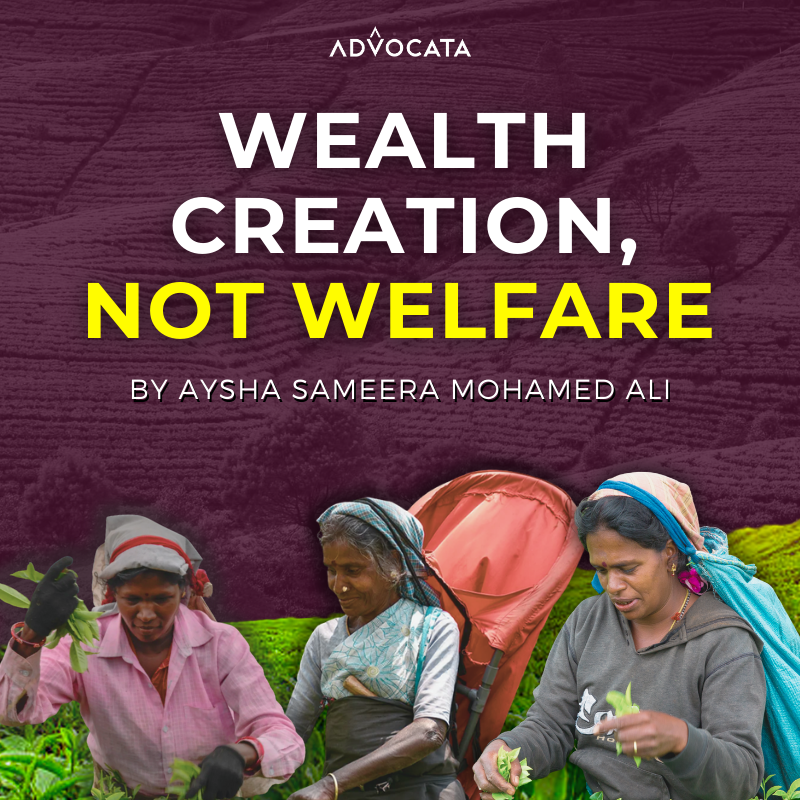
By Aysha Sameera Mohamed Ali
The government has proposed a plan to raise the daily minimum wage of estate workers from Rs. 1,350 to Rs. 1,550 alongside a state-funded daily allowance of Rs. 200, which would bring the total daily cash earnings of estate workers up to Rs. 1750. Including the associated employer contributions to EPF/ETF, the proposed Rs. 200 minimum wage hike represents an effective earnings increase of about Rs. 230 per worker. Given the well-documented economic hardships faced by the estate worker community, this wage hike may seem justifiably well-intentioned to many. However, well-intended actions do not necessarily constitute sound economic policy; by subsidising the payrolls of private Regional Plantation Companies (RPCs), the government will only ensnare the very workers it seeks to assist in a cycle of dependency, low productivity, and scarce economic opportunities.
The labour costs at plantations already make up more than 70 percent of the cost of production of Ceylon tea, which makes Sri Lanka the world’s most expensive producer of black tea and puts the industry at a unique disadvantage in the world market. The primary cause of this high labour cost is the already high daily wage of Sri Lanka’s estate workers, which is higher than in any other black tea producing country, and twice that of India. This gap is even wider in reality, given the additional non-cash benefits that Sri Lanka’s estate workers receive, estimated at Rs. 750 per working day. As extreme temperatures in the winter and summer months rob Indian estate workers of many working days a year, the real gap between the annual earnings of Sri Lankan estate workers and their Indian counterparts is even larger. On top of this, Sri Lanka’s antiquated attendance-based minimum wage system remunerates workers for their attendance rather than the amount of leaf they harvest, which makes Sri Lanka’s tea industry the least productive among its competitors. The daily average plucking rate of a worker in Sri Lanka is 18kg, which is about half of India’s and one-third of Kenya’s.
Given the substantially higher minimum wage and lower productivity compared to other black tea producing countries, Sri Lanka’s plantation sector cannot afford to pay even higher wages, unless the productivity gap is addressed. In fact, by subsidising a minimum wage hike, the government only merely supports the inefficiencies within the industry and disincentivises it from improving for the better. Simply put, the government subsidy deters RPCs from moving towards a win-win wage structure models that would both improve productivity and give estate workers higher incomes and greater dignity.
The revenue share wage model, strongly endorsed by the government’s own Tea Research Institute and successfully implemented by several RPCs, is one such win-win model. Under this, each individual estate worker is assigned a plot of land to cultivate, maintain, and pluck, virtually making smallholder tea farmers out of them. The earnings from the tea auction are then shared between the worker and the RPC, just as auction proceeds are shared between smallholders and bought-leaf factories. This approach precisely aligns incentives by tying earnings to the quantity and quality of leaves plucked, increasing productivity and producing significantly greater incomes. Most importantly, it gives motivated and productive workers the ability to earn substantially more than they ever could under the minimum wage model. It also addresses the very frustrations that push workers away from the estate sector by substituting entrepreneurship for the humiliation of strict supervision by kanganies under the minimum wage model.
Unlike the revenue share model, the subsidised minimum wage hike creates significant labour market distortions by artificially raising the cost of labour in the plantation industry. Instead of learning new skills or moving to high-growth industries where their labour may naturally be valued higher, it encourages workers to stagnate in a low-productivity environment. Instead of encouraging the mobility and dynamism necessary for a modern workforce, it pays people to continue to be impoverished and cultivates a dependence on public support.
In essence, this subsidised wage hike is a wealth transfer from the taxpayers’ wallets to the financial sheets of RPCs. It incentivises private companies to avoid the difficult, yet essential structural reforms needed to boost both productivity and efficiency. Moving forward businesses may use this as an opportunity to rely on government assistance rather than investing in technology or improving their business models to pay greater wages naturally. The focus of businesses may change from innovation to extraction, where an objective could be to push the government for handouts to satisfy payroll commitments. What will stop every troubled industry from viewing the national budget as a safety net for their operating overheads?
Furthermore, an argument propounded in the public discourse claims that ‘exorbitant’ profits of RPCs warrant a minimum wage hike entirely on the RPCs’ dime. This argument is moot for two reasons. Firstly, profits of RPCs fluctuate heavily based on seasonal factors and subject to the realities of global demand and supply factors. Given the oversupply of tea by Kenya, the price of Ceylon tea has been on a consistent decline since 2024, which means that RPCs themselves are headed towards financially difficult times, also compounded by the yet-to-be-estimated damages that RPCs have suffered from Cyclone Ditwah. Secondly, it is not absolute profits, but relative profits, that dictate wages in the RPCs. If shareholders deem that coffee, which is substantially less labour intensive than tea, provides larger profits relative to tea after the most recent wage hike, a mass conversion to coffee would be inevitable. This conversion was already in motion for several years before the wage hike precisely because of the high labour costs of tea, rendering many estate workers without work to begin with.
Finally, it is also important to ask why the government’s priority is estate workers, and not private sector minimum wage workers or smallholder tea workers, whose economic conditions are even more precarious. The minimum wage in the private sector is currently Rs. 27,000 a month (Rs. 1,080 a day), well below the earnings of estate workers. Workers in the tea smallholder sector, which represents 75 percent of the tea production in Sri Lanka, do not have a minimum wage to begin with, and they do not receive any of the statutory benefits that estate workers are entitled to. Why should one group of workers receive additional support from the government while the majority is ignored?
It is no secret that, despite the already high minimum wage and the additional statutory benefits, estate workers still represent one of the most economically disadvantaged groups in Sri Lanka. This begs the question: is the problem merely not one related to incomes, but one related to inter-generational barriers to wealth creation? Estate residents live in government-owned housing, which heavily constraints their economic mobility. Ownership rights to their estate homes would bring about lasting economic liberalisation to estate communities, more than a wage subsidy. With secure titles, the “line rooms” would become capital rather than just a place for them to reside in. By acting as collateral for loans, such asset ownership opens credit access, eliminates previous mobility constraints, and creates wealth for future generations. A short-term cash allowance just cannot deliver the kind of long-term economic dignity that such a structural shift would.
Everyone agrees that estate workers should be paid a fair wage, but the taxpayer should not foot the bill. The road to Sri Lanka’s economic ruination was paved on similarly well-intentioned policies that subsidised inefficiency and poverty instead of rewarding prosperity and entrepreneurship. To correct this course, the government should urge RPCs to implement productivity-linked wage models and give workers land rights in place of this Rs. 5 billion proposal.
(The author is an Economic Researcher at the Advocata Institute. The opinions expressed are the author’s own.)