
By Dhananath Fernando
Originally appeared on The Morning
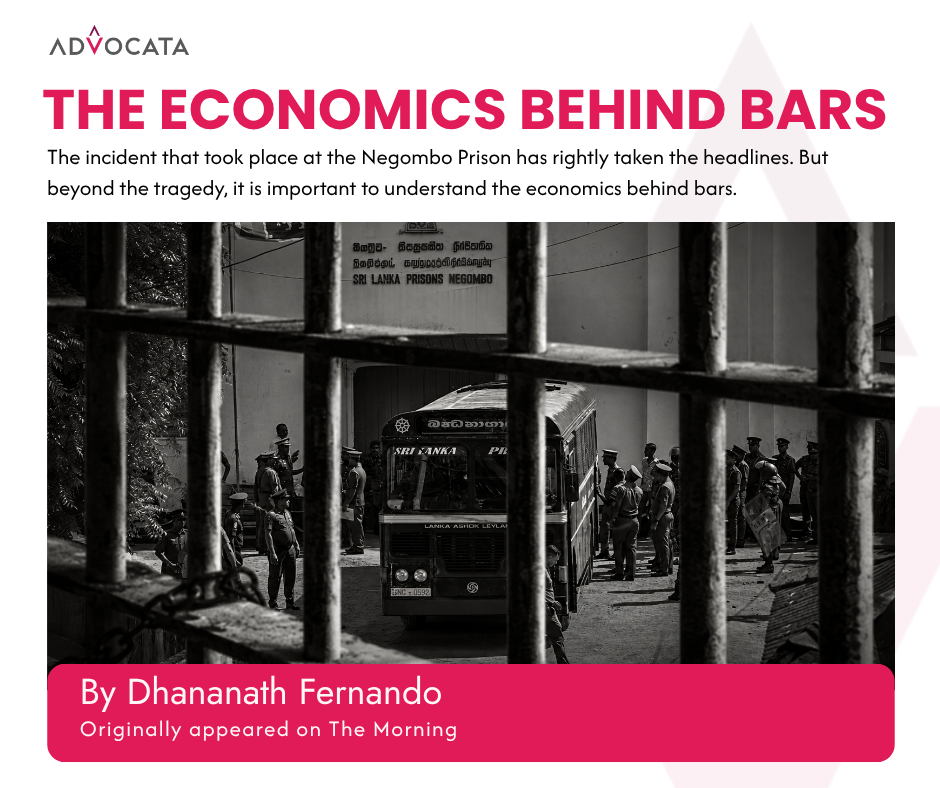
The incident that took place at the Negombo Prison has rightly taken the headlines. But beyond the tragedy, it is important to understand the economics behind bars.
Everyone knows that our prisons are running far beyond capacity. Everyone knows there are many issues inside the prison system. But what we often miss is the economic and philosophical framework behind prisons. Without understanding that, we will only react to the next incident, appoint another committee, express shock for a few days, and then move on.
An upside down prison system
From an individual freedom point of view, limiting someone’s freedom by putting them in prison is not something a free society should take lightly. Prison cannot be the centre of every solution. We cannot solve every social problem by locking people up.
But prisons are needed when one person’s actions seriously violate the freedom of others. A free society cannot function if people can violate another person’s life, property, contracts, or personal safety without consequence. Individual freedom also means protection from force, fraud, and violence. In simple terms, your freedom ends where another person’s rights begin.
So in a free society, prisons are necessary. But they are necessary for a limited purpose: to protect the larger freedom of society and to reduce the wider social cost of crime. When violence, theft, intimidation, and organised crime are not contained, the economic cost is far higher than the cost of running prisons. Businesses suffer. Families suffer. Communities suffer. Trust breaks down.
In that context, Sri Lanka’s prison system is completely upside down.
Our overcrowding is not mainly because all inmates are convicted criminals serving sentences. A large share of those in prison are not yet convicted. Many are pre-trial detainees. Legally, they are still innocent. They are in prison simply waiting for their next court date.
A significant number of them are connected to drug-related offences. Drug addiction is a serious problem. Some addicts do cross the line and violate the freedom and safety of others. But in many cases, these are people who have made bad choices in life, not necessarily people who should be kept for long periods in an overcrowded prison at the taxpayer’s cost before conviction.
That is where delayed justice becomes an economic problem. If a person is dangerous, the State must protect society. But if a person is waiting in remand for months or years because the justice system is slow, then the prison becomes a holding centre for administrative failure.
With overcrowded prisons, and with a high number of drug users and drug-linked offenders concentrated in one place, we have unintentionally created a market inside prisons. Drugs continue to move. Prices go up. Networks become stronger. People who entered prison as small offenders may come out with bigger criminal connections. The taxpayer pays for this system, and society pays again when it fails.
Not only a prison riot
The Negombo incident is not an isolated prison story. It is a governance story. It is a justice story. It is also an investment story.
Any serious investor looks at contract enforcement, the independence of the Judiciary, and the speed of dispute resolution. If investors feel that justice delayed is justice denied, they will be very careful before putting serious money into a country. This is why Port City Colombo has a special dispute resolution mechanism through an International Commercial Dispute Resolution Centre. Investors need confidence that disputes will be resolved fairly and quickly.
The same principle applies to the ordinary citizen. If commercial disputes deserve speed and certainty, criminal justice deserves it even more. A poor person waiting in remand also has an economic cost. His family loses income. His children lose support. The State spends money to keep him inside. The prison becomes more crowded. The system becomes more dangerous.
Secondly, the Negombo incident will raise serious questions about Sri Lanka’s human rights record. When the world sees prisons operating at several times their capacity, it sends a message that we are not serious enough about vulnerable people, even when some of them have made bad choices.
This matters not only morally, but economically. Sri Lanka benefits from trade concessions such as the Generalised System of Preferences (GSP) and GSP+. These are not given in a vacuum. They are linked to human rights, labour rights, good governance, and the implementation of international conventions.
So a prison riot is not only a prison riot. It can become a trade issue. It can become an investor confidence issue. It can become a diplomatic issue.
Economic cost vs. political comfort
Then comes the obvious question: if we all know prisons are overcrowded, why are we not increasing capacity?
Part of the answer is again economics.
The entire Prisons budget is about Rs. 22 billion. Out of that, less than Rs. 1 billion is for capital expenditure. In the 2026 estimates, capital expenditure for prisons has been reduced to about Rs. 600 million. That tells us something. There is no serious fiscal intention to expand or modernise prison capacity.
There is also no political incentive. Building prisons does not win many votes. No politician wants to go to an election saying: “I built more prison space.” So we wait until a tragedy happens. Then we discover what we already knew.
There is another economic angle. Many of our prisons are sitting on very high-value land. The Welikada Prison is the best example. It is on prime real estate in Colombo, close to important commercial areas and not far from the port. There has been talk for years about relocating it, including to Horana. But we are late, as usual. Many other prisons are also located in valuable city centres.
A proper prison relocation and redevelopment programme can unlock land value, improve prison conditions, and create a more modern correctional system. But this requires planning, discipline, and political courage. It cannot be done as another ad hoc real estate deal.
At the same time, the Government’s spending space is limited. Interest costs take a very large share of public expenditure. The new public financial management framework also places limits on primary expenditure. So the Government has less room to spend.
But this is exactly why we must ask the most basic question in public finance: what is the role of the Government?
The Government has limited money. Therefore, it must spend on what only the Government can do. Justice, policing, prisons, and public safety are core functions of the State. Running airlines, hotels, sugar companies, and other commercial businesses are not core functions of the State. The private sector can do those things. But the private sector cannot run the criminal justice system.
Last year, what we spent or committed to keep some State-Owned Enterprises (SOEs) alive was larger than the entire Prisons budget. That is the real distortion. We underfund justice and prisons, but somehow find money for loss-making commercial ventures.
The economic cost of prisoners and detainees breaking a prison, killing officers, damaging public property, and destroying public confidence is far higher than the political comfort of keeping a State enterprise alive.
The obvious solutions
The solutions are not simple, but they are clear.
First, the legal system needs more investment. Cases must move faster. Court delays must be reduced. Technology must be used properly. Bail rules must be reviewed, especially for non-violent offenders and people held for long periods before trial. The State must distinguish between people who are a genuine threat to society and people who are trapped in a slow system.
Second, drug addiction must be treated more seriously as a rehabilitation issue. If someone has committed violence or serious crime, prison is necessary. But if the main problem is addiction, then simply putting that person into an overcrowded prison may worsen the problem. We need stronger rehabilitation, community correction, and supervised treatment options.
Third, prison capacity and conditions must improve. This does not mean building prisons as the answer to every problem. It means recognising that if the State takes away someone’s freedom, the State also has a responsibility to maintain basic order, safety, and human dignity inside.
Fourth, we must reform public spending. The Government must exit areas where it has no business being in business. That money and balance sheet space must be used for the real functions of the State: justice, security, education, health, and basic public goods.
Finally, we need to rethink prisons from first principles. In a free society, prisons are not built for revenge. They are not built to hide social problems. They are built to protect the freedom of the larger society from those who seriously violate the rights of others.
Today, Sri Lanka’s prison problem reflects a deeper policy prison of our own making. We spend on the wrong things. We delay justice. We overcrowd prisons with people who are not yet convicted. We underinvest in the institutions that only the State can run. Then we act surprised when the system explodes.
Sometimes the prison we must first escape from is not made of walls and iron bars. It is the way we think about the role of the Government.